
Revision summary
Crime wants profit; terror wants political fear; they trade logistics. Fake currency, drugs, arms, and hawala are the usual bridge. UP’s Nepal-facing belt is a transit risk for both. Gangsters and mafias weaken ordinary law and can be hired. Cyber fraud can fund crime even when it is not charged as terror. Gangsters Act, UAPA, and ATS are the State replies.
Model answer
Introduction
Organised crime seeks profit through a continuing enterprise; terrorism seeks political fear through violence. They meet where money, arms, documents, and logistics are shared. Uttar Pradesh feels that meeting in gangs, border crime, and extremist modules.
Body
The relationship
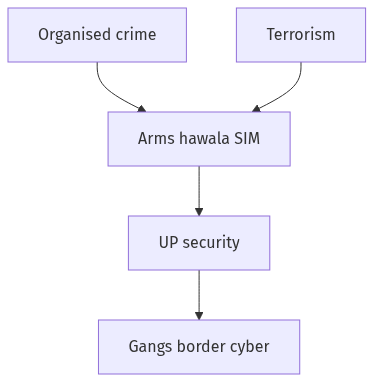
- Crime supplies terrorism with fake currency, stolen arms, hawala, SIM cards, safe houses, and forged identity; terror supplies crime with ideology, overseas links, and a climate of fear that hides extortion.
- The same courier may move drugs one month and a militant the next; the relationship is a market, not a single organisation chart.
- Narco-terror, contract killing, and cyber fraud can sit on one phone graph even when the courtroom charges differ.
Impact on UP security
- The Nepal border and eastern districts have long been watched for fake Indian currency, narcotics, and transit, which can feed both gangs and extremist logistics.
- Mining, contracting, and land mafias in parts of Purvanchal and other belts have used guns and political cover; that violence erodes ordinary policing and can be rented by other illegal networks.
- Urban gang wars, extortion, and targeted killings in western and central towns raise public fear and pull police off counter-terror and communal duty.
- Radical modules have historically used UP’s rail hubs and rented rooms; crime networks make those rooms easier to rent without a trail.
- Cyber fraud factories in some UP towns finance wider crime even when they are not “terror” in the UAPA sense; they still wound economic security.
State tools
- The Uttar Pradesh Gangsters and Anti-Social Activities (Prevention) Act, 1986, the Goonda Act, NSA, UAPA, and police ATS units are the legal grid.
- Impact is reduced only when predicate crimes—arms, drugs, hawala, cyber—are broken early, before they become a terror file.
Flow diagram
Conclusion
Organised crime and terrorism interlock through money, arms, and documents. In Uttar Pradesh that lock shows up as border transit, mafias, gang wars, and occasional extremist modules, which together strain police, courts, and public confidence.
Quick related
Students also ask
-
Evaluate the role of Uttar Pradesh Science and Technology Policy, 2025 and the Council of Science and Technology (CST-UP) in building a resilient R&D ecosystem.
Next question in the 2025 paper (Q19). View answer →
-
Are all UP gangsters terrorists?
No. Most organised crime is profit crime. The security risk is the overlap where gangs sell logistics to extremist actors.
-
Why does cyber fraud belong in this answer?
Fraud rings raise money and false identities that can feed wider organised crime, which is part of the State’s security load.
Same topic · past papers
UPPSC has asked this before
These previous-year questions sit on the same topic. Open one to practise the earlier ask.
More from this paper
Q1 · UPSC Mains 2025 · UPGS5 · 8 marks · Solution
Describe the cultural significance of 'Ayodhya' on the basis of ancient literature.
UP history, civilisation and culture
The Ramayana makes Ayodhya the Kosalan capital of Rama. The Skanda Purana’s Ayodhya Mahatmya places it among the moksha-puris. Buddhist texts remember Saketa, and Jain books remember Tirthankara births at Vinita or Saketa. Together these books give Ayodhya its lasting cultural weight in Uttar Pradesh.
Q2 · UPSC Mains 2025 · UPGS5 · 8 marks · Solution
Agra's Indo-Islamic architecture has a blend of Indian, Persian and Islamic styles. Comment.
UP history, civilisation and culture
Agra’s Mughal buildings mix Indian craft, Persian gardens, and Islamic tombs. Agra Fort shows Akbar’s sandstone and Shah Jahan’s marble in one complex. The Taj Mahal is a Persian garden-tomb built by Indian workshops. Itimad-ud-Daulah is an early white-marble inlay tomb in Agra.
Q3 · UPSC Mains 2025 · UPGS5 · 8 marks · Solution
Discuss in short the contribution of Arya Samaj in education of Uttar Pradesh.
Health and education in UP
Arya Samaj treated Vedic and modern schooling as one programme in the United Provinces. DAV schools and colleges became the main urban chain. Gurukul Kangri and kanya gurukuls modelled residential and girls’ education. Hindi as a medium was a lasting Samaj mark in Uttar Pradesh. The spread was stronger in the west than in Purvanchal.