
Revision summary
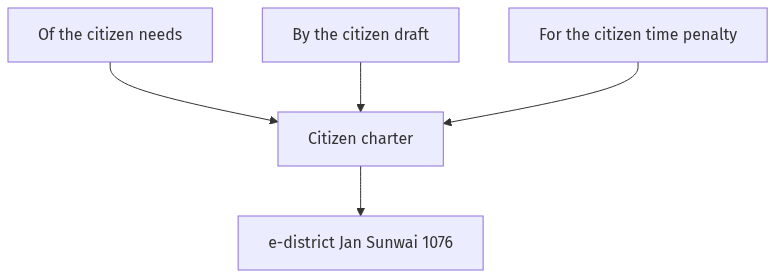
A citizen charter promises standards, time, and grievance. Of the citizen means the service list is the user’s list. By the citizen means co-drafting, not a circular. For the citizen means Hindi norms and a real penalty. UP uses e-district, Jan Sunwai, and Helpline 1076. Gaps remain where charters have no users and no clock with teeth.
Model answer
Introduction
A citizen charter is a public promise of service standards, time limits, and grievance paths. The quoted line, modelled on Lincoln, means the charter must be drafted with users, owned by them, and judged by the service they actually get in Uttar Pradesh.
Body
Of, by, and for the citizen
- Of the citizen: the list of services must match what a villager or city user actually seeks—ration, caste certificates, police FIR status, hospital tickets—not what a department finds easy to print.
- By the citizen: drafting should use jan sunwai, user groups, and social audits, not only a secretariat circular.
- For the citizen: time norms, named officers, and a penalty or compensation clause must be readable in Hindi at the window.
UP practice
- Uttar Pradesh departments and urban bodies publish charters; e-district, Jan Sunwai, CM Helpline 1076, and online portals are the working face of the same idea.
- Police, revenue, and health windows matter most because they are the daily State for most residents.
- RTI, 2005 and the charter should travel together: one copies the file, the other promises the clock.
Gaps against the quote
- Many UP charters are still of the department: English-heavy, without users in the drafting room, and without a real penalty when the clock is missed.
- Awareness is low outside towns; a charter on a website does not reach a tehsil queue.
- Multiple helplines without one tracked ticket can look like reform and still leave the citizen walking.
What would honour the sentence
- Co-drafting with women’s groups, farmers, and persons with disability; Hindi and Urdu plain text; published monthly delay scores for districts.
- Linking the charter to the public grievance software so a missed deadline becomes a visible case, not a poster.
Flow diagram
Conclusion
The sentence demands that UP charters be user-made service contracts, not departmental posters. Helplines and e-district move toward that end; they honour the quote only when citizens draft the standards and delays are punished in public.
Quick related
Students also ask
-
Elucidate the relationship between organized crime and terrorism and examine its impact on security of Uttar Pradesh.
Next question in the 2025 paper (Q18). View answer →
-
Is a charter a law?
Usually it is an administrative promise. It gains teeth only if delay is tied to penalty, audit, or a statutory right such as RTI.
-
What would make a UP charter ‘by the citizen’?
Users in the drafting room, jan sunwai revisions, and published delay scores, not only a PDF on a department site.
Same topic · past papers
UPPSC has asked this before
These previous-year questions sit on the same topic. Open one to practise the earlier ask.
-
2023 · Q15 · UPGS5 · 12 marks
Describe the role of Uttar Pradesh Police ‘Special Task Force’ in the prevention of organised crime. -
2025 · Q8 · UPGS5 · 8 marks
Define Social Media and identify few threats it has generated for internal security with special reference to Uttar Pradesh.
More from this paper
Q1 · UPSC Mains 2025 · UPGS5 · 8 marks · Solution
Describe the cultural significance of 'Ayodhya' on the basis of ancient literature.
UP history, civilisation and culture
The Ramayana makes Ayodhya the Kosalan capital of Rama. The Skanda Purana’s Ayodhya Mahatmya places it among the moksha-puris. Buddhist texts remember Saketa, and Jain books remember Tirthankara births at Vinita or Saketa. Together these books give Ayodhya its lasting cultural weight in Uttar Pradesh.
Q2 · UPSC Mains 2025 · UPGS5 · 8 marks · Solution
Agra's Indo-Islamic architecture has a blend of Indian, Persian and Islamic styles. Comment.
UP history, civilisation and culture
Agra’s Mughal buildings mix Indian craft, Persian gardens, and Islamic tombs. Agra Fort shows Akbar’s sandstone and Shah Jahan’s marble in one complex. The Taj Mahal is a Persian garden-tomb built by Indian workshops. Itimad-ud-Daulah is an early white-marble inlay tomb in Agra.
Q3 · UPSC Mains 2025 · UPGS5 · 8 marks · Solution
Discuss in short the contribution of Arya Samaj in education of Uttar Pradesh.
Health and education in UP
Arya Samaj treated Vedic and modern schooling as one programme in the United Provinces. DAV schools and colleges became the main urban chain. Gurukul Kangri and kanya gurukuls modelled residential and girls’ education. Hindi as a medium was a lasting Samaj mark in Uttar Pradesh. The spread was stronger in the west than in Purvanchal.