
Revision summary
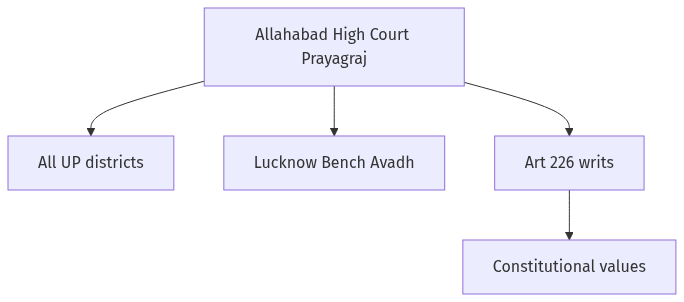
Allahabad High Court, seated at Prayagraj since 1866, covers all of Uttar Pradesh. The Lucknow Bench serves the Avadh districts. Writs under Article 226 are the main defence of fundamental rights. Judicial review and PIL carry equality and liberty into State administration. A heavy docket is the practical limit on that role.
Model answer
Introduction
The High Court of Judicature at Allahabad, now sitting at Prayagraj, is the High Court for the whole of Uttar Pradesh. A discussion must cover territorial jurisdiction, the Lucknow Bench, and writ work that guards constitutional values.
Body
Jurisdiction
- The Court was established in 1866; its principal seat is at Prayagraj.
- It has jurisdiction over the entire State of Uttar Pradesh in civil, criminal, and writ matters under Articles 226 and 227.
- The Lucknow Bench hears cases from the old Avadh districts, so litigants of central UP need not always travel to Prayagraj.
- Until November 2000 it also covered the hill districts that became Uttarakhand; that territory now has a separate High Court.
Constitutional values
- Article 226 writs of habeas corpus, mandamus, prohibition, certiorari, and quo warranto are the Court’s daily tools against illegal detention, arbitrary executive action, and breach of fundamental rights.
- Public interest petitions on Ganga pollution, prison conditions, elections, and service law have used this Court as a rights forum for a huge population.
- Judicial review of State statutes and government orders tests equality, liberty, and federal balance inside UP.
Limit
- Delay, vacancies, and a very large docket can weaken rights even when jurisdiction on paper is complete.
Flow diagram
Conclusion
Allahabad High Court at Prayagraj, with its Lucknow Bench, has statewide jurisdiction and upholds constitutional values mainly through Article 226 writs and judicial review. The role is real where orders are timely; backlog is the standing risk.
Quick related
Students also ask
-
Comment on the relevance of the Right to Information Act in Uttar Pradesh.
Next question in the 2025 paper (Q7). View answer →
-
Does Lucknow have a separate High Court?
No. Lucknow is a bench of Allahabad High Court, not a second High Court.
-
How does the Court uphold constitutional values?
Mainly by writs, judicial review of State action, and public interest cases on rights and the environment.
Same topic · past papers
UPPSC has asked this before
These previous-year questions sit on the same topic. Open one to practise the earlier ask.
-
2024 · Q6 · UPGS5 · 8 marks
Discuss the composition and jurisdiction of the State High Court of Uttar Pradesh.
More from this paper
Q1 · UPSC Mains 2025 · UPGS5 · 8 marks · Solution
Describe the cultural significance of 'Ayodhya' on the basis of ancient literature.
UP history, civilisation and culture
The Ramayana makes Ayodhya the Kosalan capital of Rama. The Skanda Purana’s Ayodhya Mahatmya places it among the moksha-puris. Buddhist texts remember Saketa, and Jain books remember Tirthankara births at Vinita or Saketa. Together these books give Ayodhya its lasting cultural weight in Uttar Pradesh.
Q2 · UPSC Mains 2025 · UPGS5 · 8 marks · Solution
Agra's Indo-Islamic architecture has a blend of Indian, Persian and Islamic styles. Comment.
UP history, civilisation and culture
Agra’s Mughal buildings mix Indian craft, Persian gardens, and Islamic tombs. Agra Fort shows Akbar’s sandstone and Shah Jahan’s marble in one complex. The Taj Mahal is a Persian garden-tomb built by Indian workshops. Itimad-ud-Daulah is an early white-marble inlay tomb in Agra.
Q3 · UPSC Mains 2025 · UPGS5 · 8 marks · Solution
Discuss in short the contribution of Arya Samaj in education of Uttar Pradesh.
Health and education in UP
Arya Samaj treated Vedic and modern schooling as one programme in the United Provinces. DAV schools and colleges became the main urban chain. Gurukul Kangri and kanya gurukuls modelled residential and girls’ education. Hindi as a medium was a lasting Samaj mark in Uttar Pradesh. The spread was stronger in the west than in Purvanchal.