
Revision summary
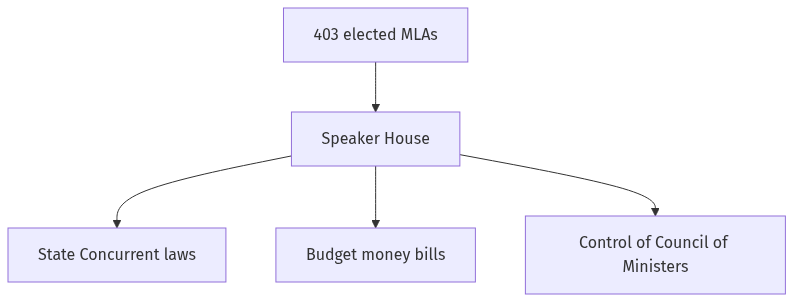
The UP Assembly has 403 elected seats and a five-year term unless dissolved. A Speaker runs the House at Lucknow; the State is bicameral with a 100-member Council. Powers are State legislation, exclusive money bills, and the budget. Functions include questions, committees, and the floor test. The Council cannot finally stop a money bill.
Model answer
Introduction
The Uttar Pradesh Legislative Assembly is the directly elected lower House of a bicameral legislature. A discussion must cover 403 seats, officers, law-making, money, and control of the Council of Ministers.
Body
Composition
- The Assembly has 403 elected members; the old nominated Anglo-Indian seat ended with the 104th Constitutional Amendment, 2019.
- Members are chosen by adult suffrage from territorial constituencies for a normal term of five years under Article 172, unless dissolved earlier.
- A Speaker and Deputy Speaker are elected from among members; a Secretariat runs the House at Vidhan Bhawan, Lucknow.
- Uttar Pradesh also has a Legislative Council of 100 members, so money bills and deadlocks follow the bicameral rules of Articles 168–169 and 197–198.
Powers
- The Assembly makes laws on the State List and, subject to Union supremacy, on the Concurrent List.
- Money bills originate only here; the Council may recommend but cannot finally block them.
- It passes the annual budget, supplementary demands, and cut motions, which is the core power of the purse.
- It elects Uttar Pradesh’s members of the Rajya Sabha and is the House whose majority the Chief Minister must command.
Functions
- Legislation, budget, and interpellation through questions, adjournment, and no-confidence are the daily functions.
- Subject committees and the Public Accounts Committee audit the executive after the Comptroller and Auditor General.
- The House is the floor-test body when the Governor must know who has majority in a 403-member House.
Limit
- Ordinance-making by the Governor, party whips, and a large House can thin debate, so composition is democratic while function depends on committee time.
Flow diagram
Conclusion
The UP Legislative Assembly is a 403-member elected House with the powers to legislate, tax, and unseat a ministry. Its functions are law, budget, and accountability; the Council only qualifies money and some bills in a bicameral State.
Quick related
Students also ask
-
"Citizen Charter should be of the Citizen, by the Citizen and for the Citizen." Discuss with special reference to Uttar Pradesh.
Next question in the 2025 paper (Q17). View answer →
-
Is UP unicameral?
No. It has a Vidhan Sabha of 403 and a Vidhan Parishad of 100.
-
Who chooses the Chief Minister?
The Governor appoints the person who commands a majority in the 403-member Assembly, tested on the floor if needed.
Same topic · past papers
UPPSC has asked this before
These previous-year questions sit on the same topic. Open one to practise the earlier ask.
-
2024 · Q6 · UPGS5 · 8 marks
Discuss the composition and jurisdiction of the State High Court of Uttar Pradesh.
More from this paper
Q1 · UPSC Mains 2025 · UPGS5 · 8 marks · Solution
Describe the cultural significance of 'Ayodhya' on the basis of ancient literature.
UP history, civilisation and culture
The Ramayana makes Ayodhya the Kosalan capital of Rama. The Skanda Purana’s Ayodhya Mahatmya places it among the moksha-puris. Buddhist texts remember Saketa, and Jain books remember Tirthankara births at Vinita or Saketa. Together these books give Ayodhya its lasting cultural weight in Uttar Pradesh.
Q2 · UPSC Mains 2025 · UPGS5 · 8 marks · Solution
Agra's Indo-Islamic architecture has a blend of Indian, Persian and Islamic styles. Comment.
UP history, civilisation and culture
Agra’s Mughal buildings mix Indian craft, Persian gardens, and Islamic tombs. Agra Fort shows Akbar’s sandstone and Shah Jahan’s marble in one complex. The Taj Mahal is a Persian garden-tomb built by Indian workshops. Itimad-ud-Daulah is an early white-marble inlay tomb in Agra.
Q3 · UPSC Mains 2025 · UPGS5 · 8 marks · Solution
Discuss in short the contribution of Arya Samaj in education of Uttar Pradesh.
Health and education in UP
Arya Samaj treated Vedic and modern schooling as one programme in the United Provinces. DAV schools and colleges became the main urban chain. Gurukul Kangri and kanya gurukuls modelled residential and girls’ education. Hindi as a medium was a lasting Samaj mark in Uttar Pradesh. The spread was stronger in the west than in Purvanchal.