
Revision summary
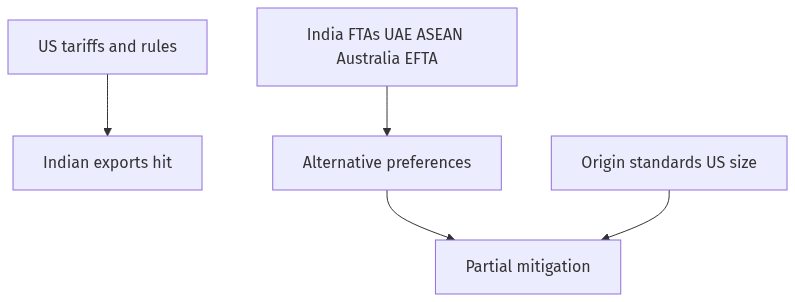
US tariffs, GSP loss, and sector rules can raise the cost of Indian goods and services. FTAs with ASEAN, Japan, Korea, the UAE, Australia, and EFTA offer alternative preferences. Mitigation works where products and standards match the partner market. Rules of origin, carbon borders, and unmatched demand limit diversion. FTAs hedge US policy; they do not replace the US market or stop security export controls.
Model answer
Introduction
United States tariff hikes, origin rules, and sector barriers can hit Indian goods that depend on that market. Free Trade Agreements with other partners can open substitute doors, and a critical evaluation must say how far those doors actually replace the United States.
Body
What US policy does to Indian exports
- The United States remains a large market for Indian gems, pharmaceuticals, textiles, engineering goods, and IT-enabled services, so a tariff or visa shock is not a small bilateral quarrel.
- Section 232-type metals tariffs, GSP withdrawal in 2019, and later reciprocal or penalty tariff talk all raise the landed cost of Indian goods.
- Services face labour and data rules that goods FTAs do not automatically fix.
How FTAs can mitigate
- Agreements with ASEAN, Japan, Korea, the UAE (CEPA), Australia (ECTA), and EFTA (TEPA) can divert some merchandise toward those markets when US duties rise.
- Preferential tariffs and simpler origin can make Indian intermediates competitive in those partners’ supply chains, including as a China-plus-one plant.
- An FTA that covers services and mobility, as in parts of the UAE and EFTA packages, can cushion IT and professional exports if the US tightens visas.
Critical extent
- Diversion is limited by product match: a diamond or generic drug sold to the US does not automatically find the same buyer in Tokyo or Dubai the next quarter.
- Rules of origin, sanitary standards, and the EU carbon border tax can block the very diversion that a tariff table promises.
- The United States is not a party to India’s Asian FTAs; without a US deal, residual dependence remains.
- Trade diversion can also mean Indian exporters eat a lower price in the new market, which is mitigation with a welfare cost.
- FTAs cannot stop a US security or industrial-policy embargo on a sensitive item; they mitigate commercial tariff pain, not every export ban.
Evaluation
- To a moderate extent, a diversified FTA web reduces the shock of adverse US policy by offering alternative preferences.
- To a large extent, the US market, dollar invoicing, and technology rules still set the ceiling, so FTAs are a hedge, not an insurance policy.
Flow diagram
Conclusion
India’s FTAs can mitigate some adverse US trade measures by shifting goods and some services to other preferential markets. The extent is partial because product mix, standards, and the size of the US market cannot be fully replaced by Asian or Gulf schedules.
Quick related
Students also ask
-
Can an FTA with the UAE cancel a US tariff on the same good?
No. UAE preference applies to trade with the UAE. It may help if the good is sold there or re-exported under origin rules; it does not rewrite the US tariff schedule.
-
Would an India–US FTA be the complete answer?
It would reduce some tariff risk with that market. It would still leave industrial policy, visas, and security controls as separate US instruments.
Same topic · past papers
UPPSC has asked this before
These previous-year questions sit on the same topic. Open one to practise the earlier ask.
-
2020 · Q6 · UPGS2 · 8 marks
Evaluate the role of Information and Communications Technology in the context of government policies.
More from this paper
Q1 · UPSC Mains 2025 · UPGS2 · 8 marks · Solution
What role do Joint Parliamentary Committees (JPCs) play in the Indian legislative process? How do they contribute to effective law-making? Analyse.
Parliament and State legislatures
A JPC is an ad hoc joint committee used for complex bills or major controversies. It gathers evidence that floor debate cannot gather at the same depth. Reports have shaped later drafting after inquiries such as Bofors and 2G. The committee cannot enact law; the Houses may still ignore the report. Effective law-making follows only when Parliament uses that record to amend the bill.
Q2 · UPSC Mains 2025 · UPGS2 · 8 marks · Solution
How does Alternative Dispute Resolution (ADR) strengthen efficient governance and enhance the effectiveness of the justice delivery system in India? Analyze.
Separation of powers
Section 89 CPC and the 1996 Arbitration Act, with the 2023 Mediation Act, give ADR a legal base. Lok Adalats under the 1987 Legal Services Authorities Act clear compoundable claims in bulk. Governance gains when contracts and welfare complaints do not wait years for a trial. Justice delivery gains only if weaker parties are not forced into unfair bargains. Courts remain necessary for crime and for constitutional rights.
Q3 · UPSC Mains 2025 · UPGS2 · 8 marks · Solution
"Legislature is supreme within its domain, yet it is not sovereign." Examine this statement in the constitutional context with examples.
Indian Constitution
Articles 245 and 246 make a legislature supreme on its constitutional list. Kesavananda and Minerva Mills deny unlimited amending power. Articles 13, 32, and 226 allow courts to void unconstitutional statutes. The NJAC judgment is an example of a constitutional amendment falling to basic structure review. India follows constitutional supremacy, not British parliamentary sovereignty.