
Revision summary
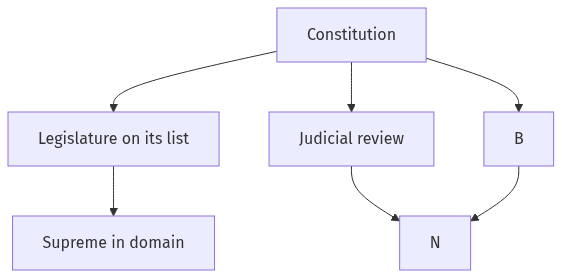
Articles 245 and 246 make a legislature supreme on its constitutional list. Kesavananda and Minerva Mills deny unlimited amending power. Articles 13, 32, and 226 allow courts to void unconstitutional statutes. The NJAC judgment is an example of a constitutional amendment falling to basic structure review. India follows constitutional supremacy, not British parliamentary sovereignty.
Model answer
Introduction
In India the legislature may make law on subjects allotted to it, which is supremacy inside a domain. Sovereignty in the British sense would mean an uncommanded Parliament, and the Constitution rejects that model.
Body
Supremacy within the domain
- Article 245 lets Parliament make laws for the whole or any part of India, and a State legislature for the State, subject to the Constitution.
- Article 246 and the Seventh Schedule divide Union, State, and Concurrent lists, so each legislature is supreme on its list unless the Constitution says otherwise.
- Ordinary statutes bind the executive until they are amended or struck down, which is legislative supremacy over administration in that field.
Why it is not sovereign
- Kesavananda Bharati v. State of Kerala held that even constituent power cannot destroy the basic structure, so Parliament is not legally unlimited.
- Minerva Mills v. Union of India confirmed that limited amending power is itself part of the basic structure.
- Articles 13, 32, and 226 allow courts to strike down law that violates fundamental rights, as in the National Judicial Appointments Commission case.
- Federal limits, the President’s assent, and Rajya Sabha’s role on State matters further show that no House is a sovereign Crown-in-Parliament.
Examples
- A State cannot tax Union property as if it were a sovereign island; Union law on a Concurrent subject can override, under Article 254, in case of conflict.
- The United Kingdom’s Parliament is described as sovereign; India’s Parliament is a creature of a written Constitution.
Flow diagram
Conclusion
The legislature is supreme inside the lists and procedures the Constitution gives it. It is not sovereign because judicial review, basic structure, and federal distribution all sit above any single House.
Quick related
Students also ask
-
To what extent is it correct to say that the Inter-State Council can effectively resolve the disputes between the Union and the States? Write the answer with suitable examples.
Next question in the 2025 paper (Q4). View answer →
-
Is Parliament sovereign after a two-thirds amendment?
No. Amendment power under Article 368 is still limited by the basic structure doctrine.
-
Does supremacy of the legislature mean courts cannot review ordinary Acts?
No. Judicial review of legislation is a settled part of the constitutional design.
Same topic · past papers
UPPSC has asked this before
These previous-year questions sit on the same topic. Open one to practise the earlier ask.
More from this paper
Q1 · UPSC Mains 2025 · UPGS2 · 8 marks · Solution
What role do Joint Parliamentary Committees (JPCs) play in the Indian legislative process? How do they contribute to effective law-making? Analyse.
Parliament and State legislatures
A JPC is an ad hoc joint committee used for complex bills or major controversies. It gathers evidence that floor debate cannot gather at the same depth. Reports have shaped later drafting after inquiries such as Bofors and 2G. The committee cannot enact law; the Houses may still ignore the report. Effective law-making follows only when Parliament uses that record to amend the bill.
Q2 · UPSC Mains 2025 · UPGS2 · 8 marks · Solution
How does Alternative Dispute Resolution (ADR) strengthen efficient governance and enhance the effectiveness of the justice delivery system in India? Analyze.
Separation of powers
Section 89 CPC and the 1996 Arbitration Act, with the 2023 Mediation Act, give ADR a legal base. Lok Adalats under the 1987 Legal Services Authorities Act clear compoundable claims in bulk. Governance gains when contracts and welfare complaints do not wait years for a trial. Justice delivery gains only if weaker parties are not forced into unfair bargains. Courts remain necessary for crime and for constitutional rights.
Q4 · UPSC Mains 2025 · UPGS2 · 8 marks · Solution
To what extent is it correct to say that the Inter-State Council can effectively resolve the disputes between the Union and the States? Write the answer with suitable examples.
Union and the States
Article 263 is the constitutional base of the Inter-State Council, set up in 1990 after Sarkaria. The Council can recommend on administrative and political friction between the Union and the States. River disputes follow Article 262 and statutory tribunals, not the Council as a court. Article 131 remains the judicial path for certain Union–State legal disputes. The Council works only to the extent it is convened and its advice is accepted.