
Revision summary
The Security Council’s permanent veto map is a 1945 settlement. G-4 and the African C-10 argue that contemporary politics need expansion. India seeks a permanent seat on the basis of population, peacekeeping, and economy. Charter amendment in practice needs P-5 acquiescence, which is the binding constraint. The statement is sound; India’s stand is coherent; delivery remains blocked.
Model answer
Introduction
The United Nations Security Council still has five permanent members with a veto, a map drawn in 1945. India argues that this structure does not match today’s population, economy, or peacekeeping load, and a critical evaluation must also show why reform stalls.
Body
Why the structure looks dated
- The Permanent Five—China, France, Russia, the United Kingdom, and the United States—lock 1945 victory into 2020s crisis management.
- Germany, Japan, India, and Brazil are G-4 claimants whose economic and political weight is not matched by a permanent chair.
- Africa has no permanent seat, which the C-10 African position treats as the clearest democratic deficit of the Council.
- Veto use on Gaza, Ukraine, and earlier Syria files shows that contemporary politics can freeze the Council even when the General Assembly is vocal.
India’s stand
- India seeks a permanent seat, with others in an expanded Council, and has worked through G-4, L.69, and the Intergovernmental Negotiations.
- India stresses population, democracy, contributions to UN peacekeeping, and a growing economy as credentials.
- New Delhi has also said that reform delayed is reform denied, and that text-based negotiations are overdue.
Critical limits of the Indian case and of the statement
- The statement is largely true as description: the Council does not mirror contemporary power or the Global South.
- Reform needs amendment of the UN Charter, including P-5 consent in practice, so China and others can block India’s seat even when the diagnosis is shared.
- A larger Council may become slower; critics inside the P-5 use that efficiency argument to keep the 1945 core.
- India’s own positions on some country-specific files are read through alliance politics, so moral claim and interest politics travel together.
Evaluation
- India’s stand is consistent with the statement and with African and G-4 pressure for expansion.
- Without a veto bargain or a transitional category of seats, the structure will keep failing the contemporary test while remaining legally intact.
Flow diagram
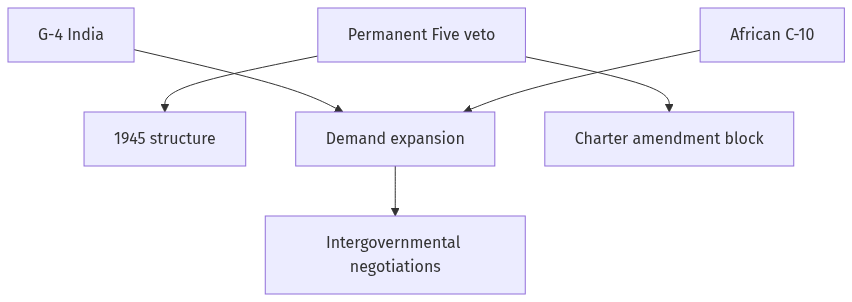
Conclusion
The UNSC’s 1945 core does not reflect contemporary global politics, and India’s reform stand names that gap correctly. Critically, the same politics that make reform necessary also give the P-5 the means to delay it.
Quick related
Students also ask
-
To what extent can India's Free Trade Agreements (FTAs) with various countries help mitigate the adverse effects of the US trade policies on India's exports? Critically evaluate.
Next question in the 2025 paper (Q20). View answer →
-
Can the General Assembly add a permanent member by simple majority?
No. Charter amendment is a high-threshold process. Permanent members’ concurrence is the practical veto on reform.
-
Does India demand a veto on day one?
India has sought full permanent membership. Transitional models without an immediate veto have been discussed in the IGN; New Delhi’s public line remains a genuine permanent seat.
Same topic · past papers
UPPSC has asked this before
These previous-year questions sit on the same topic. Open one to practise the earlier ask.
More from this paper
Q1 · UPSC Mains 2025 · UPGS2 · 8 marks · Solution
What role do Joint Parliamentary Committees (JPCs) play in the Indian legislative process? How do they contribute to effective law-making? Analyse.
Parliament and State legislatures
A JPC is an ad hoc joint committee used for complex bills or major controversies. It gathers evidence that floor debate cannot gather at the same depth. Reports have shaped later drafting after inquiries such as Bofors and 2G. The committee cannot enact law; the Houses may still ignore the report. Effective law-making follows only when Parliament uses that record to amend the bill.
Q2 · UPSC Mains 2025 · UPGS2 · 8 marks · Solution
How does Alternative Dispute Resolution (ADR) strengthen efficient governance and enhance the effectiveness of the justice delivery system in India? Analyze.
Separation of powers
Section 89 CPC and the 1996 Arbitration Act, with the 2023 Mediation Act, give ADR a legal base. Lok Adalats under the 1987 Legal Services Authorities Act clear compoundable claims in bulk. Governance gains when contracts and welfare complaints do not wait years for a trial. Justice delivery gains only if weaker parties are not forced into unfair bargains. Courts remain necessary for crime and for constitutional rights.
Q3 · UPSC Mains 2025 · UPGS2 · 8 marks · Solution
"Legislature is supreme within its domain, yet it is not sovereign." Examine this statement in the constitutional context with examples.
Indian Constitution
Articles 245 and 246 make a legislature supreme on its constitutional list. Kesavananda and Minerva Mills deny unlimited amending power. Articles 13, 32, and 226 allow courts to void unconstitutional statutes. The NJAC judgment is an example of a constitutional amendment falling to basic structure review. India follows constitutional supremacy, not British parliamentary sovereignty.