
Revision summary
Section 89 CPC and the 1996 Arbitration Act, with the 2023 Mediation Act, give ADR a legal base. Lok Adalats under the 1987 Legal Services Authorities Act clear compoundable claims in bulk. Governance gains when contracts and welfare complaints do not wait years for a trial. Justice delivery gains only if weaker parties are not forced into unfair bargains. Courts remain necessary for crime and for constitutional rights.
Model answer
Introduction
Courts in India carry a long backlog, so the state has built parallel paths of arbitration, mediation, conciliation, and Lok Adalat. ADR strengthens governance only if it is fair, cheap, and still tied to public law.
Body
Efficient governance
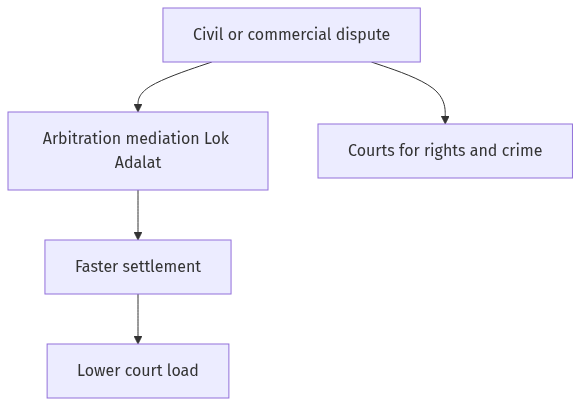
- Section 89 of the Code of Civil Procedure lets a court send a fit civil dispute to arbitration, conciliation, mediation, or Lok Adalat instead of a full trial.
- The Arbitration and Conciliation Act, 1996, and the Mediation Act, 2023, give statutory form to private settlement so that contracts and commercial policy do not wait years for a decree.
- Pre-litigation mediation and online dispute resolution cut the load on collectors and regulators who otherwise become default complaint desks.
Justice delivery
- Lok Adalats under the Legal Services Authorities Act, 1987, dispose of compoundable and money claims in bulk, which ordinary boards cannot match in speed.
- Commercial arbitration and court-annexed mediation give firms a faster forum, which is part of the ease-of-doing-business claim of the state.
- Legal Services Authorities can reach parties who would never hire a senior advocate, so access is not only speed for the rich.
Limits
- Unequal parties may settle under pressure, and delayed arbitration can copy the very backlog ADR was meant to avoid.
- Criminal public wrongs and constitutional rights still need courts; ADR is a complement, not a replacement of the judicial system.
Flow diagram
Conclusion
ADR strengthens governance by moving fit disputes off the regular docket and by giving statute to settlement. Justice delivery improves only when consent is real and when courts remain open for rights that cannot be bargained away.
Quick related
Students also ask
-
"Legislature is supreme within its domain, yet it is not sovereign." Examine this statement in the constitutional context with examples.
Next question in the 2025 paper (Q3). View answer →
-
Does ADR replace High Courts?
No. It is a parallel path for fit civil and commercial disputes. Writs, crime, and many public-law questions stay with courts.
-
Is a Lok Adalat award binding?
An award of a Lok Adalat is deemed a civil court decree and is final between the parties on that settlement.
Same topic · past papers
UPPSC has asked this before
These previous-year questions sit on the same topic. Open one to practise the earlier ask.
-
2025 · Q15 · UPGS2 · 12 marks
How does the Direct Benefit Transfer (DBT) system align with the objectives of Digital India and good governance? Analyze. -
2020 · Q19 · UPGS2 · 12 marks
What do you know about the 'Quadrilateral Security Dialogue' (QUAD)? Would the Malabar Military exercise be successful in containing the growing influence of China in world politics?
More from this paper
Q1 · UPSC Mains 2025 · UPGS2 · 8 marks · Solution
What role do Joint Parliamentary Committees (JPCs) play in the Indian legislative process? How do they contribute to effective law-making? Analyse.
Parliament and State legislatures
A JPC is an ad hoc joint committee used for complex bills or major controversies. It gathers evidence that floor debate cannot gather at the same depth. Reports have shaped later drafting after inquiries such as Bofors and 2G. The committee cannot enact law; the Houses may still ignore the report. Effective law-making follows only when Parliament uses that record to amend the bill.
Q3 · UPSC Mains 2025 · UPGS2 · 8 marks · Solution
"Legislature is supreme within its domain, yet it is not sovereign." Examine this statement in the constitutional context with examples.
Indian Constitution
Articles 245 and 246 make a legislature supreme on its constitutional list. Kesavananda and Minerva Mills deny unlimited amending power. Articles 13, 32, and 226 allow courts to void unconstitutional statutes. The NJAC judgment is an example of a constitutional amendment falling to basic structure review. India follows constitutional supremacy, not British parliamentary sovereignty.
Q4 · UPSC Mains 2025 · UPGS2 · 8 marks · Solution
To what extent is it correct to say that the Inter-State Council can effectively resolve the disputes between the Union and the States? Write the answer with suitable examples.
Union and the States
Article 263 is the constitutional base of the Inter-State Council, set up in 1990 after Sarkaria. The Council can recommend on administrative and political friction between the Union and the States. River disputes follow Article 262 and statutory tribunals, not the Council as a court. Article 131 remains the judicial path for certain Union–State legal disputes. The Council works only to the extent it is convened and its advice is accepted.