
Revision summary
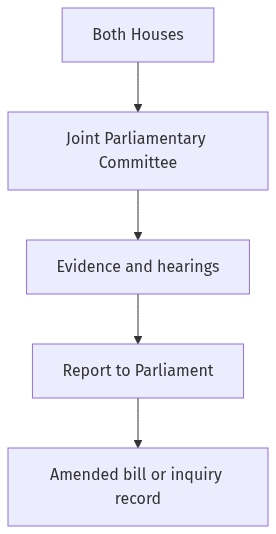
A JPC is an ad hoc joint committee used for complex bills or major controversies. It gathers evidence that floor debate cannot gather at the same depth. Reports have shaped later drafting after inquiries such as Bofors and 2G. The committee cannot enact law; the Houses may still ignore the report. Effective law-making follows only when Parliament uses that record to amend the bill.
Model answer
Introduction
A Joint Parliamentary Committee is an ad hoc body drawn from both Houses to examine a bill or a scandal that the standing system cannot finish alone. Analysis must show both its place in law-making and the limits of its reports.
Body
Role in the legislative process
- A JPC is set up by a motion of the Houses when a bill is complex or when a public controversy needs bipartisan inquiry beyond one standing committee.
- It can summon officials, call for papers, and take evidence, which ordinary floor debate cannot do in the same detail.
- Its report goes back to Parliament and informs clause-by-clause work, as in inquiries on Bofors, 2G spectrum, and later bill-based JPCs.
Contribution to effective law-making
- Cross-party membership forces the government to defend drafting in public, which can tighten definitions and safeguards.
- Hearings give states, industry, and civil groups a formal channel before a statute is locked, which standing debate on the floor often skips.
- A published JPC report creates a record that later courts and administrators can read when they apply the Act.
Limits
- A JPC cannot pass law; Parliament remains free to ignore or dilute the report.
- Delay, leaks, and a government majority on the committee can turn inquiry into theatre, so the contribution is real only when the Houses use the report.
Flow diagram
Conclusion
JPCs sit between the two Houses and the statute book as tools of scrutiny, evidence, and redrafting. They aid effective law-making only when Parliament treats the report as a working paper, not as a substitute for a vote.
Quick related
Students also ask
-
How does Alternative Dispute Resolution (ADR) strengthen efficient governance and enhance the effectiveness of the justice delivery system in India? Analyze.
Next question in the 2025 paper (Q2). View answer →
-
Can a JPC strike down a bill?
No. It can only recommend. Enactment still needs the Houses and the President’s assent.
-
Is every important bill sent to a JPC?
No. Most bills go to standing committees. A JPC is used when both Houses agree that a joint, high-visibility inquiry is needed.
Same topic · past papers
UPPSC has asked this before
These previous-year questions sit on the same topic. Open one to practise the earlier ask.
-
2023 · Q14 · UPGS2 · 12 marks
Describe the law-making process in the Legislative Assembly of Uttar Pradesh.
More from this paper
Q2 · UPSC Mains 2025 · UPGS2 · 8 marks · Solution
How does Alternative Dispute Resolution (ADR) strengthen efficient governance and enhance the effectiveness of the justice delivery system in India? Analyze.
Separation of powers
Section 89 CPC and the 1996 Arbitration Act, with the 2023 Mediation Act, give ADR a legal base. Lok Adalats under the 1987 Legal Services Authorities Act clear compoundable claims in bulk. Governance gains when contracts and welfare complaints do not wait years for a trial. Justice delivery gains only if weaker parties are not forced into unfair bargains. Courts remain necessary for crime and for constitutional rights.
Q3 · UPSC Mains 2025 · UPGS2 · 8 marks · Solution
"Legislature is supreme within its domain, yet it is not sovereign." Examine this statement in the constitutional context with examples.
Indian Constitution
Articles 245 and 246 make a legislature supreme on its constitutional list. Kesavananda and Minerva Mills deny unlimited amending power. Articles 13, 32, and 226 allow courts to void unconstitutional statutes. The NJAC judgment is an example of a constitutional amendment falling to basic structure review. India follows constitutional supremacy, not British parliamentary sovereignty.
Q4 · UPSC Mains 2025 · UPGS2 · 8 marks · Solution
To what extent is it correct to say that the Inter-State Council can effectively resolve the disputes between the Union and the States? Write the answer with suitable examples.
Union and the States
Article 263 is the constitutional base of the Inter-State Council, set up in 1990 after Sarkaria. The Council can recommend on administrative and political friction between the Union and the States. River disputes follow Article 262 and statutory tribunals, not the Council as a court. Article 131 remains the judicial path for certain Union–State legal disputes. The Council works only to the extent it is convened and its advice is accepted.