
Revision summary
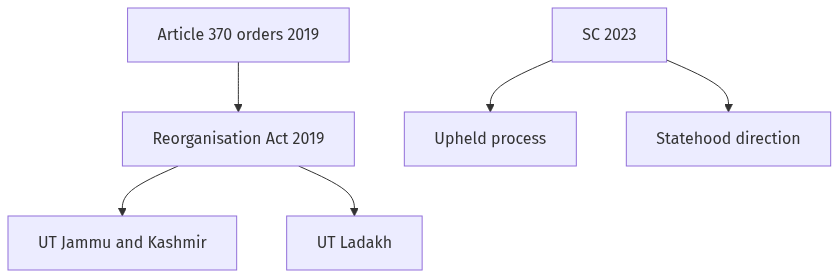
Article 370 was made inoperative in August 2019 through Presidential orders and Parliament. The Reorganisation Act, 2019, created the UT of Jammu and Kashmir with a legislature and the UT of Ladakh without one. Union laws and LG-led administration replaced much of the old State framework. The Supreme Court in 2023 upheld the Article 370 process and spoke of restoring statehood. Political critique centres on consent, federalism, civil liberties during the transition, and Ladakh’s safeguards.
Model answer
Introduction
In August 2019 the Union ended the special constitutional position of Jammu and Kashmir under Article 370 and Parliament passed the Jammu and Kashmir Reorganisation Act. A critical analysis must separate the legal steps from the still-open politics of statehood and rights.
Body
Background
- Article 370 was a temporary provision that limited the Union’s legislative reach and allowed a State constitution and a separate flag in practice.
- Presidential Orders C.O. 272 and C.O. 273 in August 2019, read with a resolution of Parliament, superseded the earlier 1954 order and declared Article 370 inoperative.
- The Reorganisation Act then bifurcated the State into the Union Territory of Jammu and Kashmir with a legislature and the Union Territory of Ladakh without one.
Key provisions of the 2019 Act
- The Act provided for two Union Territories, apportionment of assets and sitting members, and application of Union laws that had earlier needed State concurrence in many fields.
- Jammu and Kashmir became a UT with a Legislative Assembly; Ladakh became a UT under a Lieutenant Governor without that assembly.
- Delimitation and assembly seats were recast for the new UT of Jammu and Kashmir.
Constitutional and administrative implications
- The move replaced a State in the First Schedule with two Union Territories, which is the hardest recent change in India’s internal map.
- Administration shifted toward the Lieutenant Governor and Union ministries for police, public order, and all-India services in a way a full State does not know.
- In December 2023 the Supreme Court, in In Re: Article 370, upheld the constitutional process that ended Article 370 and asked that statehood be restored, while upholding the reorganisation as then framed.
Political implications and critique
- Supporters argue integration, one-constitution equality, and space against militancy and patronage.
- Critics argue that demoting a State to Union Territories without the old State legislature’s consent strains federalism and the spirit of Article 3 practice.
- Detention of political leaders, a long communications clamp, and delayed assembly elections imposed a democratic cost even if later polls returned.
- Ladakh’s demand for Sixth Schedule-type safeguards and Kashmir’s demand for statehood show that the Act closed one legal chapter and opened another political one.
Flow diagram
Conclusion
The 2019 Act, with the Article 370 orders, remade Jammu and Kashmir’s constitutional status and administration. The Supreme Court has upheld the core legal step; critically, statehood, local consent, and rights politics remain the unfinished implications.
Quick related
Students also ask
-
"The structure of the United Nations Security Council (UNSC) does not reflect the realities of contemporary global politics." Critically evaluate this statement in the light of India's stand on Security Council reforms.
Next question in the 2025 paper (Q19). View answer →
-
Did the 2019 Act itself repeal Article 370?
No. Article 370 was dealt with through Presidential orders and Parliament’s resolution. The Reorganisation Act created the two Union Territories.
-
Is Jammu and Kashmir still a State in the First Schedule?
As reorganised in 2019 it is a Union Territory with a legislature. The Supreme Court has spoken of restoring statehood as a political-constitutional next step.
Same topic · past papers
UPPSC has asked this before
These previous-year questions sit on the same topic. Open one to practise the earlier ask.
More from this paper
Q1 · UPSC Mains 2025 · UPGS2 · 8 marks · Solution
What role do Joint Parliamentary Committees (JPCs) play in the Indian legislative process? How do they contribute to effective law-making? Analyse.
Parliament and State legislatures
A JPC is an ad hoc joint committee used for complex bills or major controversies. It gathers evidence that floor debate cannot gather at the same depth. Reports have shaped later drafting after inquiries such as Bofors and 2G. The committee cannot enact law; the Houses may still ignore the report. Effective law-making follows only when Parliament uses that record to amend the bill.
Q2 · UPSC Mains 2025 · UPGS2 · 8 marks · Solution
How does Alternative Dispute Resolution (ADR) strengthen efficient governance and enhance the effectiveness of the justice delivery system in India? Analyze.
Separation of powers
Section 89 CPC and the 1996 Arbitration Act, with the 2023 Mediation Act, give ADR a legal base. Lok Adalats under the 1987 Legal Services Authorities Act clear compoundable claims in bulk. Governance gains when contracts and welfare complaints do not wait years for a trial. Justice delivery gains only if weaker parties are not forced into unfair bargains. Courts remain necessary for crime and for constitutional rights.
Q3 · UPSC Mains 2025 · UPGS2 · 8 marks · Solution
"Legislature is supreme within its domain, yet it is not sovereign." Examine this statement in the constitutional context with examples.
Indian Constitution
Articles 245 and 246 make a legislature supreme on its constitutional list. Kesavananda and Minerva Mills deny unlimited amending power. Articles 13, 32, and 226 allow courts to void unconstitutional statutes. The NJAC judgment is an example of a constitutional amendment falling to basic structure review. India follows constitutional supremacy, not British parliamentary sovereignty.