
Revision summary
Agrarian structure organises land, labour, caste and household. Class forms include owners, tenants, landless and new reverse tenancy. Caste maps onto field labour and honour in the village. Women’s farm work without title is a central inequality. Region and ecology split irrigated surplus growers from dryland and forest poor.
Model answer
Copper italics in this answer — like this — are the key facts. Each one is unpacked in the Facts & figures rail.
Introduction
Agrarian social structure is the organised pattern of land, labour, caste and household in the countryside. Inequality here is not one gap. It is several forms that overlap. Daniel Thorner’s malik, kisan and mazdoor, Béteille’s owners-tenants-labourers, and Dhanagare’s peasant strata give a class language. Caste and gender decide who sits in each class.
Body
Class forms
- Ownership inequality: large holders, medium cultivating owners, petty owners, tenants, and landless labourers. A. R. Desai stressed landlord and peasant class conflict under colonialism and after. Tenancy and sharecropping shift surplus without always shifting title. Reverse tenancy in machine-owning belts is a new class twist: small owners lease out to capitalist farmers. Attached and migrant labour (Breman) is unfreedom as well as poverty. Green Revolution and later horticulture markets widened the gap between surplus growers in Punjab-Haryana-coastal Andhra and dryland smallholders.
Caste and status forms
- Land maps onto jati in many regions: dominant cultivating castes versus Dalit labour. Béteille showed the map is not perfect, which is why analysis needs both dimensions. Untouchability in fields, separate hamlets, and exclusion from well and temple are agrarian inequalities, not extras. OBC assertion and land reform leftovers produced new dominant groups without equality for the landless.
Gender, generation and region
Women work in fields and lack titles; widows and daughters lose land in practice despite the 2005 succession amendment. Girls’ unpaid farm work subsidises male status. Regional inequality—irrigated versus rainfed, hill versus plain, Adivasi forest versus caste village—is agrarian too. Policy (ceilings, tenancy law, MNREGA, PM-KISAN) redistributes unevenly: title-based transfers miss the landless woman.
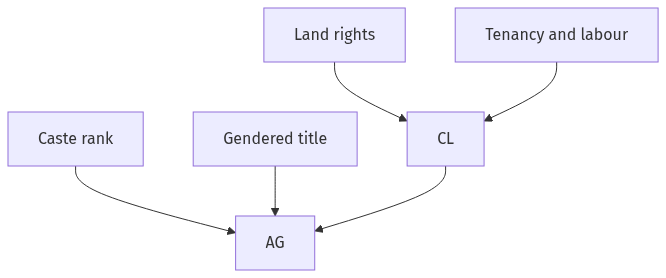
- Forms, listed: property class, tenancy, labour unfreedom, caste rank, gendered landlessness, and regional-ecological inequality. They stack. A Dalit landless woman migrant is not three separate case studies. She is the structure at its intersection.
Credit, irrigation and markets are further forms. A household with a tube well and KCC sits in a different class from one that buys water. MSP-linked grain belts differ from cash-crop distress belts. Contract farming can look like opportunity and still transfer risk downward. These are agrarian inequalities even when the caste names stay the same.
The 2020–21 farmers’ movement showed cultivator inequality vis-à-vis the state and corporates; it did not erase these internal forms.
Flow diagram
Conclusion
Agrarian inequality in India takes the forms of class (land, tenancy, labour), caste rank, gendered exclusion from title, and regional-ecological gaps. Thorner and Béteille still name the class skeleton. Caste and gender put flesh on who occupies each bone.
Quick related
Students also ask
-
Elaborate the salient features and the role of middle class in India's democracy and development
Next question on this syllabus topic (2023 · Q2(b)). View answer →
-
Did land reform end agrarian inequality?
It weakened some intermediaries and left ceilings, benami and tenancy gaps. Landless labour remains large.
-
Is PM-KISAN an equality measure?
It is a transfer to landholders. It does not address landless labour or most women without title.
Same topic · past papers
UPSC has asked this before
These previous-year questions sit on the same topic. Open one to practise the earlier ask.
-
2022 · Q7(c) · Sociology GS 2 · 15 marks
Discuss different forms of deprivation associated with slums.
More from this topic
Q3(b) · UPSC Mains 2026 · Sociology GS 2 · 20 marks · Solution
Explain the emergence of middle class in agrarian society in India. What have been the socio-structural implications of the emergence of this middle class?
Social Classes in India
This model answer examines the rise of the agrarian middle class in India, driven by post-independence land reforms, the Green Revolution, and market integration. It details their socio-structural implications, including shifting rural power dynamics, caste-class intersectionality, political mobilisation, and changing agrarian relations. The conclusion highlights the need for inclusive rural development and sustainable livelihoods to address emerging rural stratifications.
Q4(b) · UPSC Mains 2025 · Sociology GS 2 · 20 marks · Solution
"Industrial class structure is a function of social structure of Indian society." Do you agree with this statement? Analyze
Social Classes in India
Indian industrial classes include owners, managers, a small formal workforce and a large informal majority. Recruitment, unions and job queues follow caste, kinship, language and sending villages. Breman, Holmström and Ramaswamy show particularism inside industry, not a pure proletariat. Owners too are often community-based business groups. Capitalism reworks these ties but has not replaced them with a casteless class structure.
Q3(c) · UPSC Mains 2025 · Sociology GS 2 · 10 marks · Solution
Describe the main features of Indian new middle class. How is it different from the old middle class?
Social Classes in India
The old middle class grew from colonial education, law and bureaucracy and later staffed the Nehruvian state. The new middle class grew after 1991 around private services, IT and consumption. Béteille and Misra describe the older service stratum; Fernandes describes the consumer-citizen. Caste and English schooling shape entry into both. The new class is larger but still a minority; it has not absorbed the informal majority.