
Revision summary
The older industrial class was a minority organised mill and PSU workforce. Mills declined; contract labour, circular migration and job work expanded. Services and IT added a salariat above a large informal industrial and logistics workforce. Caste and gender still sort who enters secure versus hazardous work. Unions lost the mill colony world and have only partly regrouped.
Model answer
Copper italics in this answer — like this — are the key facts. Each one is unpacked in the Facts & figures rail.
Introduction
India’s industrial class was never a simple copy of the European proletariat. A. R. Desai placed it inside a colonial and then mixed-economy structure. Mark Holmström described the organised factory worker as a minority beside a vast unorganised mass. Since the 1980s, and sharply after 1991, that structure has shifted toward contract, services, and self-employment while a small formal core remains.
Body
From mill colony to fragmented labour
- The classic picture was the textile mill, steel town, and public-sector township: relatively stable male employment, union density, housing colonies, and a visible working-class culture in Bombay, Kanpur, Jamshedpur and Ahmedabad. Deindustrialisation of mills, lockouts, and the rise of powerlooms and job work broke that colony. Jan Breman’s circular migrants and footloose labour show the replacement type: rural-urban sojourners without a lifetime factory identity.
The organised sector’s share of employment stayed small. What changed is the internal composition of even registered factories: a thin regular roll and a thick contract, trainee and apprentice belt. Labour codes and earlier Contract Labour regulation did not stop this dualism. Trade unions lost density where plants casualised. New unions appear in autos, platforms and public schemes, but they rarely match the old mill’s bargaining world.
Services, IT and a split middle
Industry in the national accounts now sits beside a large services share. A software and BPO salariat, retail chains, and logistics parks create white-collar and grey-collar layers that older class maps called petty bourgeoisie or new middle class (Satish Deshpande, Pavan Varma in public debate; sociologists stress its caste and English advantages). Below them, warehouse pickers, delivery riders, and sanitation and construction crews expand an informal working class linked to industry without factory status.
Caste and gender structure the split. Dalit and Adivasi workers remain over-represented in hazardous and ‘polluting’ industrial niches. Women entered garments, electronics assembly and home-based piecework more than they entered the old heavy-industry core. The ‘industrial class’ is therefore not one consciousness. It is a hierarchy of security.
What the structure now looks like
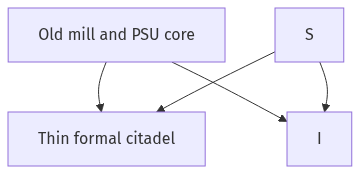
- One can sketch four layers: a small managerial-technical stratum; a shrinking regular industrial worker; a large contract and informal industrial workforce; and an own-account mass in workshops and platforms. Linkages run through putting-out, brand value chains, and labour contractors. Holmström’s ‘citadel and the rest’ is still a usable image, except the citadel is smaller and the rest is wired to global production.
The political effect is weaker class-for-itself action and stronger populist, caste and regional claims, which is why industrial class change is also a change in Indian democracy’s social base.
Flow diagram
Conclusion
Industrial class structure in India has moved from a mill-centred organised core to a dual system of a small formal citadel and a vast contract-informal mass, now extended into services and platforms. Caste and gender sort people across those layers. The old working class has not vanished; it has been reorganised.
Quick related
Students also ask
-
Identify different forms of inequalities associated with agrarian social structure in India
Next question on this syllabus topic (2024 · Q8(b)). View answer →
-
Did India ever have a large industrial proletariat?
Not as a majority of workers. Even at the mill peak, most labour was unorganised or agrarian.
-
Are gig workers an industrial class?
They are often informal wage labour tied to digital firms. They belong in the new class map even if they lack a factory.
Same topic · past papers
UPSC has asked this before
These previous-year questions sit on the same topic. Open one to practise the earlier ask.
More from this topic
Q3(b) · UPSC Mains 2026 · Sociology GS 2 · 20 marks · Solution
Explain the emergence of middle class in agrarian society in India. What have been the socio-structural implications of the emergence of this middle class?
Social Classes in India
This model answer examines the rise of the agrarian middle class in India, driven by post-independence land reforms, the Green Revolution, and market integration. It details their socio-structural implications, including shifting rural power dynamics, caste-class intersectionality, political mobilisation, and changing agrarian relations. The conclusion highlights the need for inclusive rural development and sustainable livelihoods to address emerging rural stratifications.
Q4(b) · UPSC Mains 2025 · Sociology GS 2 · 20 marks · Solution
"Industrial class structure is a function of social structure of Indian society." Do you agree with this statement? Analyze
Social Classes in India
Indian industrial classes include owners, managers, a small formal workforce and a large informal majority. Recruitment, unions and job queues follow caste, kinship, language and sending villages. Breman, Holmström and Ramaswamy show particularism inside industry, not a pure proletariat. Owners too are often community-based business groups. Capitalism reworks these ties but has not replaced them with a casteless class structure.
Q3(c) · UPSC Mains 2025 · Sociology GS 2 · 10 marks · Solution
Describe the main features of Indian new middle class. How is it different from the old middle class?
Social Classes in India
The old middle class grew from colonial education, law and bureaucracy and later staffed the Nehruvian state. The new middle class grew after 1991 around private services, IT and consumption. Béteille and Misra describe the older service stratum; Fernandes describes the consumer-citizen. Caste and English schooling shape entry into both. The new class is larger but still a minority; it has not absorbed the informal majority.