
Revision summary
The middle class is heterogeneous: old salariat, new services, and some rural rich. Beteille stresses internal split and the tension between hierarchy and equality. The Rudolphs and Yogendra Singh place it inside modernizing tradition. It staffs the developmental state and shapes media democracy. It is not the electoral majority and is divided by caste.
Model answer
Copper italics in this answer — like this — are the key facts. Each one is unpacked in the Facts & figures rail.
Introduction
India’s middle class is a layered set of salaried, professional, small-business, and farm households that live by education, office, and consumption more than by large land or factory ownership. Andre Beteille treated it as a growing, internally split formation whose values matter for both democracy and development.
Body
Salient features
- It is heterogeneous: old professional salariat, public-sector staff, new private services and information-technology workers, and a rural rich-peasant fringe.
- Entry routes are English education, credentials, and urban networks, which still carry caste and regional bias even when the language is merit.
- Yogendra Singh places this class at the hinge of modernizing tradition: it uses caste associations and also constitutional talk.
- Family strategy is typically delayed marriage, heavy schooling investment, and a nuclear or translocal household, not a clean break from kinship.
Role in democracy
- The Rudolphs showed traditional groups learning modern politics; the middle class supplies lawyers, journalists, party managers, and NGO staff who run that learning.
- It defends procedural democracy, courts, and civil liberties more loudly than many agrarian poor, yet it also fears reservation and street protest when its own mobility feels blocked.
- Beteille notes a tension between hierarchy in social life and equality in political ideology; the middle class lives that tension daily.
- Media and, later, social media amplify middle-class agendas, from anti-corruption campaigns to urban governance, which can deepen democracy or narrow it to city consumers.
Role in development
- Development planning after 1950 used this class as the staff of the developmental state: engineers, teachers, doctors, and clerks.
- Liberalisation expanded a consuming middle that legitimises growth, private education, and urban infrastructure.
- A. R. Desai would warn that a middle class allied to capital may treat labour and land reform as disorder.
- Inclusive development still depends on whether this class supports public health, common schools, and fair farm prices, or only gated services.
Limits
- It is not a majority. Electoral democracy still turns on poorer rural and urban masses.
- Caste blocs inside the middle class prevent a single class-for-itself politics.
Flow diagram
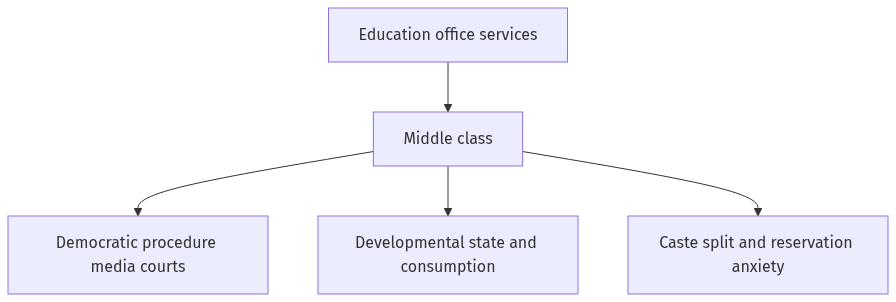
Conclusion
The Indian middle class is a credentialed, split, and politically noisy formation. It staffs development and argues for democratic procedure, while its own caste and consumption interests can thin both democracy and equal development.
Quick related
Students also ask
-
Explain the implications and the impact of globalization in situating the changing agrarian class structure in Indin
Next question on this syllabus topic (2023 · Q4(b)). View answer →
-
Is the middle class the same as the bourgeoisie?
No. Much of it is salaried and professional. A smaller business segment overlaps with capital.
-
Does a larger middle class automatically deepen democracy?
It can strengthen courts and debate. It can also push majoritarian or anti-poor urban agendas.
Same topic · past papers
UPSC has asked this before
These previous-year questions sit on the same topic. Open one to practise the earlier ask.
-
2021 · Q2(c) · Sociology GS 2 · 10 marks
Discuss the salient features of 'new middle class' in India -
2026 · Q3(b) · Sociology GS 2 · 20 marks
Explain the emergence of middle class in agrarian society in India. What have been the socio-structural implications of the emergence of this middle class? -
2025 · Q3(c) · Sociology GS 2 · 10 marks
Describe the main features of Indian new middle class. How is it different from the old middle class? -
2018 · Q4(a) · Sociology GS 2 · 20 marks
How has the New Economic Policy (1991) affected the lifestyle and life changed in new middle class in India. -
2023 · Q5(c) · Sociology GS 2 · 10 marks
Highlight the salient features of the New Education Policy (NEP) 2020
More from this topic
Q3(b) · UPSC Mains 2026 · Sociology GS 2 · 20 marks · Solution
Explain the emergence of middle class in agrarian society in India. What have been the socio-structural implications of the emergence of this middle class?
Social Classes in India
This model answer examines the rise of the agrarian middle class in India, driven by post-independence land reforms, the Green Revolution, and market integration. It details their socio-structural implications, including shifting rural power dynamics, caste-class intersectionality, political mobilisation, and changing agrarian relations. The conclusion highlights the need for inclusive rural development and sustainable livelihoods to address emerging rural stratifications.
Q4(b) · UPSC Mains 2025 · Sociology GS 2 · 20 marks · Solution
"Industrial class structure is a function of social structure of Indian society." Do you agree with this statement? Analyze
Social Classes in India
Indian industrial classes include owners, managers, a small formal workforce and a large informal majority. Recruitment, unions and job queues follow caste, kinship, language and sending villages. Breman, Holmström and Ramaswamy show particularism inside industry, not a pure proletariat. Owners too are often community-based business groups. Capitalism reworks these ties but has not replaced them with a casteless class structure.
Q3(c) · UPSC Mains 2025 · Sociology GS 2 · 10 marks · Solution
Describe the main features of Indian new middle class. How is it different from the old middle class?
Social Classes in India
The old middle class grew from colonial education, law and bureaucracy and later staffed the Nehruvian state. The new middle class grew after 1991 around private services, IT and consumption. Béteille and Misra describe the older service stratum; Fernandes describes the consumer-citizen. Caste and English schooling shape entry into both. The new class is larger but still a minority; it has not absorbed the informal majority.