
Revision summary
Child labour recurs because of household need, contractor chains and caste-typed work. Enforcement must join child-labour law with RTE and joint liability of contractors. Adult wages, meals, hostels and raid-linked social security replace the child’s income. Migrant-portable schooling and bridge courses keep rescued children in class. Stigmatised caste occupations and girls’ unpaid work need named targeting.
Model answer
Copper italics in this answer — like this — are the key facts. Each one is unpacked in the Facts & figures rail.
Introduction
Child labour in India returns because households need the wage, employers need cheap flexible hands, and caste still sorts who is ‘available’ as a child worker. Actionable measures must close the labour market to children and open a livable school-and-wage path to adults.
Body
Law that works on the ground
- Enforce the Child Labour (Prohibition and Regulation) Amendment Act, 2016, and the Right to Education Act together: rescue without a seat in school is a round trip to the kiln.
- Treat trafficking corridors, brick kilns, cotton seed plots, domestic work, and roadside eateries as inspection priorities, not only registered factories.
- Make principal employers and contractors jointly liable, because A. R. Desai’s class chain hides the child behind a labour contractor.
- Fast-track rehabilitation funds so a released child eats this week, not after a file moves.
Household economics
- Raise and actually pay adult minimum wages in the sectors that currently run on child hands.
- Expand reliable midday meals, hostels, and scholarships for first-generation learners, especially Dalit and Adivasi children who Srinivas’s village still places at the well’s edge.
- Link MGNREGA and social security to households identified in child-labour raids so the adult replaces the child’s income.
School as a labour-market rival
- NEP-era foundational literacy only helps if the teacher is present and the child is not seasonal migrant; portable admissions for migrant children are an actionable device.
- Bridge courses for older children who have missed years, so age shame does not push them back to work.
- Community boards, including women’s groups, to name missing children the way Operation Barga named unrecorded tenants: publicity plus record.
Caste, gender, and demand
- Target occupations historically tied to caste stigma, where children inherit work as destiny rather than as a short crisis.
- Treat girls’ domestic and farm labour as labour, not as training for marriage.
- Ban and prosecute hazardous home-based piecework that uses children for export and domestic value chains.
Culture of enforcement
- Public names of repeat employers, as courts have sometimes done, change honour more than a quiet fine.
- Train panchayats and police against the idea that ‘poor children must help’.
- Beteille’s equality as a value has to reach the workshop, not only the textbook.
What not to do
- Do not romanticise ‘family learning of craft’ when it is full-time wage substitution.
- Do not make the child a criminal; the employer and the missing public school are the problem.
Flow diagram
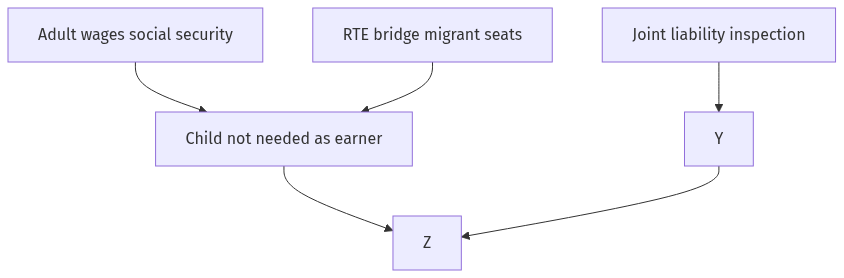
Conclusion
Recurrent child labour ends when adult wages, school seats, and inspector power meet at the same household. Statutes already exist. The actionable core is to make the legal child more expensive to hire than a paid adult, and safer to keep in school.
Quick related
Students also ask
-
How do you view the growth of informal sector in india ?
Next question on this syllabus topic (2022 · Q5(c)). View answer →
-
Does a ban on child labour starve poor families?
If adult wages and school support are missing, a ban can hide the child at home. The measure is ban plus household income.
-
Is family work always exempt in spirit?
When family work is full-time production for a contractor, it is child labour with a kinship mask.
Same topic · past papers
UPSC has asked this before
These previous-year questions sit on the same topic. Open one to practise the earlier ask.
-
2025 · Q6(c) · Sociology GS 2 · 10 marks
Which measures would you suggest for preventing caste conflicts in India ? Justify your argument -
2025 · Q7(a) · Sociology GS 2 · 20 marks
What are the Private and Public network and support systems operative in Indian society for the aged? Suggest measures to curb down the challenges before care givers of the aged -
2025 · Q8(a) · Sociology GS 2 · 20 marks
Is it possible to have sustainable development in India? Cite major environmental issues and suggest a few measures to achieve the sustainability -
2024 · Q6(a) · Sociology GS 2 · 20 marks
Discuss the major challenges related to women's reproductive health in India. What measures would you suggest to overcome these challenges? -
2023 · Q8(b) · Sociology GS 2 · 20 marks
Discuss the challenges faced by the cooperative movements in India. Suggest measures to strengthen the movement at the grass-roots level
More from this topic
Q7(c) · UPSC Mains 2026 · Sociology GS 2 · 10 marks · Solution
Examine the process of formalisation of informal sector to safeguard the interests of marginalised sections of the society
Industrialization and Urbanisation in India
• **Core Objective:** Formalising India's vast informal workforce integrates vulnerable groups into legal and institutional frameworks to secure their rights. • **Digital Tracking:** The e-Shram portal creates national databases and assigns Unique Account Numbers (UAN) to make unorganized workers visible for welfare delivery. • **Welfare Delivery:** Registration streamlines access to accident insurance, PM-SYM pensions, and direct benefit transfers. • **Wage Reforms:** Consolidating labour laws introduces universal statutory minimum wages and mandates formal appointment letters. • **Safety Standards:** New codes aim to improve occupational health and reduce the workplace exploitation of marginalised communities. • **Implementation Hurdles:** High compliance costs push micro-enterprises to stay informal, limiting the reach of safety nets. • **Social Realities:** Deep-rooted caste and class vulnerabilities among SC, ST, and OBC workers require more than just administrative registration to resolve.
Q6(b) · UPSC Mains 2025 · Sociology GS 2 · 20 marks · Solution
Discuss the trend of urbanization in India. Do you think that Industrialization is the only precondition of urbanization? Give you arguments
Industrialization and Urbanisation in India
India’s urbanisation is rising but remains metro-concentrated and full of census towns and slums. Kundu’s exclusionary urbanisation captures labour demand without inclusive housing. Tertiary growth, administrative history, transport and agrarian distress urbanise besides factories. Industrial belts exist and matter; they do not exhaust the trend. Policy that waits only for industry misses actually existing urban India.
Q5(e) · UPSC Mains 2025 · Sociology GS 2 · 10 marks · Solution
Do you think that law has been able to abolish child labour in India? Comment.
Industrialization and Urbanisation in India
The 1986 Act as amended in 2016 bans most child work under 14 but allows family-enterprise help. RTE adds a schooling right that is unevenly realised. Child labour persists in agriculture, kilns, domestic and home-based informal work. Poverty, caste occupations and weak inspection explain the gap between statute and practice. Law delegitimised the practice more than it abolished it.