
Revision summary
Sustainable development is possible in India only if growth is decoupled from dumping costs on the poor. Main issues are climate risk, air and water stress, forest loss, land conversion and inequality. Guha–Gadgil’s sociology of ecosystem people versus omnivores still explains who suffers. Measures include just energy transition, FRA, crop and city reform, and SDG-consistent budgets. Possibility is a political path, not a technical guarantee.
Model answer
Copper italics in this answer — like this — are the key facts. Each one is unpacked in the Facts & figures rail.
Introduction
Sustainable development is possible in India, not as a green slogan and not as a freeze on the poor. It is possible as a politically enforced path: lower carbon and pollution intensity, restored commons, and a fairer share of ecological space. The obstacles are structural—coal-and-car growth, caste-class dumping of waste, and a development state that still treats nature as a free input.
Body
Major issues
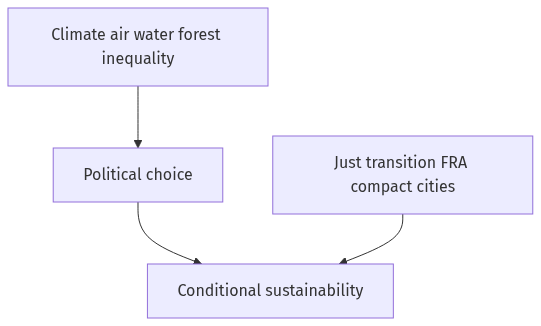
- Climate: monsoon instability, heat, Himalayan water towers, and coastal risk. Air: Indo-Gangetic winter smog as a class-blind killer that still hits outdoor labour first. Water: groundwater mining in Green Revolution belts, polluted rivers, and peri-urban tanker mafias. Forests and biodiversity: mining and linear projects versus FRA and Gram Sabha. Land: conversion of cultivating fields (Q5a) and displacement. Inequality: the rich consume; the poor live beside the dump, the mine, and the floodplain. Energy: coal lock-in versus renewable jobs that may not go to the same districts.
- Sociology adds: environmentalism of the poor (Guha, Gadgil’s omnivores vs ecosystem people), urban middle-class beautification that evicts, and caste in sanitation work. Chipko, Narmada, and Niyamgiri are not “green extras”; they are conflicts over who owns the future of a river or a hill.
Measures
A just energy transition with retraining in coal belts; crop diversification and procurement that does not mandate paddy where aquifers die; public transport and compact cities against exclusionary sprawl; genuine FRA and PESA; enforcement against industrial effluent; SDG-aligned budgets that treat Goal 13 and Goal 10 together; and making the polluter—not the ragpicker—pay. NEP and skill policy should include green trades without romanticising unpaid Adivasi conservation. Heat action plans, urban forests, and crop insurance are adaptation; they fail if they ignore informal outdoor labour.
- Possibility is empirical: India already runs a huge renewable programme and a huge coal programme. Sustainability is the political choice to stop using the poor as the sink. Yogendra Singh’s modernity without ecological accounting is incomplete; Desai’s development path must now count carbon and caste together. SDG reporting without Gram Sabha consent is green letterhead, not a lived village commons.
Flow diagram
Conclusion
Yes, India can develop sustainably if ecological costs stop being assigned by caste and class. The issues are climate, air, water, forest and inequality. The measures are just transition, commons rights, and cities that do not export harm to the edge.
Quick related
Students also ask
-
Do you think that forced displacement of labourers has caused their deprivation and resultant inequalities during the recent past years? Elaborate
Next question on this syllabus topic (2025 · Q8(b)). View answer →
-
Does sustainability mean no industry?
No. It means industry that does not treat Adivasi land and urban air as free sewers, plus public transport and clean power.
-
Are SDGs enough?
They are a dashboard. Without conflict over land and energy, the dashboard stays a report.
Same topic · past papers
UPSC has asked this before
These previous-year questions sit on the same topic. Open one to practise the earlier ask.
-
2026 · Q4(b) · Sociology GS 2 · 20 marks
Draw the current population pyramid of India. What policy measures would you recommend for population dynamics to achieve sustainability?
More from this topic
Q7(b) · UPSC Mains 2026 · Sociology GS 2 · 20 marks · Solution
Give a sociological explanation of violence against women in India. What suggestions would you give to mitigate these violences?
Challenges of Social Transformation
• Rooted in structural patriarchy, unequal socialization, and institutionalized gender roles within public and private spheres. • Sustained by family, marriage, and religion, which normalize male dominance and control over women's autonomy. • Intersecting factors like class, caste, and religion expose marginalized women to multiple layers of structural violence. • Requires rigorous legal enforcement and gender-sensitizing law enforcement to improve justice delivery. • Demands stronger institutional support, including one-stop crisis centers, helplines, and accessible legal aid. • Calls for educational reforms and community engagement to dismantle toxic masculinity and promote gender equality. • Grounded in Articles 14 and 21, demanding a shift toward transformative social engineering and substantive equality.
Q8(b) · UPSC Mains 2025 · Sociology GS 2 · 20 marks · Solution
Do you think that forced displacement of labourers has caused their deprivation and resultant inequalities during the recent past years? Elaborate
Challenges of Social Transformation
Forced displacement strips land, commons and urban foothold, then cheapens labour. Cernea’s impoverishment risks and Fernandes’s undercounting still describe Indian projects. Recent drivers include mining, highways, city beautification, conflict, climate and COVID reverse migration. Women, ST, SC and migrants lose most; land-value winners gain. R&R law exists; deprivation remains the modal outcome when consent and livelihoods are thin.
Q6(c) · UPSC Mains 2025 · Sociology GS 2 · 10 marks · Solution
Which measures would you suggest for preventing caste conflicts in India ? Justify your argument
Challenges of Social Transformation
Caste conflict is organised competition over honour, land, jobs and votes. Prevention needs prosecution under atrocity law, not only peace meetings. Common schooling, wages and land reduce the material fuse. Panchayat reservation forces some sharing of dominant-caste power. Anti-caste public culture and slow change in endogamy are the deep levers.