
Revision summary
Private support for the aged is still mainly kin, plus a small paid-care market. Public support is pensions, NPHCE and the 2007 Maintenance Act, all thin relative to need. Nuclear residence and migration weaken the joint-family guarantee without ending dependence. Caregivers, mostly women, face time poverty and little respite. Measures must combine adequate pensions, home services and gender-equal family law.
Model answer
Copper italics in this answer — like this — are the key facts. Each one is unpacked in the Facts & figures rail.
Introduction
India still tells itself that the joint family will keep the aged. Demography, migration and women’s labour have already thinned that promise. Support now sits in a private–public mix: kin and paid hands on one side; thin pensions and clinics on the other. Caregivers—mostly women—are the hidden institution.
Body
Private networks
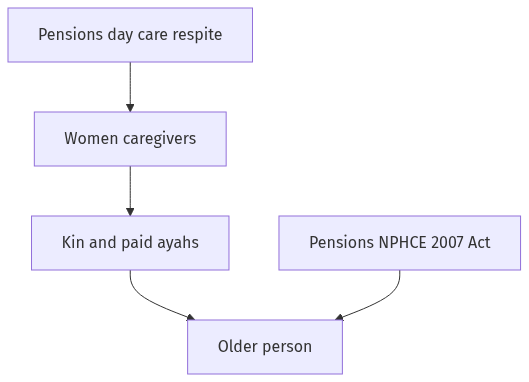
The son’s household remains the normative carer in much of North India; South Indian and matrilineal pockets differ. Siblings, daughters (increasingly after marriage), neighbours, and caste associations fill gaps. Paid care—ayahs, nursing homes in metros, unregulated “old age homes”—is a class good. I. P. Desai and later family sociologists showed residential nuclearisation with continuing obligation; the aged may live apart and still depend on remittances. Loneliness, property disputes, and elder abuse sit inside this private sphere. The Maintenance and Welfare of Parents and Senior Citizens Act, 2007 tries to legally compel children—an admission that custom slipped. NRI children and Gulf migrants stretch care across WhatsApp: money without hands.
Public networks
Indira Gandhi National Old Age Pension and state top-ups, widow pensions, NPS for the formal few, railway concessions, and the National Programme for Health Care of the Elderly are the public kit. Coverage is low relative to need; amounts are often below nutrition. Ayushman and state health schemes help some hospital episodes, not daily ADL care. Public-sector pensions and CGHS cover a minority. For the informal majority, the public network is a thin cash plus a crowded OPD. That gap is why private kin remain the real welfare state of old age, with all the gender injustice that implies.
Caregivers
Daughters-in-law and daughters juggle unpaid geriatric care, paid work, and children. Migration leaves skipped-generation households. Dementia and chronic disease raise skill needs that kin do not have. Male carers exist but are culturally licensed to “help,” not to own the roster. Measures: living pensions, day-care and home-nursing as public services, respite for carers, gender-equal inheritance actually enforced, crèche-like geriatric centres at panchayat level, and recognition of care time in labour law. Without this, “family values” is a subsidy extracted from women. A public caregiver allowance, like a modest MGNREGA for care, would sociologically name the work.
Flow diagram
Conclusion
Private kin still do most elder care; public pensions and clinics are thin. Caregivers need money, services and time off, not only a duty lecture. Ageing policy is family policy and gender policy together.
Quick related
Students also ask
-
"Educational development is the only Panacea for country's all ills and evils." Critically examine the above statement with reference to NEP-2020
Next question on this syllabus topic (2025 · Q7(b)). View answer →
-
Has the joint family collapsed?
Residential jointness has declined in many classes; ritual and property jointness often continue. Care gaps are still real.
-
Is a nursing-home model the answer?
Not as the only answer. Most Indians cannot buy it, and many want ageing in place with public home-care support.
Same topic · past papers
UPSC has asked this before
These previous-year questions sit on the same topic. Open one to practise the earlier ask.
-
2023 · Q8(b) · Sociology GS 2 · 20 marks
Discuss the challenges faced by the cooperative movements in India. Suggest measures to strengthen the movement at the grass-roots level -
2022 · Q2(c) · Sociology GS 2 · 15 marks
Discuss the problem of religious minorities in India and suggest measures to solve them. -
2026 · Q1(b) · Sociology GS 2 · 10 marks
According to you, which social reform had long-lasting impact on a specific section of society? Support your answer with suitable example. -
2020 · Q6(b) · Sociology GS 2 · 15 marks
Do you think MSP (Minimum Support Price) Scheme for ag can help in rural development? Elaborate your response with suitable examples.
More from this topic
Q5(e) · UPSC Mains 2026 · Sociology GS 2 · 10 marks · Solution
Bring out the debates of 'insiders' and 'outsiders' approaches in understanding Indian society.
Perspectives on the study of Indian society
• The insider (emic) approach studies Indian society using native categories, sacred texts, and cultural immersion, championed by G.S. Ghurye and D.P. Mukerji. • Critics argue the insider view suffers from upper-caste bias and ignores ground realities in favor of normative texts. • The outsider (etic) approach applies universal models and comparative frameworks, famously used by Western scholars like Louis Dumont. • Critics dismiss the outsider view as orientalist reductionism that imposes Western concepts and misinterprets local idioms. • Modern Indian sociology bridges this binary through a reflexive methodology combining cultural familiarity with analytical rigor. • Ultimately, combining native insights with objective scrutiny is essential to capture India's complex social dynamics.
Q5(a) · UPSC Mains 2026 · Sociology GS 2 · 10 marks · Solution
Discuss the challenges faced by the aged people in receiving 'elder care'.
Perspectives on the study of Indian society
• India's aging population faces severe elder care challenges due to the breakdown of traditional joint families and youth out-migration. • Over 80% of seniors lack formal pensions because they worked in the informal sector, worsening financial vulnerability. • High out-of-pocket medical costs for chronic illnesses quickly drain meager personal savings. • Public hospitals suffer from an acute shortage of geriatric specialists, dedicated wards, and rehabilitation facilities. • Implementation of the Maintenance and Welfare of Parents and Senior Citizens Act, 2007 remains weak, leaving legal tribunals overburdened. • Solutions require shifting from a welfare approach to a rights-based framework, combining community care networks with strict legal enforcement under Article 41.
Q4(c) · UPSC Mains 2026 · Sociology GS 2 · 10 marks · Solution
Compare G. S. Ghurye's and A. R. Desai's approaches used in understanding Indian society
Perspectives on the study of Indian society
• **Ghurye’s Indological Approach:** Relied on sacred texts and classical literature to study Indian society through civilizational continuity. • **Core Themes in Ghurye:** Focused on caste, kin, and how Hinduism historically integrated diverse tribal and regional groups. • **Desai’s Materialist Approach:** Rejected textual idealism in favor of Marxist political economy to study social structures. • **Economic Formations:** Analyzed Indian society through successive modes of production—ancient, feudal, and colonial capitalist. • **Caste vs. Class:** Viewed caste and religion as superstructural elements that mask underlying economic exploitation. • **Critique of State and Nationalism:** Argued that the nationalist movement was bourgeois, leaving agrarian inequalities intact post-independence. • **Key Contrast:** Ghurye highlights cultural tradition and integration, while Desai emphasizes economic power and class conflict.