
Revision summary
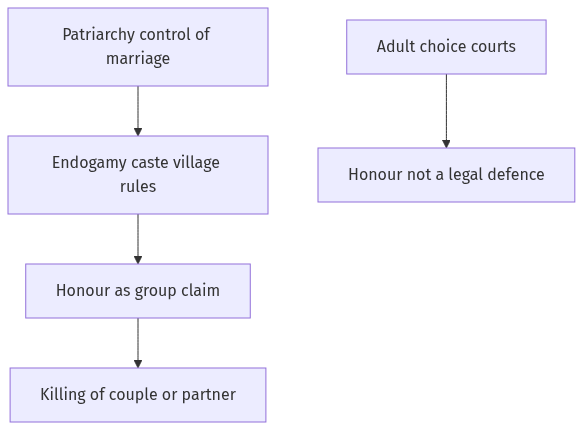
Patriarchy stores family and caste honour in control of women’s and men’s marriage choice. Honour killing punishes alliances that break endogamy, gotra or status rules. Manoj–Babli, Nitish Katara and Shankar–Kausalya are court-reported illustrations. Shakti Vahini 2018 rejects khap punishment and affirms adult choice. The theme is structured power, not inexplicable rage.
Model answer
Copper italics in this answer — like this — are the key facts. Each one is unpacked in the Facts & figures rail.
Introduction
Patriarchy here is a structured control of women’s sexuality, marriage, and movement, and a ranking of men who ‘own’ family honour. Honour killing is the extreme punishment when a match or friendship is said to soil that honour. The theme is not private madness. It is caste-kinship power using violence to keep endogamy.
Body
Thematic linkage
- Uma Chakravarti’s Brahmanical patriarchy stores caste purity in the daughter’s body; the son’s forbidden love is punished when it mixes rank.
- Srinivas’s endogamy and Dumont’s hierarchy explain why the ‘wrong’ alliance is treated as a group wound, not a couple’s choice.
- North Indian village exogamy and khap-type councils add a territorial rule: the same village or gotra can be named as incestuous even when the law sees two adults.
- Men who kill are often kin claiming to restore male honour; women relatives may be coerced into silence. Patriarchy is a system, not only a father.
Court-reported cases, without spectacle
- The Manoj–Babli case (Kaithal, Haryana, 2007; convictions thereafter) showed a married couple murdered after a khap-linked diktat against their match; courts treated it as murder, not as custom.
- The Nitish Katara murder (2002; later convictions of Vikas Yadav and others) was prosecuted as killing to block an inter-status relationship; the Delhi courts recorded honour as motive, not as defence.
- The Shankar–Kausalya case (Tamil Nadu, 2016; trials and appeals in the public record) concerned an inter-caste marriage and the killing of the husband; it showed the pattern is not only north Indian.
- Shakti Vahini v. Union of India (Supreme Court, 2018) directed states against honour crimes and illegal khap punishments, stating that adults have a right to choose a spouse.
What the cases teach together
- Law now names honour as an aggravating social motive. Local power still tries to outrank the Special Marriage Act and Lata Singh’s line that an adult may choose.
- The Rudolphs’ traditional council meeting modernity is visible: khaps use press conferences and then face IPC murder charges.
- Beteille’s disharmony is lethal here: constitutional equality versus ranked kinship.
Limits of a court-only view
- Many coercive confinements never become FIRs.
- Actionable prevention is housing for couples, swift police against illegal gatherings, and ending impunity, not sermons alone.
Flow diagram
Conclusion
Honour killing is patriarchy enforcing caste and kin rules on marriage. Public cases from Haryana, Delhi, and Tamil Nadu, and the Shakti Vahini directions, show the courts rejecting honour as a right to kill. The linkage remains because endogamy still organises status.
Quick related
Students also ask
-
Discuss the changing dimensions of family structure in urban India
Next question on this syllabus topic (2021 · Q3(c)). View answer →
-
Is honour killing a rural north Indian custom only?
It is denser where khap-type endogamy is strong. Inter-caste killings have also been prosecuted in the south.
-
Can honour be a legal defence?
No. Indian criminal law treats the act as murder. Courts have said custom cannot authorise killing.
Same topic · past papers
UPSC has asked this before
These previous-year questions sit on the same topic. Open one to practise the earlier ask.
-
2018 · Q8(b) · Sociology GS 2 · 15 marks
Western patriarchy which surrenders feminine principles is the development project in India. Do you agree with this view? Why? -
2015 · Q3(b) · Sociology GS 2 · 15 marks
What is patriarchy? How does it affect the child socialization pattern in India? -
2024 · Q1(c) · Sociology GS 2 · 10 marks
Is patriarchy a key to understanding different forms of inequalities in Indian society? Elaborate. -
2022 · Q3(b) · Sociology GS 2 · 15 marks
Discuss the material basis of patriarchy as an ideological system. -
2019 · Q4(a) · Sociology GS 2 · 20 marks
Define patriarchy. Does it have bearings on women's entitlement in Indian family system ? Explain
More from this topic
Q7(a) · UPSC Mains 2026 · Sociology GS 2 · 20 marks · Solution
Urbanisation in Independent India has been characterized by over-urbanization and rural push. Explain with demographic and sociological dimensions
Systems of Kinship in India
• Indian urban growth is driven by distress migration from rural areas rather than industrial pull factors, creating over-urbanization. • The tertiary sector expands faster than secondary manufacturing, resulting in a large informal workforce, underemployment, and slum proliferation. • Urban population crossed 31% by 2011, fuelled by net migration and the reclassification of rural settlements into urban areas. • Primate city concentration in Tier-I metros causes lopsided regional development and severe strain on civic infrastructure. • Migration streams remain male-selective, leading to skewed sex ratios in cities and remittance-dependent rural households. • Caste, kinship networks, and primordial ties heavily mediate urban entry and occupational placement. • Cities exhibit deep socio-spatial dualism, separating formal enclaves from precarious informal settlements while altering family structures and gender roles.
Q1(e) · UPSC Mains 2024 · Sociology GS 2 · 10 marks · Solution
Despite the efforts of the government, bonded labour still continues in India. Discuss.
Systems of Kinship in India
The 1976 Act abolished bonded labour in law; neo-bondage continues in kilns, farms and migration streams. Advances and contractors tie Dalit, Adivasi and other poor households season after season. Breman’s neo-bondage is market unfreedom, not only old agrestic serfdom. Rescue without credit and work leads to re-bondage. Informal capitalism and caste together explain why government effort has not ended the practice.
Q1(d) · UPSC Mains 2024 · Sociology GS 2 · 10 marks · Solution
Do you think that family bondings are being affected by the changing kinship patterns in India? Comment.
Systems of Kinship in India
Kinship patterns in India are changing through migration, law, education and marriage markets. Shah and I. P. Desai separate residential nuclearisation from continuing joint family obligations. Bonds are stressed around care, authority and marriage choice. Remittances, caste weddings and digital contact keep translocal jointness alive. The family remains the main care institution for most groups.