
Revision summary
Descent places people in a lineage or gotra for ritual and property. Alliance treats marriage as structured exchange between groups. Karve and Dumont contrast a northern agnatic-exogamous field with southern Dravidian cross-cousin alliance. Kerala matriliny shows descent is not everywhere patrilineal. Modern markets mix residence without erasing these rules.
Model answer
Copper italics in this answer — like this — are the key facts. Each one is unpacked in the Facts & figures rail.
Introduction
Descent traces who belongs to a kin corporation across generations. Alliance traces how groups are linked by marriage. North and South Indian systems both use descent and alliance, but they organise the marriage field differently.
Body
Descent
- Descent is the rule that assigns a person to a lineage, clan, or gotra for property, ritual, and often surname.
- North Indian kinship is strongly agnatic in the classical model: a man belongs to his father’s line; a woman marries out and is incorporated into her husband’s line for many ritual purposes.
- Clan and gotra exogamy forbid marriage inside a named descent set even when the village is large.
Alliance
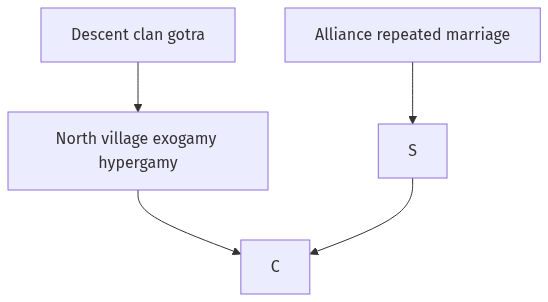
- Alliance theory, associated with Claude Levi-Strauss and used on India by Louis Dumont, treats marriage as a lasting exchange between groups, not only as a contract of two persons.
- South Indian Dravidian kinship prefers cross-cousin marriage, so the same groups repeat alliance across generations.
- Dumont argued that South Indian caste and kinship make alliance a structural principle, whereas the north stresses hypergamy and wife-givers ranked below wife-takers.
North versus South, with examples
- Irawati Karve mapped this regional contrast: Indo-Aryan north versus Dravidian south, with intermediate zones.
- North: village exogamy in much of the Hindi belt, gotra rules, and a bride who travels to her husband’s village; the mother’s brother’s daughter may be forbidden as too close in some groups and preferred in others, but parallel-cousin marriage is widely barred.
- South: Tamil, Telugu, Kannada, and Malayalam Dravidian systems often prefer mother’s brother’s daughter; the bride may already be a known affine, and the in-law relationship is pre-built.
- Kerala’s historical matriliny among some groups (for example Nayar taravad in older ethnography) shows that descent itself can be matrilineal, which is not the north Indian default.
- Marriott-style interaction still matters: who eats with affines differs by region, but caste endogamy frames both systems.
Modern pressure
- Law, migration, and matrimonial markets mix the two maps. A Tamil software household in Bengaluru may still ask about cross-cousin eligibility; a Haryana household may still refuse same-village matches.
- Honour disputes follow these maps when a match violates village exogamy or caste alliance rules.
Flow diagram
Conclusion
Descent assigns corporate belonging; alliance organises marriage exchange. North Indian kinship leans on agnatic descent, village exogamy, and hypergamy. South Indian Dravidian kinship leans on repeated cross-cousin alliance. Both remain caste-bound.
Quick related
Students also ask
-
Explain the thematic linkages between 'Patriarchy' and 'Honour killing' in India, citing some recent cases
Next question on this syllabus topic (2023 · Q8(a)). View answer →
-
Do all South Indians practise cross-cousin marriage?
No. It is a structural preference in many Dravidian systems, not a universal daily fact, and law plus class now mix patterns.
-
Is alliance absent in the north?
No. North Indian groups also exchange women between villages and clans. The south more often repeats the same alliance.
Same topic · past papers
UPSC has asked this before
These previous-year questions sit on the same topic. Open one to practise the earlier ask.
-
2020 · Q4(a) · Sociology GS 2 · 20 marks
Discuss the conceptual issues about lineage and descent in India. Give suitable illustrations ,
More from this topic
Q7(a) · UPSC Mains 2026 · Sociology GS 2 · 20 marks · Solution
Urbanisation in Independent India has been characterized by over-urbanization and rural push. Explain with demographic and sociological dimensions
Systems of Kinship in India
• Indian urban growth is driven by distress migration from rural areas rather than industrial pull factors, creating over-urbanization. • The tertiary sector expands faster than secondary manufacturing, resulting in a large informal workforce, underemployment, and slum proliferation. • Urban population crossed 31% by 2011, fuelled by net migration and the reclassification of rural settlements into urban areas. • Primate city concentration in Tier-I metros causes lopsided regional development and severe strain on civic infrastructure. • Migration streams remain male-selective, leading to skewed sex ratios in cities and remittance-dependent rural households. • Caste, kinship networks, and primordial ties heavily mediate urban entry and occupational placement. • Cities exhibit deep socio-spatial dualism, separating formal enclaves from precarious informal settlements while altering family structures and gender roles.
Q1(e) · UPSC Mains 2024 · Sociology GS 2 · 10 marks · Solution
Despite the efforts of the government, bonded labour still continues in India. Discuss.
Systems of Kinship in India
The 1976 Act abolished bonded labour in law; neo-bondage continues in kilns, farms and migration streams. Advances and contractors tie Dalit, Adivasi and other poor households season after season. Breman’s neo-bondage is market unfreedom, not only old agrestic serfdom. Rescue without credit and work leads to re-bondage. Informal capitalism and caste together explain why government effort has not ended the practice.
Q1(d) · UPSC Mains 2024 · Sociology GS 2 · 10 marks · Solution
Do you think that family bondings are being affected by the changing kinship patterns in India? Comment.
Systems of Kinship in India
Kinship patterns in India are changing through migration, law, education and marriage markets. Shah and I. P. Desai separate residential nuclearisation from continuing joint family obligations. Bonds are stressed around care, authority and marriage choice. Remittances, caste weddings and digital contact keep translocal jointness alive. The family remains the main care institution for most groups.