
Revision summary
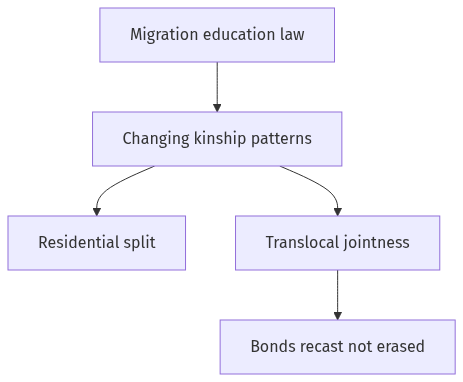
Kinship patterns in India are changing through migration, law, education and marriage markets. Shah and I. P. Desai separate residential nuclearisation from continuing joint family obligations. Bonds are stressed around care, authority and marriage choice. Remittances, caste weddings and digital contact keep translocal jointness alive. The family remains the main care institution for most groups.
Model answer
Copper italics in this answer — like this — are the key facts. Each one is unpacked in the Facts & figures rail.
Introduction
Kinship is the rule-bound organisation of descent, marriage, residence and care. Family bonding is the practical solidarity that those rules support: who eats together, who pays for a hospital, who decides a wedding. In India those patterns are changing. The question is whether bonds are breaking or being reorganised. Village ethnography and urban studies both point to reorganisation more than to a simple collapse.
Body
What is changing
A. M. Shah distinguished household from family: people may live in smaller residential units while remaining a joint family for property and ritual. I. P. Desai found similar ‘jointness’ beneath nuclear façades. That distinction is now stretched by Gulf and metropolitan migration, dual-earner households, and delayed marriage. North Indian village exogamy and Dravidian cross-cousin patterns (Karve, Dumont, Trautmann) still operate, but they compete with office romances, caste-endogamous ‘love’ matches, and a small rise in inter-caste and delayed first marriage.
- Law recast authority: the Hindu Succession amendments, maintenance case law, and the Domestic Violence Act give wives and daughters claims that older karta power did not assume. NEP-era education and women’s college enrolment change who can refuse a match. Smartphones keep a migrant son in daily contact and also expose youth to matches outside the local field.
Are bonds affected?
Yes. Authority of elders over marriage and occupation is weaker where wages are individual. Care of the aged is more contested when daughters-in-law work and sons live in another city. Divorce and separation, though still low by world standards, are more visible. Live-in and delayed household formation in metros alter the timing of bonding.
No, if ‘affected’ means emptied. Patricia Uberoi showed the family as an ideological site that modern India keeps investing in. Remittances, WhatsApp kin groups, caste samaj weddings, and return for death pollution show translocal jointness. Gay and lesbian couples still often negotiate with natal families rather than living as isolated individuals. The household remains the main welfare institution because public care is thin.
Bonded labour, kinship and the short 10-marker close
Family bonding is also affected when a bonded or circular-migrant husband is absent for months and the wife runs the farm under a father-in-law. That is kinship change produced by labour unfreedom, which links this short note to bonded labour and to agrarian class. The comment asked by the question is therefore: yes, bonds are affected; no, they are not simply over.
So changing kinship patterns stress bonds, redistribute them toward conjugal and sibling ties in some classes, and stretch them across cities. They do not replace kinship with a market of strangers for most Indians.
Flow diagram
Conclusion
- Family bondings are affected: residence splits, marriage choice widens a little, and elder authority is bargained. The Indian pattern is still jointness under new logistics—money, phones, and caste marriage markets—rather than the death of the family.
Quick related
Students also ask
-
Despite the efforts of the government, bonded labour still continues in India. Discuss.
Next question on this syllabus topic (2024 · Q1(e)). View answer →
-
Is the Indian joint family disappearing?
Residential jointness has declined in many urban groups. Property, ritual and crisis support often remain joint.
-
Do changing patterns mean Western nuclear family?
Not as a general rule. Conjugal households still sit inside caste endogamy and wider kin claims.
Same topic · past papers
UPSC has asked this before
These previous-year questions sit on the same topic. Open one to practise the earlier ask.
More from this topic
Q7(a) · UPSC Mains 2026 · Sociology GS 2 · 20 marks · Solution
Urbanisation in Independent India has been characterized by over-urbanization and rural push. Explain with demographic and sociological dimensions
Systems of Kinship in India
• Indian urban growth is driven by distress migration from rural areas rather than industrial pull factors, creating over-urbanization. • The tertiary sector expands faster than secondary manufacturing, resulting in a large informal workforce, underemployment, and slum proliferation. • Urban population crossed 31% by 2011, fuelled by net migration and the reclassification of rural settlements into urban areas. • Primate city concentration in Tier-I metros causes lopsided regional development and severe strain on civic infrastructure. • Migration streams remain male-selective, leading to skewed sex ratios in cities and remittance-dependent rural households. • Caste, kinship networks, and primordial ties heavily mediate urban entry and occupational placement. • Cities exhibit deep socio-spatial dualism, separating formal enclaves from precarious informal settlements while altering family structures and gender roles.
Q1(e) · UPSC Mains 2024 · Sociology GS 2 · 10 marks · Solution
Despite the efforts of the government, bonded labour still continues in India. Discuss.
Systems of Kinship in India
The 1976 Act abolished bonded labour in law; neo-bondage continues in kilns, farms and migration streams. Advances and contractors tie Dalit, Adivasi and other poor households season after season. Breman’s neo-bondage is market unfreedom, not only old agrestic serfdom. Rescue without credit and work leads to re-bondage. Informal capitalism and caste together explain why government effort has not ended the practice.
Q8(a) · UPSC Mains 2023 · Sociology GS 2 · 20 marks · Solution
Explain the thematic linkages between 'Patriarchy' and 'Honour killing' in India, citing some recent cases
Systems of Kinship in India
Patriarchy stores family and caste honour in control of women’s and men’s marriage choice. Honour killing punishes alliances that break endogamy, gotra or status rules. Manoj–Babli, Nitish Katara and Shankar–Kausalya are court-reported illustrations. Shakti Vahini 2018 rejects khap punishment and affirms adult choice. The theme is structured power, not inexplicable rage.