
Revision summary
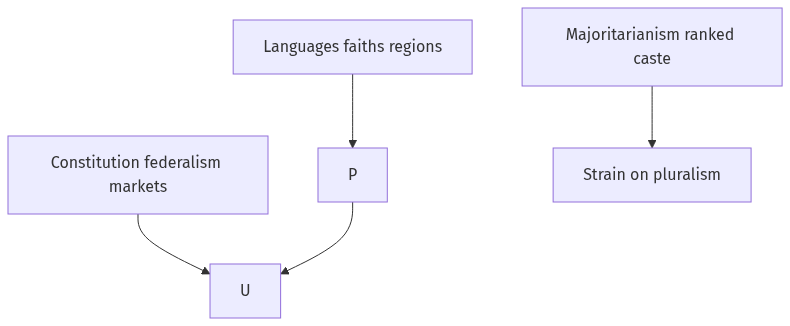
Cultural pluralism is legally protected difference inside one political community. Unity in diversity names that Indian claim. Constitution, federalism and everyday mixing are the civic mechanisms. Ranked caste and majoritarian pressure strain the claim. Pluralism is practice, not only a civilisational slogan.
Model answer
Copper italics in this answer — like this — are the key facts. Each one is unpacked in the Facts & figures rail.
Introduction
Cultural pluralism means several languages, faiths, and ways of life sharing one political community without a single culture being the price of membership. India’s unity in diversity is the public name for that claim. Sociology tests whether the claim is living practice or only a slogan.
Body
What pluralism is here
- It is not a melting pot. It is legally protected difference plus some shared civic rules.
- The Rudolphs’ modernity of tradition shows communities using parties, courts, and schools while remaining plural.
- Yogendra Singh treats Indian unity as a civilisational field that modernizes without becoming culturally one.
Mechanisms of unity
- The Constitution recognises languages, personal laws, and minority rights, and it forbids discrimination by religion, caste, and sex.
- Federalism, festivals in public space, and inter-regional markets create everyday mixing.
- Andre Beteille’s point on equality as a new value sits beside older ranked diversity: unity is now supposed to be civic, not only imperial or Sanskritic.
Strains
- Communal violence, language chauvinism, and majoritarian pressure treat diversity as a problem to be thinned.
- Caste pluralism is ranked pluralism; Dalit and Adivasi cultures are not equal partners if land and honour are denied.
- A. R. Desai would add that a class state can use ‘unity’ to police labour and protest.
Flow diagram
Conclusion
- Cultural pluralism is the sociological content of unity in diversity: many cultures, one citizenship. It holds when law and livelihood protect difference. It fails when unity is recoded as sameness.
Quick related
Students also ask
-
Highlight the salient features of the New Education Policy (NEP) 2020
Next question on this syllabus topic (2023 · Q5(c)). View answer →
-
Is unity in diversity the same as no conflict?
No. Pluralism expects dispute. It requires rules so dispute does not become domination.
-
Does a common civil code end pluralism?
A uniform law of marriage could still allow cultural practice. Forced cultural sameness would not be pluralism.
Same topic · past papers
UPSC has asked this before
These previous-year questions sit on the same topic. Open one to practise the earlier ask.
-
2023 · Q4(c) · Sociology GS 2 · 10 marks
Critique the victory narratives of Green Revolution in the context of Indian society -
2020 · Q4(c) · Sociology GS 2 · 15 marks
Write a note on cultural pluralism in multi-religious society like India.
More from this topic
Q5(e) · UPSC Mains 2026 · Sociology GS 2 · 10 marks · Solution
Bring out the debates of 'insiders' and 'outsiders' approaches in understanding Indian society.
Perspectives on the study of Indian society
• The insider (emic) approach studies Indian society using native categories, sacred texts, and cultural immersion, championed by G.S. Ghurye and D.P. Mukerji. • Critics argue the insider view suffers from upper-caste bias and ignores ground realities in favor of normative texts. • The outsider (etic) approach applies universal models and comparative frameworks, famously used by Western scholars like Louis Dumont. • Critics dismiss the outsider view as orientalist reductionism that imposes Western concepts and misinterprets local idioms. • Modern Indian sociology bridges this binary through a reflexive methodology combining cultural familiarity with analytical rigor. • Ultimately, combining native insights with objective scrutiny is essential to capture India's complex social dynamics.
Q5(a) · UPSC Mains 2026 · Sociology GS 2 · 10 marks · Solution
Discuss the challenges faced by the aged people in receiving 'elder care'.
Perspectives on the study of Indian society
• India's aging population faces severe elder care challenges due to the breakdown of traditional joint families and youth out-migration. • Over 80% of seniors lack formal pensions because they worked in the informal sector, worsening financial vulnerability. • High out-of-pocket medical costs for chronic illnesses quickly drain meager personal savings. • Public hospitals suffer from an acute shortage of geriatric specialists, dedicated wards, and rehabilitation facilities. • Implementation of the Maintenance and Welfare of Parents and Senior Citizens Act, 2007 remains weak, leaving legal tribunals overburdened. • Solutions require shifting from a welfare approach to a rights-based framework, combining community care networks with strict legal enforcement under Article 41.
Q4(c) · UPSC Mains 2026 · Sociology GS 2 · 10 marks · Solution
Compare G. S. Ghurye's and A. R. Desai's approaches used in understanding Indian society
Perspectives on the study of Indian society
• **Ghurye’s Indological Approach:** Relied on sacred texts and classical literature to study Indian society through civilizational continuity. • **Core Themes in Ghurye:** Focused on caste, kin, and how Hinduism historically integrated diverse tribal and regional groups. • **Desai’s Materialist Approach:** Rejected textual idealism in favor of Marxist political economy to study social structures. • **Economic Formations:** Analyzed Indian society through successive modes of production—ancient, feudal, and colonial capitalist. • **Caste vs. Class:** Viewed caste and religion as superstructural elements that mask underlying economic exploitation. • **Critique of State and Nationalism:** Argued that the nationalist movement was bourgeois, leaving agrarian inequalities intact post-independence. • **Key Contrast:** Ghurye highlights cultural tradition and integration, while Desai emphasizes economic power and class conflict.