
Revision summary
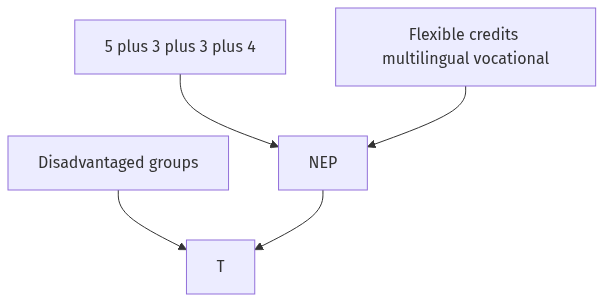
NEP 2020 replaces 10+2 as the public stage-story with 5+3+3+4. Higher education is to allow multiple entry, exit and credit mobility. Early mother-tongue teaching, multilingualism and vocational exposure are named pillars. Equity for disadvantaged groups is a stated aim. Outcomes will follow teachers, funding and the still-unequal English market.
Model answer
Copper italics in this answer — like this — are the key facts. Each one is unpacked in the Facts & figures rail.
Introduction
The National Education Policy 2020 is a framework to recast school and higher education around flexibility, multilingual foundations, and a claimed shift from rote to competency. For sociology it is also a state attempt to modernize opportunity structures that still follow caste, class, and region.
Body
Structural features
- Schooling is recast as a 5+3+3+4 design from foundational years through secondary, replacing the older 10+2 as the main public story of stages.
- Multiple entry and exit in higher education, academic credit banks, and a four-year undergraduate option aim to reduce a single fail-or-leave gate.
- A common regulatory direction for higher education and a stress on multidisciplinary universities sit beside existing professional councils in practice.
Curriculum and language
- Foundational literacy and numeracy, mother-tongue or regional-language teaching in early years, and later multilingualism are central policy claims.
- Vocational exposure from school, internships, and a less rigid arts–science split try to join education to work.
- Indian knowledge systems are named as content, which Yogendra Singh would read as modernization of tradition inside the classroom.
Equity claims and sociological limits
- The policy speaks of socio-economically disadvantaged groups, gender inclusion, and special education zones.
- Without teachers, buildings, and English as a still-closed elite code, flexibility can widen the gap Beteille notes between certified merit and inherited advantage.
- Digital education after the pandemic showed that a platform is not a school for the landless household.
Flow diagram
Conclusion
NEP 2020’s salient features are a new stage design, flexible higher education, multilingual early schooling, and vocational mixing. Whether it equalises India depends on public provision, not only on the document.
Quick related
Students also ask
-
Discuss the nature of regional variations in sex ratio in India, stating reasons thereof
Next question on this syllabus topic (2023 · Q5(e)). View answer →
-
Did NEP 2020 immediately replace all state boards?
No. It is a national framework. States and institutions phase parts at different speeds.
-
Is vocationalisation the same as ending inequality?
It can reduce stigma of skill education. Caste and English still sort prestige courses.
Same topic · past papers
UPSC has asked this before
These previous-year questions sit on the same topic. Open one to practise the earlier ask.
-
2021 · Q6(a) · Sociology GS 2 · 20 marks
Explain the sociological significance of the New Education Policy and its thrust on vocationalization and skill development -
2020 · Q5(d) · Sociology GS 2 · 10 marks
How does the New Education Policy, 2020 aim to eradicate disparities in the system of education in India? -
2025 · Q7(b) · Sociology GS 2 · 20 marks
"Educational development is the only Panacea for country's all ills and evils." Critically examine the above statement with reference to NEP-2020
More from this topic
Q5(e) · UPSC Mains 2026 · Sociology GS 2 · 10 marks · Solution
Bring out the debates of 'insiders' and 'outsiders' approaches in understanding Indian society.
Perspectives on the study of Indian society
• The insider (emic) approach studies Indian society using native categories, sacred texts, and cultural immersion, championed by G.S. Ghurye and D.P. Mukerji. • Critics argue the insider view suffers from upper-caste bias and ignores ground realities in favor of normative texts. • The outsider (etic) approach applies universal models and comparative frameworks, famously used by Western scholars like Louis Dumont. • Critics dismiss the outsider view as orientalist reductionism that imposes Western concepts and misinterprets local idioms. • Modern Indian sociology bridges this binary through a reflexive methodology combining cultural familiarity with analytical rigor. • Ultimately, combining native insights with objective scrutiny is essential to capture India's complex social dynamics.
Q5(a) · UPSC Mains 2026 · Sociology GS 2 · 10 marks · Solution
Discuss the challenges faced by the aged people in receiving 'elder care'.
Perspectives on the study of Indian society
• India's aging population faces severe elder care challenges due to the breakdown of traditional joint families and youth out-migration. • Over 80% of seniors lack formal pensions because they worked in the informal sector, worsening financial vulnerability. • High out-of-pocket medical costs for chronic illnesses quickly drain meager personal savings. • Public hospitals suffer from an acute shortage of geriatric specialists, dedicated wards, and rehabilitation facilities. • Implementation of the Maintenance and Welfare of Parents and Senior Citizens Act, 2007 remains weak, leaving legal tribunals overburdened. • Solutions require shifting from a welfare approach to a rights-based framework, combining community care networks with strict legal enforcement under Article 41.
Q4(c) · UPSC Mains 2026 · Sociology GS 2 · 10 marks · Solution
Compare G. S. Ghurye's and A. R. Desai's approaches used in understanding Indian society
Perspectives on the study of Indian society
• **Ghurye’s Indological Approach:** Relied on sacred texts and classical literature to study Indian society through civilizational continuity. • **Core Themes in Ghurye:** Focused on caste, kin, and how Hinduism historically integrated diverse tribal and regional groups. • **Desai’s Materialist Approach:** Rejected textual idealism in favor of Marxist political economy to study social structures. • **Economic Formations:** Analyzed Indian society through successive modes of production—ancient, feudal, and colonial capitalist. • **Caste vs. Class:** Viewed caste and religion as superstructural elements that mask underlying economic exploitation. • **Critique of State and Nationalism:** Argued that the nationalist movement was bourgeois, leaving agrarian inequalities intact post-independence. • **Key Contrast:** Ghurye highlights cultural tradition and integration, while Desai emphasizes economic power and class conflict.