
Revision summary
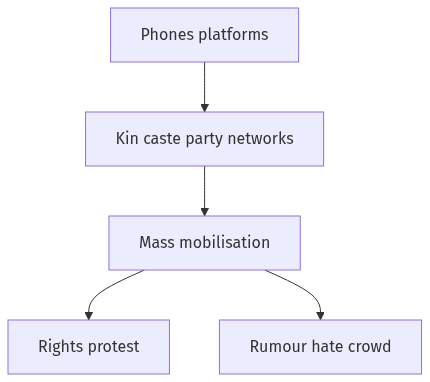
Social media lowers the cost of assembling a public in India. Feeds still follow kin, caste, faith and party networks. Protests have used platforms to scale and to document force. Rumour and hate also travel in the same pipes. Lasting mobilisation still needs organisation beyond the forward.
Model answer
Copper italics in this answer — like this — are the key facts. Each one is unpacked in the Facts & figures rail.
Introduction
Social media connects strangers into a public that can assemble faster than party offices or village factions once did. Mass mobilisation in India now travels through phones as well as through caste, union, and shrine networks. The interconnection is organisational, not only technological.
Body
How the link works
- Platforms lower the cost of calling a crowd, sharing a frame of injustice, and streaming police action, which is why farmers’ protests, student protests, and city solidarity campaigns could scale quickly.
- Existing social structure still routes the feed: WhatsApp groups follow kin, jati, mosque, church, and workplace, so the Rudolphs’ traditional associations now have digital rooms.
- Hashtags and forwards create a felt majority that may be a bubble, which can embolden street action.
Democratic and dark sides
- Mobilisation for rights, disaster help, and evidence against abuse can deepen the public sphere Beteille ties to citizenship.
- The same pipes carry rumour, targeted hate, and coordinated harassment; lynchings and riot moods have been linked in court and inquiry discourse to forwards, not only to old rumours in the bazaar.
- Algorithmic speed outruns Dumont’s slow ritual public and also outruns local verification.
Sociological caution
- A. R. Desai would ask which class owns the platforms and which labourers still lack data or time.
- Online crowd is not automatically a lasting movement; Chipko’s staying power came from organisation, not only from a message.
Flow diagram
Conclusion
Social media and mass mobilisation interconnect because platforms amplify already structured Indian networks. They can widen democratic assembly and they can industrialise rumour. The sociology is of organisation and inequality, not of gadgets alone.
Quick related
Students also ask
-
What actionable measures would you suggest to curb the recurrent child labour menace in India?
Next question on this syllabus topic (2023 · Q6(c)). View answer →
-
Did social media create mass politics in India?
No. Mass politics is older. Media changed speed, scale and the evidence trail.
-
Is online mobilisation leaderless?
It can look leaderless. Caste associations, parties and local influencers still steer many crowds.
Same topic · past papers
UPSC has asked this before
These previous-year questions sit on the same topic. Open one to practise the earlier ask.
-
2025 · Q5(c) · Sociology GS 2 · 10 marks
Discuss the social bases of political mobilization in Independent India. Has some change occurred in these during the last 60-70 years?
More from this topic
Q7(c) · UPSC Mains 2026 · Sociology GS 2 · 10 marks · Solution
Examine the process of formalisation of informal sector to safeguard the interests of marginalised sections of the society
Industrialization and Urbanisation in India
• **Core Objective:** Formalising India's vast informal workforce integrates vulnerable groups into legal and institutional frameworks to secure their rights. • **Digital Tracking:** The e-Shram portal creates national databases and assigns Unique Account Numbers (UAN) to make unorganized workers visible for welfare delivery. • **Welfare Delivery:** Registration streamlines access to accident insurance, PM-SYM pensions, and direct benefit transfers. • **Wage Reforms:** Consolidating labour laws introduces universal statutory minimum wages and mandates formal appointment letters. • **Safety Standards:** New codes aim to improve occupational health and reduce the workplace exploitation of marginalised communities. • **Implementation Hurdles:** High compliance costs push micro-enterprises to stay informal, limiting the reach of safety nets. • **Social Realities:** Deep-rooted caste and class vulnerabilities among SC, ST, and OBC workers require more than just administrative registration to resolve.
Q6(b) · UPSC Mains 2025 · Sociology GS 2 · 20 marks · Solution
Discuss the trend of urbanization in India. Do you think that Industrialization is the only precondition of urbanization? Give you arguments
Industrialization and Urbanisation in India
India’s urbanisation is rising but remains metro-concentrated and full of census towns and slums. Kundu’s exclusionary urbanisation captures labour demand without inclusive housing. Tertiary growth, administrative history, transport and agrarian distress urbanise besides factories. Industrial belts exist and matter; they do not exhaust the trend. Policy that waits only for industry misses actually existing urban India.
Q5(e) · UPSC Mains 2025 · Sociology GS 2 · 10 marks · Solution
Do you think that law has been able to abolish child labour in India? Comment.
Industrialization and Urbanisation in India
The 1986 Act as amended in 2016 bans most child work under 14 but allows family-enterprise help. RTE adds a schooling right that is unevenly realised. Child labour persists in agriculture, kilns, domestic and home-based informal work. Poverty, caste occupations and weak inspection explain the gap between statute and practice. Law delegitimised the practice more than it abolished it.