
Revision summary
Early mobilisation ran through the Congress coalition, language states and dominant-caste farmers. Mandal made OBC politics central; Dalit parties institutionalised Ambedkarite identity. Mandir and regional parties reordered religion and federal identity. Media, the new middle class and DBT welfare added new glues. Caste, class and region did not vanish; their hierarchy of importance shifted.
Model answer
Copper italics in this answer — like this — are the key facts. Each one is unpacked in the Facts & figures rail.
Introduction
Independent India’s politics never floated free of society. The social bases of mobilisation have been caste, class, language, region, religion and, later, a welfare-beneficiary identity. Over seventy years the mix has shifted from a Congress catch-all to a more segmented and mediated arena.
Body
Early decades
The national movement bequeathed a coalitional Congress (Rajni Kothari’s Congress system): Brahmins and other elites plus dependent rural votes, with socialist and communist class pockets. Language reorganised states. Farmer and landed dominant castes (Srinivas) captured state politics. Religion was never absent (Hindu Code debates, communal riots) but was not always the master frame.
The long shift
Mandal (1990) and Indra Sawhney (1992) made OBC the central arithmetic in the Hindi belt; Christophe Jaffrelot called it a silent revolution. Dalit parties (BSP) turned Ambedkarite identity into a vote. Mandir politics from the 1980s–90s recentred religious polarisation. Regional parties (DMK, TDP, Shiv Sena, Akalis, TRS/BRS) mobilised linguistic and sub-national pride. After 1991, a new middle class and private media changed campaign style. The last fifteen years added direct benefit transfer, welfare delivery and digital campaigning as a social base of their own: the beneficiary household.
Women vote more autonomously in some surveys; they are not yet a single bloc. Class remains: farmers’ protests, union belts, and informal labour, but class is usually spoken through caste and region. Yogendra Yadav described a democratic upsurge of the socially disadvantaged; later work asked whether that upsurge was captured by new elites of the same groups.
Social media and WhatsApp do not invent new bases so much as intensify religious and caste publics that already existed. Farmer identity in 2020–21 showed that class can still break through when prices and law hit a landed constituency. Adivasi belts mobilise around jal-jungle-zameen more than around a national Left.
- Change, then: from one-party accommodation to competitive caste-religious federalism, then toward a national religious-welfare combination—without the older bases disappearing.
Flow diagram
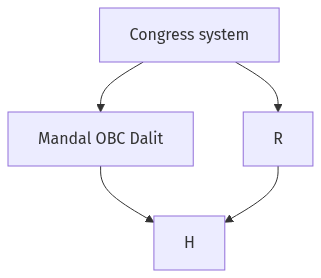
Conclusion
- Mobilisation still sits on caste, region and religion. What changed is the ranking: OBC and Hindu-majoritarian frames rose, Congress catch-all fell, and welfare media now glue coalitions that land reform once promised to.
Quick related
Students also ask
-
Education is a key to social development. Elucidate
Next question on this syllabus topic (2024 · Q3(c)). View answer →
-
Has class replaced caste in politics?
No. Farmer and labour protests exist, but electoral blocs are still largely caste-religious-regional.
-
Did 70 years secularise mobilisation?
Institutions secularised the vote. Campaigns often re-sacralised community. Both trends are real.
Same topic · past papers
UPSC has asked this before
These previous-year questions sit on the same topic. Open one to practise the earlier ask.
-
2023 · Q5(d) · Sociology GS 2 · 10 marks
Analyse the sociological interconnections between Social Media and Mass Mobilization in India -
2023 · Q7(a) · Sociology GS 2 · 20 marks
Do you think that the decades of Dalit political mobilizations and movements have helped in strengthening India's democracy? Substantiate your arguments with facts
More from this topic
Q4(a) · UPSC Mains 2026 · Sociology GS 2 · 20 marks · Solution
How does the Constitution of India promote education? Do you think that education can be a major instrument of social change? Clarify
Visions of Social Change in India
• Article 21A (added by the 86th Amendment, 2002) makes elementary education a fundamental right for children aged 6 to 14. • Originally, free and compulsory education for children was placed under DPSP Article 45. • Articles 15(5) and 46 provide protective discrimination and special educational provisions for SCs, STs, and backward classes. • Education acts as an instrument of social change by enabling upward mobility and breaking caste-based occupational rigidities. • Schooling empowers women, challenges patriarchal norms, and boosts female workforce participation. • Critical pedagogy fosters democratic participation, civic awareness, and constitutional morality. • Commercialization and unequal standards create a dual education system that reinforces class divides. • Marginalized groups still face systemic dropouts due to poverty, poor infrastructure, and institutional discrimination.
Q6(c) · UPSC Mains 2024 · Sociology GS 2 · 10 marks · Solution
Critically examine the relevance of development planning in India
Visions of Social Change in India
Planning meant Five-Year Plans, public investment and a mixed economy. It built industry and science and left caste-agrarian power under-attacked. Desai read it as bourgeois-state planning. NITI Aayog replaced the Commission but missions and state plans continue. Climate, health and equity still require democratic planning, not only markets.
Q3(c) · UPSC Mains 2024 · Sociology GS 2 · 10 marks · Solution
Education is a key to social development. Elucidate
Visions of Social Change in India
Social development is more than GDP; education is a main public lever for capabilities. Ambedkar treated schooling as anti-caste equipment. NEP 2020 recasts foundational learning and language policy as development tools. Bourdieu’s cultural capital and India’s dual school system show reproduction of inequality. Education works as a key when joined to work, health and anti-discrimination.