
Revision summary
Slums are insecure dense settlements tied to urban labour, not only to poverty as a personal trait. Mill and port cities produced classic industrial slums such as parts of Mumbai. Service and construction urbanisation produces slums without a factory core. Caste, tenure politics and eviction cycles shape Indian slums. They manifest growth under informality more than a simple planning failure.
Model answer
Copper italics in this answer — like this — are the key facts. Each one is unpacked in the Facts & figures rail.
Introduction
Slums are dense settlements with insecure tenure, poor water and sanitation, and a close mix of living and earning. In India they are not an accident at the edge of growth. They are how urbanisation with thin formal housing and informal labour actually looks. Industrialisation is part of the story, not the whole story.
Body
Industrialisation and the mill city
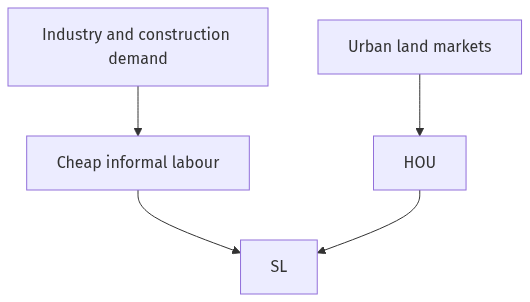
Dharavi beside Mumbai’s old industrial and now service economy, mill lands, and port work is the classic picture: labour needed by the city cannot afford formal shelter, so it builds self-housing on residual land. Jamshedpur’s planned core and its labour bustees, Kanpur’s old mill neighbourhoods, and garment pockets in NCR show the same. Industry wants cheap labour at the gate; it does not build enough quarters.
Urbanisation beyond the factory
India urbanises through construction, services and census-town sprawl. Slums and informal colonies appear around those jobs too: domestic workers near elite housing, construction workers on sites, waste workers near dumps. Mike Davis-style planetary slum arguments fit only if we keep Indian specificity: caste clusters inside slums, political patronage of votes, and periodic eviction for ‘world-class’ projects.
Are slums manifestations of industrialisation and urbanisation? Yes, as the housing form of a labour regime that urbanises without a corresponding right to the city. Not only, because rural landlessness, partition-era camps, and failure of public housing also feed them. Slums are the urban face of informality, which industrialisation and urbanisation in India have jointly expanded.
Clearance without work and tenure just shifts the slum. In-situ upgrading and the political organisation of slum dwellers (Mumbai, Ahmedabad) show they are also a social world, not only a planning disease.
Flow diagram
Conclusion
Slums in India manifest industrial and urban growth that needs cheap labour and does not provide secure housing. They also manifest caste, patronage and public-housing failure. Treating them as the city’s outside misses that they are how the Indian city is made.
Quick related
Students also ask
-
Analyse the sociological interconnections between Social Media and Mass Mobilization in India
Next question on this syllabus topic (2023 · Q5(d)). View answer →
-
Would more factories end slums?
Not if wages and public housing stay low. Formal industry in India often still sits beside bustees.
-
Are all poor urban neighbourhoods slums?
No. Some are authorised poor housing. Slum names insecure tenure and missing services.
Same topic · past papers
UPSC has asked this before
These previous-year questions sit on the same topic. Open one to practise the earlier ask.
-
2026 · Q7(a) · Sociology GS 2 · 20 marks
Urbanisation in Independent India has been characterized by over-urbanization and rural push. Explain with demographic and sociological dimensions
More from this topic
Q7(c) · UPSC Mains 2026 · Sociology GS 2 · 10 marks · Solution
Examine the process of formalisation of informal sector to safeguard the interests of marginalised sections of the society
Industrialization and Urbanisation in India
• **Core Objective:** Formalising India's vast informal workforce integrates vulnerable groups into legal and institutional frameworks to secure their rights. • **Digital Tracking:** The e-Shram portal creates national databases and assigns Unique Account Numbers (UAN) to make unorganized workers visible for welfare delivery. • **Welfare Delivery:** Registration streamlines access to accident insurance, PM-SYM pensions, and direct benefit transfers. • **Wage Reforms:** Consolidating labour laws introduces universal statutory minimum wages and mandates formal appointment letters. • **Safety Standards:** New codes aim to improve occupational health and reduce the workplace exploitation of marginalised communities. • **Implementation Hurdles:** High compliance costs push micro-enterprises to stay informal, limiting the reach of safety nets. • **Social Realities:** Deep-rooted caste and class vulnerabilities among SC, ST, and OBC workers require more than just administrative registration to resolve.
Q6(b) · UPSC Mains 2025 · Sociology GS 2 · 20 marks · Solution
Discuss the trend of urbanization in India. Do you think that Industrialization is the only precondition of urbanization? Give you arguments
Industrialization and Urbanisation in India
India’s urbanisation is rising but remains metro-concentrated and full of census towns and slums. Kundu’s exclusionary urbanisation captures labour demand without inclusive housing. Tertiary growth, administrative history, transport and agrarian distress urbanise besides factories. Industrial belts exist and matter; they do not exhaust the trend. Policy that waits only for industry misses actually existing urban India.
Q5(e) · UPSC Mains 2025 · Sociology GS 2 · 10 marks · Solution
Do you think that law has been able to abolish child labour in India? Comment.
Industrialization and Urbanisation in India
The 1986 Act as amended in 2016 bans most child work under 14 but allows family-enterprise help. RTE adds a schooling right that is unevenly realised. Child labour persists in agriculture, kilns, domestic and home-based informal work. Poverty, caste occupations and weak inspection explain the gap between statute and practice. Law delegitimised the practice more than it abolished it.