
Revision summary
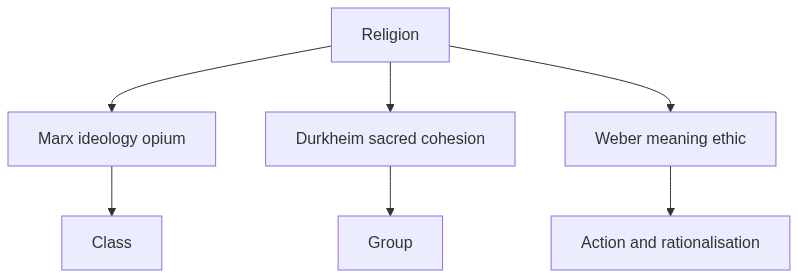
Marx treats religion as ideological consolation and mystification in class society. Durkheim treats religion as the sacred form of social solidarity and classification. Weber treats religion as meaningful ethic that can steer economic and political action. Differences follow the questions of critique, function and interpretation. Marx expects unmasking; Durkheim expects the sacred to migrate; Weber traces disenchantment. Do not flatten the three into a single sentence about the importance of faith.
Model answer
Copper italics in this answer — like this — are the key facts. Each one is unpacked in the Facts & figures rail.
Introduction
Karl Marx, Max Weber and Emile Durkheim all took religion seriously, and they took it as a social fact, not as a matter of private taste. They did not ask the same question. Marx asked whose power religion conceals. Durkheim asked how religion makes a society possible. Weber asked how religious meanings steer action and, sometimes, economic history. The differences are the syllabus point.
Body
Three theories
For Marx, religion is part of the superstructure. In a class society it offers consolation and inverted consciousness: the opium of the people soothes suffering that is produced by exploitation, and it can bless the earthly order as divine. Critique of heaven is therefore a step toward critique of earth. Religion is not the root of oppression, but it often mystifies the root.
Durkheim, in The Elementary Forms of Religious Life, studied Australian totemism to find the elementary: the sacred set apart from the profane, and the rite in which the group experiences collective effervescence. God is society transfigured. Religion’s function is to bind and to classify, to make moral community. Even in secular dress, national ceremonies can be religious in this sociological sense.
Weber began from meaning. People need a theodicy of fortune and suffering. The Protestant ethic essay linked inner-worldly asceticism to the spirit of capitalism, without saying that religion was only a mask for class. He compared prophets, priests, virtuosi and masses, and he traced disenchantment as rationalisation drains magical gardens. Religion can be a switchman of history, directing the tracks that material interests also lay.
How they differ
- Marx is critical and historical-materialist: look through belief to production. Durkheim is functional and morphological: look at rite and belonging. Weber is comparative and interpretative: look at ethic, organisation and unintended consequence. Durkheim downplays inner faith as sociology’s object; Weber requires it. Marx expects religion to fade with emancipation; Durkheim expects the sacred to migrate; Weber expects a tension between vocation, bureaucracy and leftover charisma. Indian illustrations can be used lightly: a temple festival as Durkheimian solidarity, a reformist ethic as Weberian, and a landlord’s dharma as Marxist ideology—provided the theories stay distinct and are not mashed into “all three said religion is important.”
Flow diagram
Conclusion
- Marx, Durkheim and Weber differ in the question they put to religion: ideology, cohesion, or meaningful action. A good comparison keeps those questions apart and then notes that a living religious field can carry all three processes at once without making the theories identical.
Quick related
Students also ask
-
How do 'Civil Society Organizations' such as 'NGOs' and 'Self-Help Groups' contribute to grassroot level social changes? Discuss
Next question on this syllabus topic (2025 · Q8(b)). View answer →
-
Did Durkheim deny that individuals believe?
No. He argued that the sociologically elementary object is the collective rite and the sacred, not private dogma.
-
Is Weber closer to Marx or to Durkheim?
He shares Marx’s interest in history and economy, and Durkheim’s refusal to reduce religion to error, while remaining interpretative and comparative.
Same topic · past papers
UPSC has asked this before
These previous-year questions sit on the same topic. Open one to practise the earlier ask.
-
2023 · Q6(b) · Sociology GS 1 · 20 marks
Explain Max Weber's theory of social stratification. How does Weber's idea of class differ from that of Marx? -
2023 · Q2(a) · Sociology GS 1 · 20 marks
What, according to Robert Michels, is the iron law of oligarchy? Do lions folly and foxes in Vilfredo Pareto's theory, essentially differ from each other? Substantiate -
2015 · Q6(c) · Sociology GS 1 · 15 marks
How do the rules of descent and alliance in kinship differ from each other? Illustrate.
More from this topic
Q7(c) · UPSC Mains 2026 · Sociology GS 1 · 10 marks · Solution
Compare the social organisation of work in industrial capitalism and platform capitalism
Sociological Thinkers: Karl Marx
• **Setting:** Industrial capitalism centres work in physical factories; platform capitalism disperses it via digital apps. • **Control:** Factories use direct managerial supervision and time-discipline; platforms use invisible algorithms and automated ratings. • **Contracts:** Industrial work relies on standard, secure employment with welfare benefits; platform work relies on gig contracts and independent contractors. • **Risk:** Factories shoulder capital costs; platform capitalism shifts risks and equipment costs onto individual workers. • **Solidarity:** Shared factory spaces foster collective class consciousness; digital isolation creates an atomised "precariat." • **Surplus Value:** Both systems extract surplus value, but platforms obscure exploitation behind the illusion of entrepreneurial freedom.
Q5(d) · UPSC Mains 2026 · Sociology GS 1 · 10 marks · Solution
How does Max Weber's 'theory of authority' shape bureaucracy? Analyse.
Sociological Thinkers: Karl Marx
Max Weber's sociological framework links different forms of legitimate domination directly to the rise of modern rational-legal bureaucracy. Traditional and charismatic authority provide historical context, but rational-legal authority creates the impersonal rules, hierarchy, and technical expertise defining bureaucratic structures. While ensuring efficiency, this iron cage of rationalisation also poses risks of alienation and goal displacement, which later thinkers critiqued.
Q3(c) · UPSC Mains 2026 · Sociology GS 1 · 10 marks · Solution
How does Emile Durkheim conceptualize religion as a 'social fact'? Explain
Sociological Thinkers: Karl Marx
Emile Durkheim treats religion as a quintessential social fact in 'The Elementary Forms of the Religious Life' (1912). Moving away from supernatural or animistic definitions, he argues that religion is fundamentally a collective product. Society objectifies its own moral authority and solidarity through sacred symbols and rituals. By separating the sacred from the profane, religious practices reinforce social integration and collective consciousness. Thus, religion is society worshipping itself, operating as an external and coercive constraint upon individual thought and action.