
Revision summary
NGOs and SHGs are civil society forms between family, market and state. They contribute through services, rights mobilisation, thrift, credit and women’s public voice. SEWA, Kudumbashree and SHG-bank linkage are standard Indian illustrations. Social capital and capabilities names for the gain. NGOisation, donor dependence and microcredit capture are the critical limits. Grassroots change holds when members remain political subjects, not only project targets.
Model answer
Copper italics in this answer — like this — are the key facts. Each one is unpacked in the Facts & figures rail.
Introduction
Civil society organisations sit between household, market and state. Non-governmental organisations and self-help groups are two familiar forms in development practice. They claim to work at the grassroots: the hamlet, the slum, the women’s meeting under a tree. The sociological question is how they actually produce social change, and for whom.
Body
How they contribute
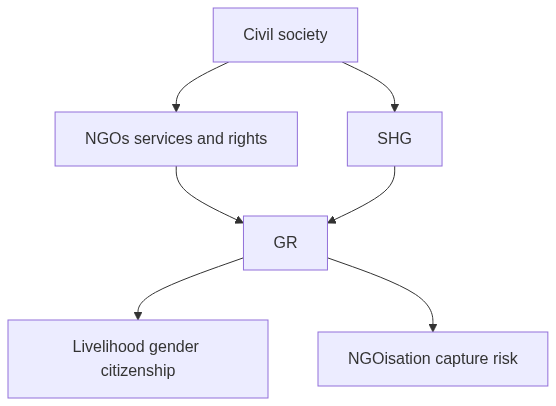
NGOs may deliver services the state undersupplies—health camps, legal aid, watershed works—or they may mobilise rights, as in campaigns for information, forest rights or disability. They translate local trouble into files, courts and media. Antonio Gramsci’s civil society is a field of hegemony as well as resistance; Tocqueville’s associations train citizens. SHGs, especially women’s groups linked to banks after NABARD’s programme, create small credit, thrift and a public female voice in villages where the panchayat was a male space. Kerala’s Kudumbashree and SEWA’s organising of informal women workers show that livelihood and citizenship can move together. Sanitation, immunisation and school attendance campaigns often run through such groups. At their best they thicken social capital in Coleman’s sense and expand capabilities in Sen’s sense.
Grassroots change is not automatic
Critics of NGOisation argue that donor-funded organisations can depoliticise struggle, professionalise leaders, and substitute project cycles for movements. Sangeeta Kamat and others described this risk. SHGs can become instruments of microfinance extraction, or of party and caste capture, rather than sisterhood. Men may take the loan while women carry the liability. NGOs may bypass panchayats and weaken already thin local democracy, or they may train panchayat women. Scale is limited: a successful cluster does not equal agrarian reform. The state may outsource its duties and then blame civil society for gaps.
Contribution is therefore conditional. NGOs and SHGs change grassroots life when they organise voice and resources without replacing politics, and when the poor remain members rather than beneficiaries on a list. They fail when they become a parallel bureaucracy of projects. Indian illustrations should keep both the SEWA and Kudumbashree yield and the microcredit caution. Change is grassroots only if local people can refuse a project and still have a public voice.
Flow diagram
Conclusion
NGOs and SHGs can shift credit, care, rights and women’s public presence at the grassroots. They are not a substitute for a capable, accountable state or for redistribution. Civil society contributes to change when it organises people, not when it only delivers a scheme.
Quick related
Students also ask
-
What are the 'basic and irreducible' functions of the family as proposed by Talcott Parsons? Explain.
Next question on this syllabus topic (2024 · Q1(e)). View answer →
-
Are SHGs the same as NGOs?
No. SHGs are usually small membership groups. NGOs are often registered agencies that may promote SHGs.
-
Can they replace the panchayat?
They should not. Healthy contribution is to make local government more reachable, not to become a parallel patron.
Same topic · past papers
UPSC has asked this before
These previous-year questions sit on the same topic. Open one to practise the earlier ask.
-
2022 · Q4(b) · Sociology GS 1 · 15 marks
Social stratification is claimed to contribute to maintenance of social order and stability in society. Critically assess.
More from this topic
Q7(c) · UPSC Mains 2026 · Sociology GS 1 · 10 marks · Solution
Compare the social organisation of work in industrial capitalism and platform capitalism
Sociological Thinkers: Karl Marx
• **Setting:** Industrial capitalism centres work in physical factories; platform capitalism disperses it via digital apps. • **Control:** Factories use direct managerial supervision and time-discipline; platforms use invisible algorithms and automated ratings. • **Contracts:** Industrial work relies on standard, secure employment with welfare benefits; platform work relies on gig contracts and independent contractors. • **Risk:** Factories shoulder capital costs; platform capitalism shifts risks and equipment costs onto individual workers. • **Solidarity:** Shared factory spaces foster collective class consciousness; digital isolation creates an atomised "precariat." • **Surplus Value:** Both systems extract surplus value, but platforms obscure exploitation behind the illusion of entrepreneurial freedom.
Q5(d) · UPSC Mains 2026 · Sociology GS 1 · 10 marks · Solution
How does Max Weber's 'theory of authority' shape bureaucracy? Analyse.
Sociological Thinkers: Karl Marx
Max Weber's sociological framework links different forms of legitimate domination directly to the rise of modern rational-legal bureaucracy. Traditional and charismatic authority provide historical context, but rational-legal authority creates the impersonal rules, hierarchy, and technical expertise defining bureaucratic structures. While ensuring efficiency, this iron cage of rationalisation also poses risks of alienation and goal displacement, which later thinkers critiqued.
Q3(c) · UPSC Mains 2026 · Sociology GS 1 · 10 marks · Solution
How does Emile Durkheim conceptualize religion as a 'social fact'? Explain
Sociological Thinkers: Karl Marx
Emile Durkheim treats religion as a quintessential social fact in 'The Elementary Forms of the Religious Life' (1912). Moving away from supernatural or animistic definitions, he argues that religion is fundamentally a collective product. Society objectifies its own moral authority and solidarity through sacred symbols and rituals. By separating the sacred from the profane, religious practices reinforce social integration and collective consciousness. Thus, religion is society worshipping itself, operating as an external and coercive constraint upon individual thought and action.