
Revision summary
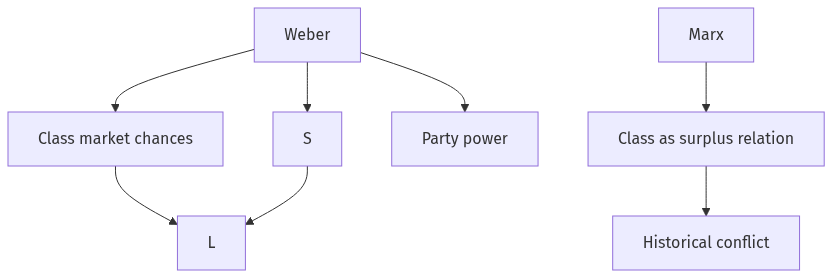
Weber stratifies through class, status, and party as distinct orders. Class for Weber is market situation and life chances, not automatic community. Marx defines class by ownership and surplus extraction in a mode of production. The difference is market chance versus exploitative relation, and many motors versus one historical motor. Caste in India is status with class effects and party organisation. Both maps are required.
Model answer
Copper italics in this answer — like this — are the key facts. Each one is unpacked in the Facts & figures rail.
Introduction
- Max Weber treated social stratification as three distinct but interacting orders: class, status, and party. Karl Marx treated class as the primary relation to surplus in a mode of production. Weber’s class is a market situation. Marx’s class is a relation of exploitation. That is the core difference.
Body
Weber’s three orders
- Class is a set of people in the same class situation, meaning typical chances in the market for goods, services, and income.
- Property class, commercial class, and social class are his finer distinctions. A class need not be a community that acts.
- Status is a claim to social honour, often shown in style of life, marriage closure, and ritual rank. Caste is a status order in this sense.
- Party is an association for the acquisition of power, in a state or in any organised group.
- The three can align, as when property, honour, and office sit together, or they can cut across, as when a wealthy group lacks honour.
How class works in Weber
- Class situation is determined by market position: owner or not, skill, and credit.
- Class action is possible but not automatic. A common situation does not by itself produce a class for itself.
- This is closer to a map of life chances than to a theory of historical stages.
How Marx’s class differs
- For Marx, class is defined by relation to the means of production and by the extraction of surplus value, not by income bands in a market.
- The bourgeoisie and the proletariat are polar classes of capitalism, with middle strata that the dynamic tends to press.
- Class is inherently antagonistic. Consciousness and party arise from that antagonism, even if ideology delays it.
- Historical materialism makes class the motor of epochal change. Weber refuses a single motor.
Consequences of the difference
- Weber can place caste, race, and education as status without reducing them to a mask of class, though class still organises many life chances.
- Marx can show why market equality of contract hides unpaid surplus in the working day, which Braverman later specified in the labour process.
- Indian stratification needs both: property and informal labour as class, jati and honour as status, and caste associations as party.
Limits
- Weber multiplies dimensions and can lose the unity of exploitation.
- Marx can under-specify status honour that organises votes and marriage against economic interest.
- A working account uses Marx for surplus and Weber for the cross-cutting of honour and organisation.
Flow diagram
Conclusion
Weber’s stratification is class as market chance, status as honour, and party as power organisation. Marx’s class is a relation of surplus in production and the motor of historical conflict. Weber’s class therefore differs as a life-chance category that need not act. Marx’s class differs as an antagonistic production relation that tends toward conflict. Indian caste and class are unreadable from one side alone.
Quick related
Students also ask
-
Critically examine how Durkheim and Merton explicate Anomie.
Next question on this syllabus topic (2022 · Q3(b)). View answer →
-
Did Weber deny class conflict?
No. He denied that class is the only order and that a common market situation always produces a community of struggle.
-
Is caste only status?
It is primarily a status order in Weber’s terms. It also distributes land, labour, and party power, which Marx helps to read.
Same topic · past papers
UPSC has asked this before
These previous-year questions sit on the same topic. Open one to practise the earlier ask.
-
2025 · Q7(b) · Sociology GS 1 · 20 marks
How do theories of Marx, Weber and Durkheim differ in understanding religion? Explain -
2023 · Q2(a) · Sociology GS 1 · 20 marks
What, according to Robert Michels, is the iron law of oligarchy? Do lions folly and foxes in Vilfredo Pareto's theory, essentially differ from each other? Substantiate -
2015 · Q6(c) · Sociology GS 1 · 15 marks
How do the rules of descent and alliance in kinship differ from each other? Illustrate. -
2022 · Q4(b) · Sociology GS 1 · 15 marks
Social stratification is claimed to contribute to maintenance of social order and stability in society. Critically assess. -
2019 · Q4(b) · Sociology GS 1 · 20 marks
Compare and Contrast the contributions of Marx and Weber on social stratification in capitalist society
More from this topic
Q7(c) · UPSC Mains 2026 · Sociology GS 1 · 10 marks · Solution
Compare the social organisation of work in industrial capitalism and platform capitalism
Sociological Thinkers: Karl Marx
• **Setting:** Industrial capitalism centres work in physical factories; platform capitalism disperses it via digital apps. • **Control:** Factories use direct managerial supervision and time-discipline; platforms use invisible algorithms and automated ratings. • **Contracts:** Industrial work relies on standard, secure employment with welfare benefits; platform work relies on gig contracts and independent contractors. • **Risk:** Factories shoulder capital costs; platform capitalism shifts risks and equipment costs onto individual workers. • **Solidarity:** Shared factory spaces foster collective class consciousness; digital isolation creates an atomised "precariat." • **Surplus Value:** Both systems extract surplus value, but platforms obscure exploitation behind the illusion of entrepreneurial freedom.
Q5(d) · UPSC Mains 2026 · Sociology GS 1 · 10 marks · Solution
How does Max Weber's 'theory of authority' shape bureaucracy? Analyse.
Sociological Thinkers: Karl Marx
Max Weber's sociological framework links different forms of legitimate domination directly to the rise of modern rational-legal bureaucracy. Traditional and charismatic authority provide historical context, but rational-legal authority creates the impersonal rules, hierarchy, and technical expertise defining bureaucratic structures. While ensuring efficiency, this iron cage of rationalisation also poses risks of alienation and goal displacement, which later thinkers critiqued.
Q3(c) · UPSC Mains 2026 · Sociology GS 1 · 10 marks · Solution
How does Emile Durkheim conceptualize religion as a 'social fact'? Explain
Sociological Thinkers: Karl Marx
Emile Durkheim treats religion as a quintessential social fact in 'The Elementary Forms of the Religious Life' (1912). Moving away from supernatural or animistic definitions, he argues that religion is fundamentally a collective product. Society objectifies its own moral authority and solidarity through sacred symbols and rituals. By separating the sacred from the profane, religious practices reinforce social integration and collective consciousness. Thus, religion is society worshipping itself, operating as an external and coercive constraint upon individual thought and action.