
Revision summary
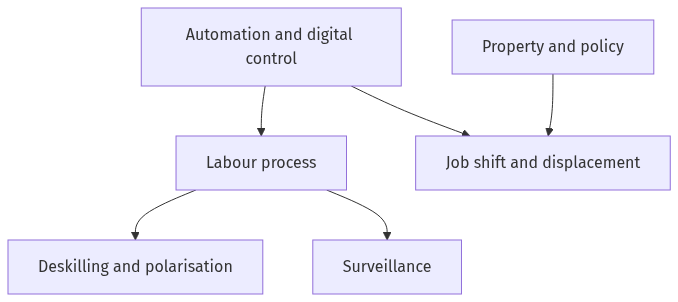
Marx treated machinery as part of the struggle over skill and the working day. Braverman described deskilling and the split between conception and execution. Automation can raise safety and productivity while polarising employment. Surveillance and algorithmic allocation change the nature of remaining jobs. Job creation in new sectors coexists with displacement in routine work. Outcomes depend on ownership, policy and bargaining, not on technology alone.
Model answer
Copper italics in this answer — like this — are the key facts. Each one is unpacked in the Facts & figures rail.
Introduction
Technological advancement and automation change how work is done and who is employed to do it. Machines, software and now algorithms take over tasks that human labour once performed. Karl Marx already saw machinery as a weapon in the struggle over the working day and skill. A critical assessment must look at the nature of work, not only at a headline count of jobs lost or created.
Body
Changes in the nature of work
Automation can raise productivity and cut dangerous toil. It can also strip skill from the craft worker and place control with engineers and managers. Harry Braverman argued that scientific management and machinery deepen the separation of conception from execution. The worker becomes a watcher of a process designed elsewhere. Digital automation extends this to offices, warehouses and platforms. Call-centre scripts, barcode picking and ride-allocation are automated labour processes. Shoshana Zuboff and later writers on surveillance describe monitoring of keystrokes and location. The nature of employment shifts toward polarisation in many economies: some high-skill design jobs, many low-skill service jobs, and a squeezed middle of routine clerical and factory posts. Joseph Schumpeter’s creative destruction captures the churn of firms and occupations. It does not by itself tell us who bears the destruction.
Employment and a critical view
Optimistic accounts say that new technology creates new sectors, as the green revolution, IT services and logistics did in India. NASSCOM-era software work and platform delivery both exist because of technical change. Pessimistic accounts stress displacement of textile workers, clerical staff and, in the future, drivers. Both can be true in different segments. The critical sociological point is distribution. Those who own the machines and the data capture surplus. Those whose skills are coded into software lose bargaining power. Women in routine office work and in some manufacturing lines are often more exposed to replacement. Informal workers may not be replaced by robots so much as tied to them, as in warehouses that combine cheap labour with scanning systems.
Indian public debate on Industry 4.0, electric vehicles and artificial intelligence often repeats a skill-gap story. Skill matters. Without social security, unions and industrial policy, reskilling talk can become a way of blaming the displaced. Marx’s machinery chapter still helps: technology is not a neutral spirit. It is introduced under definite property relations. Automation can shorten necessary labour. Under present relations it often lengthens control and fragments employment into contracts and gigs.
A critical assessment therefore grants gains in productivity and safety, and then asks about deskilling, surveillance, inequality and the missing link to decent employment.
Employment quality, not only employment counts
A warehouse that adds scanning and robots may keep a large staff on short contracts. The job count looks stable while the nature of work becomes paced by software. An IT firm may hire fewer routine testers and more prompt engineers. The net national employment effect can hide a sharp local loss. Public policy that only counts vacancies will miss this. Vocational training helps only if there are employers who hire on decent terms. Automation under public ownership and strong unions has a different sociology from automation in a weakly regulated platform firm. The critical task is to name those relations each time the machine is praised.
Flow diagram
Conclusion
Technological advancement and automation reshape skill, control and the mix of jobs. They can reduce drudgery and they can deepen precarity. The outcome depends on who owns the technology and how the state and labour can bargain. A critical view studies those relations, not the machine in isolation.
Quick related
Students also ask
-
Explain G.H. Mead's idea of development of 'self' through the 'generalised other'.
Next question on this syllabus topic (2024 · Q5(b)). View answer →
-
Does automation always reduce total employment?
Historically it has shifted employment more than it has ended work. The social question is the quality, security and distribution of the remaining jobs.
-
Is Industry 4.0 only a factory story?
No. Software, logistics and services are being automated too, which matters for India’s large clerical and platform workforce.
Same topic · past papers
UPSC has asked this before
These previous-year questions sit on the same topic. Open one to practise the earlier ask.
-
2023 · Q7(a) · Sociology GS 1 · 20 marks
Explain how economic globalization has brought changes in the patterns of employment in the 21st century -
2025 · Q6(b) · Sociology GS 1 · 20 marks
What do you understand by gender-based domestic division of labour? Is it undergoing a change in the wake of increasing participation of women in formal employment? Clarify your answer with illustrations
More from this topic
Q8(c) · UPSC Mains 2026 · Sociology GS 1 · 10 marks · Solution
Discuss the significance and limitations of 'intersectionality' in social research
Sociology
Intersectionality, coined by Kimberlé Crenshaw, examines how overlapping identities like race, class, and gender shape systemic oppression. Its significance in social research lies in capturing lived realities beyond single-axis frameworks and preventing reductive generalisations. However, limitations include methodological complexity, risks of infinite regress, and difficulties in operationalising fluid categories. Effective application requires balancing structural macro-analysis with micro-level lived experiences.
Q6(b) · UPSC Mains 2026 · Sociology GS 1 · 20 marks · Solution
Critically analyse the nature-nurture debate from different perspectives
Sociology
1. The nature-nurture debate explores whether biology or society primarily shapes human behavior
Q6(a) · UPSC Mains 2026 · Sociology GS 1 · 20 marks · Solution
Discuss the intellectual origins of sociology and its evolution as a distinct field of study
Sociology
Sociology arose in 19th-century Western Europe to make sense of massive upheavals caused by the Industrial and French Revolutions. Enlightenment thinkers laid the groundwork by championing reason, empirical observation, and human agency over traditional dogma. Auguste Comte gave the discipline its name, pushing for a positivist "physics of society" based on scientific laws. Émile Durkheim secured its academic legitimacy by defining "social facts" and using empirical methods to study human behavior. Max Weber introduced interpretive sociology, while Karl Marx focused on material conditions and class struggle. In the 20th century, Talcott Parsons advanced structural-functionalism to study systemic equilibrium. Later, conflict theories, the Frankfurt School, and postmodern critiques broadened the field to address power and marginalisation. Today, sociology continues to evolve by analyzing globalisation, digital shifts, and modern identity politics.