
Revision summary
Mead’s self arises in interaction through language and role-taking. The Me is internalised attitudes of others; the I is the spontaneous reply. Play takes one role at a time; the game takes an organised set of roles. The generalised other is the community’s organised attitude in the person. Moral self-control depends on seeing one’s act from that group standpoint. Multiple communities can give a person more than one generalised other.
Model answer
Copper italics in this answer — like this — are the key facts. Each one is unpacked in the Facts & figures rail.
Introduction
George Herbert Mead argued that the self is not a thing one is born with. It arises in social interaction through language and role-taking. The child first meets significant others, then learns to take the attitude of a whole community. That organised attitude is the generalised other. Through it the person can become an object to herself and can act with a social self.
Body
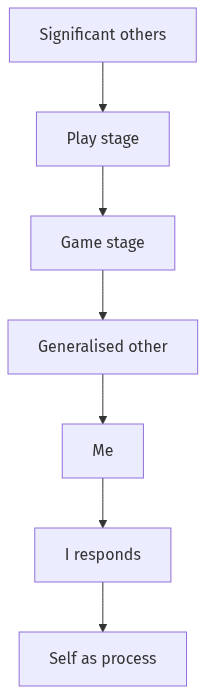
Self as process: I, Me, play and game
Mead distinguished the I and the Me. The Me is the organised set of attitudes of others that one has taken in. The I is the spontaneous response to that Me. The self is the conversation of the two. Charles Horton Cooley’s looking-glass self sits nearby: we imagine how we appear to others. Mead made the mechanism more precise through gestures and significant symbols, especially language.
In the play stage the child takes the role of particular others, one at a time: parent, teacher, hero. In the game stage the child must take several roles at once, as in a team sport where each position answers the others. Only then does a fully social self become possible. Herbert Blumer later named this family of ideas symbolic interactionism.
The generalised other
The generalised other is the community’s organised attitudes as they live in the person. It is not one neighbour. It is the rules of the game, the law, the school, the caste public, or the nation as the child comes to feel them. When a person asks “what would people say?”, the generalised other is at work. Moral responsibility, for Mead, depends on this ability to take the group’s standpoint toward one’s own act. The self is therefore developed from the outside in, through communication, and then becomes a source of inner control.
Indian socialisation studies can use this idea without copying Chicago. A child learns the Me of family honour, school discipline and, later, a professional code. Conflict among several generalised others, such as village caste and city workplace, is a Meadian problem of modern selfhood. Erving Goffman’s later dramaturgy shows performance; Mead remains the account of how the self is formed so that performance is possible.
Flow diagram
Conclusion
Mead’s self develops through role-taking, from particular others in play to the organised community in the game. The generalised other is that community attitude internalised. The person becomes a self by learning to look at herself as the group looks at her.
Quick related
Students also ask
-
Discuss the concept of animism and differentiate it from naturism
Next question on this syllabus topic (2024 · Q6(c)). View answer →
-
Is the generalised other the same as Freud’s superego?
They both name inner control. Mead’s version is built from communication and role-taking, not from a drive theory of the same kind.
-
Does Mead deny individuality?
No. The I is the novel response. Individuality is social in origin, not absent.
Same topic · past papers
UPSC has asked this before
These previous-year questions sit on the same topic. Open one to practise the earlier ask.
-
2022 · Q3(c) · Sociology GS 1 · 15 marks
Suggest measures to minimize the influence of the researchers in process of collecting data through focus group discussion. -
2021 · Q1(c) · Sociology GS 1 · 10 marks
Discuss the challenges involved in collecting data through census method -
2016 · Q6(b) · Sociology GS 1 · 15 marks
"Social change can be brought about through development." Illustrate. from the contemporary situation of India. -
2025 · Q8(b) · Sociology GS 1 · 20 marks
How do 'Civil Society Organizations' such as 'NGOs' and 'Self-Help Groups' contribute to grassroot level social changes? Discuss -
2022 · Q6(a) · Sociology GS 1 · 20 marks
According to Mead the idea of self develops when the individual becomes self-conscious.Explain.
More from this topic
Q8(c) · UPSC Mains 2026 · Sociology GS 1 · 10 marks · Solution
Discuss the significance and limitations of 'intersectionality' in social research
Sociology
Intersectionality, coined by Kimberlé Crenshaw, examines how overlapping identities like race, class, and gender shape systemic oppression. Its significance in social research lies in capturing lived realities beyond single-axis frameworks and preventing reductive generalisations. However, limitations include methodological complexity, risks of infinite regress, and difficulties in operationalising fluid categories. Effective application requires balancing structural macro-analysis with micro-level lived experiences.
Q6(b) · UPSC Mains 2026 · Sociology GS 1 · 20 marks · Solution
Critically analyse the nature-nurture debate from different perspectives
Sociology
1. The nature-nurture debate explores whether biology or society primarily shapes human behavior
Q6(a) · UPSC Mains 2026 · Sociology GS 1 · 20 marks · Solution
Discuss the intellectual origins of sociology and its evolution as a distinct field of study
Sociology
Sociology arose in 19th-century Western Europe to make sense of massive upheavals caused by the Industrial and French Revolutions. Enlightenment thinkers laid the groundwork by championing reason, empirical observation, and human agency over traditional dogma. Auguste Comte gave the discipline its name, pushing for a positivist "physics of society" based on scientific laws. Émile Durkheim secured its academic legitimacy by defining "social facts" and using empirical methods to study human behavior. Max Weber introduced interpretive sociology, while Karl Marx focused on material conditions and class struggle. In the 20th century, Talcott Parsons advanced structural-functionalism to study systemic equilibrium. Later, conflict theories, the Frankfurt School, and postmodern critiques broadened the field to address power and marginalisation. Today, sociology continues to evolve by analyzing globalisation, digital shifts, and modern identity politics.