
Revision summary
Taylorism is scientific management: timed tasks, planning separated from doing, incentive pay. Merits are higher measured output, faster training, and plant predictability. Demerits are deskilling, bodily wear, speed-up conflict, and neglect of informal groups. Braverman and Marx read it as expropriation of skill and alienation of the labour process. Apps and warehouses extend the same logic without always keeping the old industrial wage.
Model answer
Copper italics in this answer — like this — are the key facts. Each one is unpacked in the Facts & figures rail.
Introduction
- Taylorism is scientific management as stated by Frederick Winslow Taylor: the breaking of work into timed tasks, the separation of planning from doing, and the use of incentive pay to enforce the one best way. It reorganised the factory in the early twentieth century and still organises warehouses, call centres, and apps. Merits and demerits belong to productivity and to the worker’s skill and body.
Body
What it is
- Time and motion study measures each element of a job and sets a standard time.
- Management gathers the craftsman’s knowledge into rules, which Harry Braverman later called the expropriation of skill.
- A planning office tells the shop floor what to do. The worker executes.
- Differential piece rates reward meeting the standard and punish falling short.
- Henry Ford’s assembly line was a related mass-production form, not identical in every detail, but joined in public talk as Fordism.
Merits
- Output per worker rose in many machine shops, which cut unit cost and cheapened some goods.
- Training time for a narrow task fell, which allowed rapid expansion of industrial employment.
- Managerial control made large plants predictable for owners and for some states that wanted standardised munitions and public works.
- Safety rules and rest pauses could be written once tasks were visible, though they were often ignored.
- Later operations research and today’s algorithmic scheduling still use the same logic of measured time.
Demerits
- Deskilling reduces the worker to a timed motion, which Marx had already analysed as alienation from the labour process.
- The body wears out through repetition. Fatigue and injury are regular, not accidental.
- Conflict rises when the standard is used as a speed-up. Strikes against the stopwatch were part of early labour history.
- The Hawthorne studies showed that informal groups and meaning still shape output, which Taylor’s isolated individual missed.
- Gender and caste can be built into who gets the timed cheap job and who gets the planning office.
- In the twenty-first century, gig apps revive Taylorism without the stable wage of the classic plant.
Analysis
- Merit is control and measurable productivity for capital and for some cheap consumer goods.
- Demerit is the degradation of work, health cost, and the fiction that the worker is a machine without a group or a politics.
- Weber’s bureaucracy is the office twin of this shop-floor rationalisation. Merton’s trained incapacity appears when the one best way cannot meet a new product.
Judgement
- Taylorism is an efficient tool of domination of labour time. It is not a complete science of work.
Flow diagram
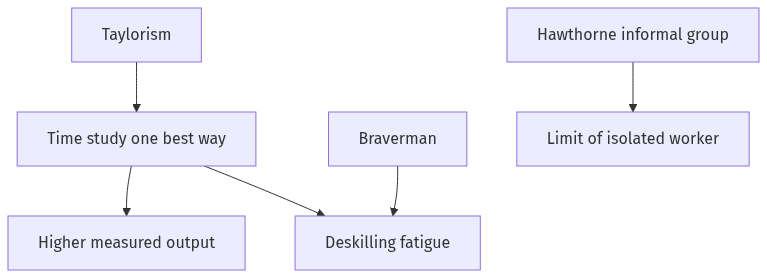
Conclusion
Taylorism is scientific management of timed tasks, separated planning, and incentive control. Its merit is raised measured output and cheap mass goods. Its demerit is deskilling, fatigue, and conflict, which Braverman, Marx, and Hawthorne each show. The form continues in digital scheduling. Efficiency for the firm is not welfare for the worker.
Quick related
Students also ask
-
What are new religious movements? Elaborate emphasizing their forms and orientations
Next question on this syllabus topic (2023 · Q8(b)). View answer →
-
Is every factory Taylorist?
No. Craft, team, and lean systems differ. Many still use timed standards for a core of tasks.
-
Did Taylor care about the worker’s pay?
He promised higher wages with higher output. Control of knowledge and pace remained with management.
More from this topic
Q8(c) · UPSC Mains 2026 · Sociology GS 1 · 10 marks · Solution
Discuss the significance and limitations of 'intersectionality' in social research
Sociology
Intersectionality, coined by Kimberlé Crenshaw, examines how overlapping identities like race, class, and gender shape systemic oppression. Its significance in social research lies in capturing lived realities beyond single-axis frameworks and preventing reductive generalisations. However, limitations include methodological complexity, risks of infinite regress, and difficulties in operationalising fluid categories. Effective application requires balancing structural macro-analysis with micro-level lived experiences.
Q6(b) · UPSC Mains 2026 · Sociology GS 1 · 20 marks · Solution
Critically analyse the nature-nurture debate from different perspectives
Sociology
1. The nature-nurture debate explores whether biology or society primarily shapes human behavior
Q6(a) · UPSC Mains 2026 · Sociology GS 1 · 20 marks · Solution
Discuss the intellectual origins of sociology and its evolution as a distinct field of study
Sociology
Sociology arose in 19th-century Western Europe to make sense of massive upheavals caused by the Industrial and French Revolutions. Enlightenment thinkers laid the groundwork by championing reason, empirical observation, and human agency over traditional dogma. Auguste Comte gave the discipline its name, pushing for a positivist "physics of society" based on scientific laws. Émile Durkheim secured its academic legitimacy by defining "social facts" and using empirical methods to study human behavior. Max Weber introduced interpretive sociology, while Karl Marx focused on material conditions and class struggle. In the 20th century, Talcott Parsons advanced structural-functionalism to study systemic equilibrium. Later, conflict theories, the Frankfurt School, and postmodern critiques broadened the field to address power and marginalisation. Today, sociology continues to evolve by analyzing globalisation, digital shifts, and modern identity politics.