
Revision summary
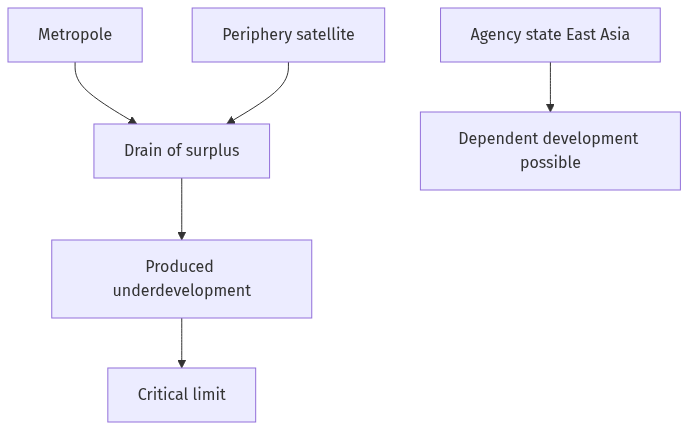
Frank held that underdevelopment is produced by surplus drain from satellite to metropole. It rejected modernisation stages such as Rostow’s ladder. The gain is a relational map of empire, export, and local allied classes. The limit is underplaying dependent industrialisation and internal social structure. Keep the drain thesis. Drop the closed law.
Model answer
Copper italics in this answer — like this — are the key facts. Each one is unpacked in the Facts & figures rail.
Introduction
Andre Gunder Frank argued that underdevelopment is not an original lack. It is produced by the incorporation of satellites into a capitalist world system that drains surplus to metropoles. The theory was a sharp critique of modernisation. It is too rigid as a total history of every poor region.
Body
What Frank claimed
- In Capitalism and Underdevelopment in Latin America, Frank treated Chile and Brazil as cases of a chain of surplus extraction from village to capital city to foreign metropole.
- Development and underdevelopment are two sides of one process, not two stages on W. W. Rostow’s ladder.
- The more a region is tied to the core, the more its development is distorted toward export and monopoly.
- Breaking the chain, in his early politics, pointed toward socialist delinking.
Critical gains
- It named empire, unequal trade, and class allies inside the periphery, which modernisation had treated as cultural lag.
- It still helps read extractive belts, export enclaves, and the location of dirty work in global chains.
- It joins Marx’s surplus to a geography of core and periphery, which Immanuel Wallerstein later systematised.
Critical limits
- Cardoso and others in dependency debate showed that some dependent development of industry does occur, as in parts of East Asia, which Frank’s early drain model underplayed.
- Internal class, caste, and state capacity are not only effects of the metropole.
- Delinking as a programme failed or was unused in most states, while selective engagement plus public investment produced other paths.
- Culture, gender, and ecology are thin in the original texts.
Assessment
- Keep Frank as a theory of relational drain and distorted export structure.
- Reject Frank as a law that contact always and only underdevelops.
Flow diagram
Conclusion
Frank’s development of underdevelopment correctly treats poverty as a product of surplus drain in a world capitalist chain, not as a first stage of growth. The critique of Rostow still holds. The theory over-states the impossibility of industrialisation in the periphery and under-states internal structure. Use it as a relational warning, not as a closed law.
Quick related
Students also ask
-
What is Taylorism? Analyze its merits and demerits
Next question on this syllabus topic (2023 · Q8(a)). View answer →
-
Did Frank deny any growth in the periphery?
He denied that satellite growth was autonomous development. Enclave export could rise while the structure stayed underdeveloped.
-
Is the theory only about Latin America?
The cases were Latin American. The logic was applied to Africa and Asia. Fit must still be tested, not assumed.
Same topic · past papers
UPSC has asked this before
These previous-year questions sit on the same topic. Open one to practise the earlier ask.
-
2019 · Q5(d) · Sociology GS 1 · 10 marks
Critique A.G. Frank's 'development of underdevelopment'
More from this topic
Q8(c) · UPSC Mains 2026 · Sociology GS 1 · 10 marks · Solution
Discuss the significance and limitations of 'intersectionality' in social research
Sociology
Intersectionality, coined by Kimberlé Crenshaw, examines how overlapping identities like race, class, and gender shape systemic oppression. Its significance in social research lies in capturing lived realities beyond single-axis frameworks and preventing reductive generalisations. However, limitations include methodological complexity, risks of infinite regress, and difficulties in operationalising fluid categories. Effective application requires balancing structural macro-analysis with micro-level lived experiences.
Q6(b) · UPSC Mains 2026 · Sociology GS 1 · 20 marks · Solution
Critically analyse the nature-nurture debate from different perspectives
Sociology
1. The nature-nurture debate explores whether biology or society primarily shapes human behavior
Q6(a) · UPSC Mains 2026 · Sociology GS 1 · 20 marks · Solution
Discuss the intellectual origins of sociology and its evolution as a distinct field of study
Sociology
Sociology arose in 19th-century Western Europe to make sense of massive upheavals caused by the Industrial and French Revolutions. Enlightenment thinkers laid the groundwork by championing reason, empirical observation, and human agency over traditional dogma. Auguste Comte gave the discipline its name, pushing for a positivist "physics of society" based on scientific laws. Émile Durkheim secured its academic legitimacy by defining "social facts" and using empirical methods to study human behavior. Max Weber introduced interpretive sociology, while Karl Marx focused on material conditions and class struggle. In the 20th century, Talcott Parsons advanced structural-functionalism to study systemic equilibrium. Later, conflict theories, the Frankfurt School, and postmodern critiques broadened the field to address power and marginalisation. Today, sociology continues to evolve by analyzing globalisation, digital shifts, and modern identity politics.