
Revision summary
NRMs are organised religious groups that are new relative to majority institutions. Wallis’s world-rejecting, world-accommodating, and world-affirming orientations are the main map. Forms include commune, urban clientele, transnational franchise, and therapy market. Weber’s charisma and its routinisation, and Durkheim’s sacred, explain rise and hardening. Indian guru and bhakti-derived movements often keep caste honour beside spiritual equality talk.
Model answer
Copper italics in this answer — like this — are the key facts. Each one is unpacked in the Facts & figures rail.
Introduction
New religious movements are organised religious groups that arise outside, or on the edge of, long-established churches, mosques, temples, and caste sects, usually with a recent founding, a distinctive practice, and a claim to transform the person. They are new relative to the host society’s majority institutions, not necessarily new in every idea they use.
Body
How to define without a slur
- The older word cult is a stigma. Sociology prefers new religious movement, sect, and denomination as more analytical terms.
- Roy Wallis distinguished world-rejecting, world-accommodating, and world-affirming orientations.
- Bryan Wilson treated sects as protest against the church’s compromise with the world. Some NRMs fit that pattern. Others sell therapy to the already comfortable.
Forms
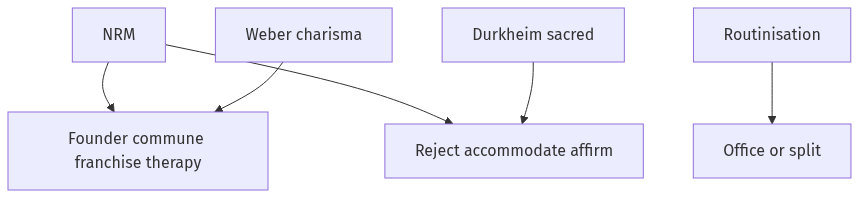
- Charismatic founder and inner circle, which Weber’s charisma and Michels’s oligarchy both help to read as the group hardens.
- Commune or ashram with a break from household caste duty, or a loose urban clientele that attends weekend sessions.
- Transnational franchise: ISKCON, Brahma Kumaris, Soka Gakkai, and similar bodies that keep a brand across states.
- Therapy and New Age forms that mix healing, meditation, and market workshops.
- Millenarian and apocalyptic forms that date the end or the dawn of a new age.
- Online-only fellowships that never meet as a parish.
Orientations
- World-rejecting: high boundary, communal life, suspicion of the ordinary economy, sometimes conflict with the state.
- World-accommodating: intensified piety inside ordinary jobs and families, close to revival inside a tradition.
- World-affirming: success, health, and self as the sacred goods, close to the market.
- Reform versus rupture: some NRMs rework bhakti or Sufi stocks. Others claim a complete break.
- Political orientations range from withdrawal to aggressive public morality campaigns.
Indian and comparative illustrations
- Nineteenth-century reform associations were new in their day. Late twentieth-century guru movements and urban yoga brands are new in ours.
- ISKCON shows a transnational Vaishnava form with both temple piety and counter-cultural recruits in its early Western phase.
- Scientology and similar therapy-churches show the world-affirming pole outside India.
- Caste does not vanish. Many Indian movements reproduce vegetarian honour and marriage closure even as they preach spiritual equality.
Durkheim and Weber in this field
- Durkheim’s sacred can be rebuilt around a living person or a technique of the self.
- Weber’s routinisation of charisma explains the shift from founder to office, which many NRMs undergo or split over.
Elaboration
- Forms are organisational. Orientations are the stance toward the world. Both must be stated, or every new group is collapsed into one scare-word.
Flow diagram
Conclusion
New religious movements are recent organised alternatives to established religion, taking forms from commune to franchise to therapy market. Wallis’s three orientations to the world organise the field. Weber’s charisma and Durkheim’s sacred explain energy and rite. Caste and oligarchy often return as the movement ages. The term is analytical, not a synonym for danger.
Quick related
Students also ask
-
Delimit the scope of sociology in relation to other social sciences.
Next question on this syllabus topic (2022 · Q1(a)). View answer →
-
Is every new temple trust an NRM?
No. An NRM has a distinctive organised claim and usually a recent founding identity, not only a new building.
-
Are NRMs always short-lived?
Many die or split. Some become denominations. Longevity is an outcome, not the definition.
Same topic · past papers
UPSC has asked this before
These previous-year questions sit on the same topic. Open one to practise the earlier ask.
-
2026 · Q5(e) · Sociology GS 1 · 10 marks
How do different theories explain social dimensions of social movements? Discuss. -
2025 · Q6(c) · Sociology GS 1 · 10 marks
How can you assess the significance of social movements in the digital era? Explain -
2024 · Q6(a) · Sociology GS 1 · 20 marks
Underline the role of social media in contemporary social movements and describe its challenges -
2022 · Q7(b) · Sociology GS 1 · 15 marks
Discuss how "environmentalism" can be explained with new social movements approach. -
2020 · Q8(c) · Sociology GS 1 · 15 marks
Examine how social movements come to an end. Illustrate with examples.
More from this topic
Q8(c) · UPSC Mains 2026 · Sociology GS 1 · 10 marks · Solution
Discuss the significance and limitations of 'intersectionality' in social research
Sociology
Intersectionality, coined by Kimberlé Crenshaw, examines how overlapping identities like race, class, and gender shape systemic oppression. Its significance in social research lies in capturing lived realities beyond single-axis frameworks and preventing reductive generalisations. However, limitations include methodological complexity, risks of infinite regress, and difficulties in operationalising fluid categories. Effective application requires balancing structural macro-analysis with micro-level lived experiences.
Q6(b) · UPSC Mains 2026 · Sociology GS 1 · 20 marks · Solution
Critically analyse the nature-nurture debate from different perspectives
Sociology
1. The nature-nurture debate explores whether biology or society primarily shapes human behavior
Q6(a) · UPSC Mains 2026 · Sociology GS 1 · 20 marks · Solution
Discuss the intellectual origins of sociology and its evolution as a distinct field of study
Sociology
Sociology arose in 19th-century Western Europe to make sense of massive upheavals caused by the Industrial and French Revolutions. Enlightenment thinkers laid the groundwork by championing reason, empirical observation, and human agency over traditional dogma. Auguste Comte gave the discipline its name, pushing for a positivist "physics of society" based on scientific laws. Émile Durkheim secured its academic legitimacy by defining "social facts" and using empirical methods to study human behavior. Max Weber introduced interpretive sociology, while Karl Marx focused on material conditions and class struggle. In the 20th century, Talcott Parsons advanced structural-functionalism to study systemic equilibrium. Later, conflict theories, the Frankfurt School, and postmodern critiques broadened the field to address power and marginalisation. Today, sociology continues to evolve by analyzing globalisation, digital shifts, and modern identity politics.