
Revision summary
Social media lowered the cost of calling, framing, and witnessing protest. Castells and Tufekci describe leader-light networks of outrage with real limits in bargaining. Indian CAA, farmers’, and #MeToo campaigns show hybrid online and street repertoires. Shutdowns, trolling, and influencer oligarchy are the other side of the same tools. The change of form is significant. Street, union, and court remain decisive.
Model answer
Copper italics in this answer — like this — are the key facts. Each one is unpacked in the Facts & figures rail.
Introduction
Social media are platforms that let users publish, share, and assemble without passing through a newspaper or party office. Forms of protest are the repertoires people use to claim, disrupt, and persuade. The case argued here is yes, the changes are significant in speed, scale, and visibility. They are not a replacement of street, union, and party.
Body
What has changed
- Manuel Castells described networks of outrage and hope: rapid assembly without a single headquarters, as in parts of the Arab Spring and Occupy.
- Hashtags, livestreams, and encrypted groups lower the cost of calling a crowd and of documenting police action.
- Transnational mirroring lets a local injury travel as a template, which Zeynep Tufekci analysed as a strength and as a weakness of leader-light movements.
- Everyday Goffman-like presentation now includes the protest profile: symbols, frames, and counter-frames compete in the same feed.
- New forms include online petitions, coordinated rating campaigns, leak drops, and hybrid sit-ins that are both camp and channel.
Indian illustrations
- The 2011 anti-corruption mobilisation used television and early social media together.
- The 2019–20 Citizenship Amendment Act protests and the 2020–21 farmers’ movement used WhatsApp, YouTube, and Twitter to coordinate langar, legal updates, and counter-narratives.
- #MeToo in Indian workplaces showed a repertoire of naming that bypassed slow internal committees, with risks of defamation law and unequal digital access.
What has not been abolished
- Occupying a physical place, blocking a road, and striking still decide outcomes when platforms can be throttled.
- Michels’s oligarchy reappears as influencer hierarchies and as parties that harvest online anger.
- The state uses the same tools for surveillance, shutdown, and organised trolling, which changes the risk of protest rather than ending protest.
- Digital divides of language, gender, and rural bandwidth mean the feed is not the people.
Argument
- Significant change is in the repertoire: faster framing, wider witnessing, and weaker formal leadership at the start.
- Significance is not the same as success. Leader-light networks can occupy a square and then fail to bargain, which Tufekci noted.
- Marx still asks who owns the platforms. Weber still asks who holds the monopoly of force. Those questions bound the new forms.
Judgement
- Yes, forms have changed significantly. No, the street, the union, and the court are not obsolete.
Flow diagram
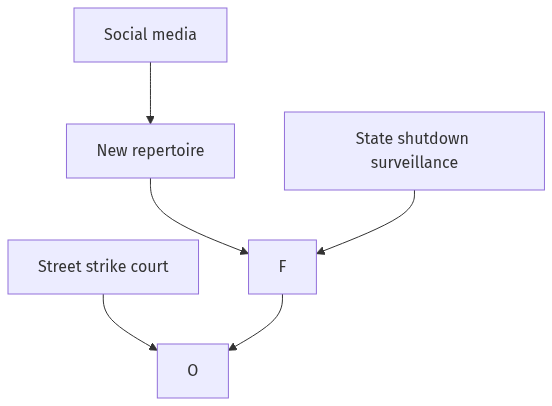
Conclusion
Social media has changed protest by speeding assembly, witnessing, and framing, as Castells and Indian hybrid movements show. The change is significant in repertoire. It is limited by shutdowns, oligarchy of influencers, and the continuing need for physical disruption and organisation. The fair case is significant change without replacement of older forms.
Quick related
Students also ask
-
Assess critically A. G. Frank's theory of development of underdevelopment'
Next question on this syllabus topic (2023 · Q7(c)). View answer →
-
Is a hashtag a social movement?
It can be a frame and a call. A movement still needs lasting organisation, claim, and often a physical presence.
-
Do social media cause protests?
They change how protests are organised and seen. Grievance, organisation, and the state still cause the conflict.
Same topic · past papers
UPSC has asked this before
These previous-year questions sit on the same topic. Open one to practise the earlier ask.
-
2016 · Q6(c) · Sociology GS 1 · 15 marks
Examine the role of protest movements in changing the status of Dalits in India. -
2024 · Q6(a) · Sociology GS 1 · 20 marks
Underline the role of social media in contemporary social movements and describe its challenges
More from this topic
Q8(c) · UPSC Mains 2026 · Sociology GS 1 · 10 marks · Solution
Discuss the significance and limitations of 'intersectionality' in social research
Sociology
Intersectionality, coined by Kimberlé Crenshaw, examines how overlapping identities like race, class, and gender shape systemic oppression. Its significance in social research lies in capturing lived realities beyond single-axis frameworks and preventing reductive generalisations. However, limitations include methodological complexity, risks of infinite regress, and difficulties in operationalising fluid categories. Effective application requires balancing structural macro-analysis with micro-level lived experiences.
Q6(b) · UPSC Mains 2026 · Sociology GS 1 · 20 marks · Solution
Critically analyse the nature-nurture debate from different perspectives
Sociology
1. The nature-nurture debate explores whether biology or society primarily shapes human behavior
Q6(a) · UPSC Mains 2026 · Sociology GS 1 · 20 marks · Solution
Discuss the intellectual origins of sociology and its evolution as a distinct field of study
Sociology
Sociology arose in 19th-century Western Europe to make sense of massive upheavals caused by the Industrial and French Revolutions. Enlightenment thinkers laid the groundwork by championing reason, empirical observation, and human agency over traditional dogma. Auguste Comte gave the discipline its name, pushing for a positivist "physics of society" based on scientific laws. Émile Durkheim secured its academic legitimacy by defining "social facts" and using empirical methods to study human behavior. Max Weber introduced interpretive sociology, while Karl Marx focused on material conditions and class struggle. In the 20th century, Talcott Parsons advanced structural-functionalism to study systemic equilibrium. Later, conflict theories, the Frankfurt School, and postmodern critiques broadened the field to address power and marginalisation. Today, sociology continues to evolve by analyzing globalisation, digital shifts, and modern identity politics.