
Revision summary
Overcentralised globalisation concentrates rules, capital and the dollar in Northern centres and exports risk south. A Global South-sensitive model shares voice, WTO policy space, climate finance and digital/food buffers. G20, Voice of Global South, AU membership of G20 and BRICS are incomplete pluralising moves. Trump tariffs show the core can revolt against its own system; Southern grievance is not the only crack. The aim is embedded liberalism with a wider membership, not autarky.
Model answer
Copper italics in this answer — like this — are the key facts. Each one is unpacked in the Facts & figures rail.
Introduction
Overcentralised globalisation is a system in which rules, capital and reserve-currency privilege sit in a few Northern centres, while risk is exported south. A Global South-sensitive model would keep openness but spread voice, policy space and buffers. The claim of the question is preventive: without that shift, globalisation dies of its own political reaction — tariffs, WHO walkouts, and democratic backsliding fuelled by left-behind regions.
Body
The danger of overcentralisation
John Williamson’s Washington Consensus, IMF conditionality, and TRIPS-era intellectual property produced growth for some and crises for others (Stiglitz, UNCTAD). Dollar dominance means U.S. interest-rate turns become emerging-market shocks. Standard-setting in tech, green tariffs (CBAM), and health rules can look like regulation without representation. COVID vaccine hoarding was overcentralisation in a moral key. Trump’s 2025 reciprocal tariffs are the core’s own revolt against the system it wrote — proof that the danger is not only Southern grievance.
What ‘sensitive’ would mean
It would mean special and differential treatment at the WTO that is real, not rhetorical; a repaired dispute system that the strong cannot ignore; climate finance and technology transfer that match Paris promises; reform of IMF quotas; and digital public infrastructure that is not only Silicon Valley’s. G20 under India’s 2023 presidency, the Voice of Global South summits, African Union in the G20, and BRICS expansion are incomplete attempts to pluralise the table. UNCTAD, South–South trade, and regional value chains (ASEAN, African Continental FTA) are the economic geography.
Sensitivity is not autarky. It is embedded liberalism with more than North Atlantic members. Food public stockholding, energy transition pathways, and data localisation debates are where India actually fights. A model that tells Lagos and Lucknow to wait for trickle-down will feed both Southern populists and Northern protectionists.
Prevention, not poetry
- Overcentralised globalisation produces the twin of Q2(a): elite-driven openness without domestic buffers, then nationalist backlash. A Southern-sensitive order would still have conflict — China is not a charity — but it would reduce the sense that multilateralism is a club. WHO reimagining, WTO salvage, and India–EU talks after tariff threats are all tests of whether rules can be recentred without a 1930s smash. The alternative is blocs, weaponised interdependence (Farrell and Newman), and a smaller world.
Flow diagram
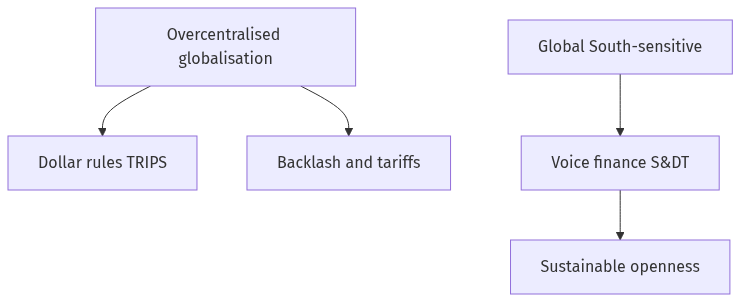
Conclusion
A Global South-sensitive globalisation keeps trade and science but shares rule-making, finance and policy space. That is the practical answer to overcentralisation. Without it, openness collapses into tariffs and clubs.
Quick related
Students also ask
-
Latin America has made moderate success in countering US-led global economic order by framing various organizations emphasizing regional sovereignty, economic integration and alternative development. Discuss
Next question on this syllabus topic (2025 · Q4(a)). View answer →
-
Is BRICS a Global South-sensitive globalisation?
It is a hedge and a voice club. It is not yet a full monetary or trading order, and China-weight inside it worries India.
-
Does sensitive globalisation mean protectionism?
It means policy space for industrial and food security, plus fairer rules — not a general war on trade. Tariff nationalism in the core is a different, more destructive animal.
Same topic · past papers
UPSC has asked this before
These previous-year questions sit on the same topic. Open one to practise the earlier ask.
-
2025 · Q2(a) · PSIR GS 2 · 20 marks
The world currently has been in the throes of a twin process of 'democratic backsliding' and 'democratic backlash'. How would you explain this paradox? -
2025 · Q5(b) · PSIR GS 2 · 10 marks
Would you agree with the contention that India's inclination to lean on a 'more aggressive hyper-realist posture' has gained a new momentum in the aftermath of the Pahalgam terrorist strike? Comment. -
2025 · Q5(c) · PSIR GS 2 · 10 marks
For India, a multipolar world order would also mean a multipolar Asia. Comment. -
2024 · Q6(a) · PSIR GS 2 · 20 marks
Would you concur with the view that of late, India's foreign policy has been in a transition mode from Nehruvianism to Neoliberalism? Support your answer with the help of suitable examples.
More from this topic
Q8(a) · UPSC Mains 2026 · PSIR GS 2 · 20 marks · Solution
Critically evaluate India-Russia relations in the 21st century. How have both the countries responded to America meddling in their relations in the recent times?
India and the Global South
- India and Russia share a "Special and Privileged Strategic Partnership" driven by defense, energy, and multipolar goals, moving beyond Cold War ties. - Core cooperation rests on defense production (BrahMos), discounted oil imports pushing trade past $50 billion, and joint platforms like BRICS and SCO. - Structural challenges include Russia's heavy reliance on China post-2022, a major trade deficit favoring Moscow, and differing views on the Indo-Pacific. - Both capitals counter Western pressure (like CAATSA and SWIFT restrictions) by asserting strategic autonomy and bypassing dollar-based payment systems. - Moscow implicitly tolerates India's QUAD participation, while New Delhi maintains independent foreign policy choices despite U.S. pressure. - The relationship survives on pragmatic adaptation rather than sentiment, remaining a vital pillar of India's multi-aligned foreign policy framework.
Q7(b) · UPSC Mains 2026 · PSIR GS 2 · 15 marks · Solution
The island of Kachchatheevu remains an intractable issue in India-Sri Lanka relations. Comment
India and the Global South
The Kachchatheevu island issue stems from the 1974 and 1976 Indo-Sri Lankan maritime boundary agreements which ceded the islet to Colombo. While legally settled, it persists as a live domestic political debate involving Tamil Nadu's regional parties and New Delhi. Livelihood concerns of Indian fishermen facing Sri Lankan naval action complicate bilateral ties. Strategic anxieties regarding regional security further elevate the issue in contemporary geopolitics. Resolving it requires a fine balance between cooperative maritime diplomacy and safeguarding domestic fisherfolk interests.
Q6(b) · UPSC Mains 2026 · PSIR GS 2 · 15 marks · Solution
Critically evaluate the important factors of India-Maldives relations on the eve of sixty years of diplomatic ties between the two countries
India and the Global South
• India and the Maldives are marking 60 years of diplomatic ties anchored in