
Revision summary
• India and the Maldives are marking 60 years of diplomatic ties anchored in
Model answer
Copper italics in this answer — like this — are the key facts. Each one is unpacked in the Facts & figures rail.
Introduction
As India and the Maldives approach sixty years of diplomatic ties, their bilateral relationship stands as a crucial fulcrum of India's Neighbourhood First and SAGAR doctrines. While historical goodwill and strategic convergence anchor this partnership, recent political oscillations underscore the delicate balance between sovereign aspirations and regional security imperatives.
Body
Strategic Geography and Security Anchor
- Maritime Hub: The Maldives sits astride critical Sea Lanes of Communication (SLOCs) in the Indian Ocean, making its security vital for India's peninsular defense.
- Security Partnership: Joint exercises like Ekuverin and hydrographic surveys reinforce Interoperability and maritime domain awareness against non-traditional threats.
Development Partnership and Capacity Building
- Giga-Projects: High-impact infrastructure initiatives such as the Greater Malé Connectivity Project funded through Indian lines of credit demonstrate delivery-focused diplomacy.
- Humanitarian Assistance: Historical interventions like Operation Cactus and rapid COVID-19 medical assistance validate New Delhi's role as a net security provider.
Geopolitical Friction and Domestic Politics
- Sovereignty Concerns: Shifts in Maldivian domestic politics have leveraged 'India Out' narratives, weaponizing the presence of Indian technical personnel operating humanitarian platforms.
- External Footprint: Growing Chinese debt-trap diplomacy and infrastructure acquisition in the archipelago test India's traditional primacy in its near abroad.
Critical Evaluation and Pragmatic Calibration
- Asymmetry Dilemma: The structural asymmetry between a major power and a smaller neighbor breeds domestic nationalist anxieties that require careful diplomatic management.
- Course Correction: Recent high-level diplomatic engagements signal a pragmatic reset, substituting political rhetoric with institutional dialogue and economic interdependence.
Flow diagram
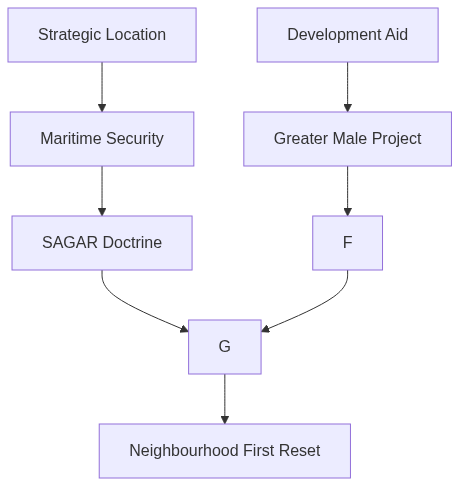
Conclusion
The approaching diamond jubilee of India-Maldives relations demands moving beyond transactional diplomacy toward institutionalized interdependence. India must anchor its engagement in mutual sensitivity and developmental transparency, ensuring that bilateral ties remain immune to domestic political volatility in Malé. Ultimately, shared maritime destiny dictates that security and sovereignty must be co-constitutive.
Quick related
Students also ask
-
The island of Kachchatheevu remains an intractable issue in India-Sri Lanka relations. Comment
Next question on this syllabus topic (2026 · Q7(b)). View answer →
-
What are the core pillars of India-Maldives relations?
The core pillars include strategic maritime security in the Indian Ocean, robust development assistance, historical cultural ties, and regional stability under the SAGAR framework.
-
How does India balance sovereignty concerns with strategic interests in the Maldives?
India balances these through non-reciprocal economic aid, transparent capacity-building projects, and respecting domestic political shifts while maintaining baseline maritime security red lines.
Same topic · past papers
UPSC has asked this before
These previous-year questions sit on the same topic. Open one to practise the earlier ask.
-
2023 · Q5(e) · PSIR GS 2 · 10 marks
What diplomatic steps has India taken to articulate the interests of the Global South in International Politics?
More from this topic
Q8(a) · UPSC Mains 2026 · PSIR GS 2 · 20 marks · Solution
Critically evaluate India-Russia relations in the 21st century. How have both the countries responded to America meddling in their relations in the recent times?
India and the Global South
- India and Russia share a "Special and Privileged Strategic Partnership" driven by defense, energy, and multipolar goals, moving beyond Cold War ties. - Core cooperation rests on defense production (BrahMos), discounted oil imports pushing trade past $50 billion, and joint platforms like BRICS and SCO. - Structural challenges include Russia's heavy reliance on China post-2022, a major trade deficit favoring Moscow, and differing views on the Indo-Pacific. - Both capitals counter Western pressure (like CAATSA and SWIFT restrictions) by asserting strategic autonomy and bypassing dollar-based payment systems. - Moscow implicitly tolerates India's QUAD participation, while New Delhi maintains independent foreign policy choices despite U.S. pressure. - The relationship survives on pragmatic adaptation rather than sentiment, remaining a vital pillar of India's multi-aligned foreign policy framework.
Q7(b) · UPSC Mains 2026 · PSIR GS 2 · 15 marks · Solution
The island of Kachchatheevu remains an intractable issue in India-Sri Lanka relations. Comment
India and the Global South
The Kachchatheevu island issue stems from the 1974 and 1976 Indo-Sri Lankan maritime boundary agreements which ceded the islet to Colombo. While legally settled, it persists as a live domestic political debate involving Tamil Nadu's regional parties and New Delhi. Livelihood concerns of Indian fishermen facing Sri Lankan naval action complicate bilateral ties. Strategic anxieties regarding regional security further elevate the issue in contemporary geopolitics. Resolving it requires a fine balance between cooperative maritime diplomacy and safeguarding domestic fisherfolk interests.
Q4(a) · UPSC Mains 2025 · PSIR GS 2 · 20 marks · Solution
Latin America has made moderate success in countering US-led global economic order by framing various organizations emphasizing regional sovereignty, economic integration and alternative development. Discuss
India and the Global South
Latin America answered U.S. economic primacy with Mercosur, ALBA, UNASUR, CELAC, Banco del Sur and Brazil’s BRICS role. The intellectual root is ECLAC, Prebisch and dependency: unequal exchange and the need for regional policy space. Success is moderate: some intra-trade, a diplomacy without Washington in CELAC, and diversified China markets. The dollar, IMF programmes and U.S. financial cycles still dominate crises. Cyclical politics and a reluctant Brazilian paymaster explain the ceiling.