
Revision summary
The Red Lipstick Movement uses visible makeup as dissent against compulsory hijab and morality police, especially in Iran after 2022. The act claims the face and street as women’s civic space, not as fashion advertising. It sits with Woman, Life, Freedom and with feminist arguments that the personal and the bodily are political. Lipstick feminism in Western theory reclaimed makeup; the Iranian use is a harder human-rights refusal. Closed regimes leak through small, repeatable gestures when parties and press are blocked.
Model answer
Copper italics in this answer — like this — are the key facts. Each one is unpacked in the Facts & figures rail.
Introduction
The Red Lipstick Movement is a feminist practice of dissent in which women paint a visible, ‘immodest’ mouth as a claim on the street. In Iran, after the death of Mahsa (Jina) Amini in 2022 and through the Woman, Life, Freedom rising, red lipstick became a small, repeatable refusal of the morality police. The point is not cosmetics. It is the body as a rights-bearing public fact.
Body
What the act does
Compulsory hijab and the Guidance Patrol try to write women’s faces out of civic space. Lipstick, uncovered hair, and dancing in the street reverse the instruction. A red mouth is cheap, mobile and photographable. It says: this face is not the state’s property. Similar gestures appear in other autocratic settings where dress codes police gender — but the UPSC stem is read most clearly through Iran’s 2020s protests, not as a Western advertising slogan.
Feminist rights, not fashion
First-wave rights were the vote and the law. Second-wave rights named the personal as political. Lipstick feminism (a late-wave, often Western, strand) reclaimed makeup from the charge that it is only patriarchal display. The Iranian street use is harder. It is closer to Nawal El Saadawi and to bodily autonomy under theocracy than to a mall. Carole Pateman’s sexual contract, Nancy Fraser on public spheres, and Cynthia Enloe’s ‘where are the women?’ all help: the international is made in households and on pavements. When a regime beats women for a lock of hair, lipstick is a human-rights claim — expression, equality, freedom from cruel treatment — not a lifestyle brand.
Comparative politics
The movement shows how closed socialisation leaks. It also shows transnational feminist networks: diaspora video, #MahsaAmini, and UN Human Rights Council scrutiny. States reply with arrests, internet cuts and ‘hijab law’ amendments. Success is mixed: the Islamic Republic has not fallen; everyday non-compliance has widened. For PSIR, the lesson is that feminist rights are fought in the grammar of appearance when speech and parties are blocked. Say that clearly, without treating Iranian women as a metaphor for someone else’s culture war.
Flow diagram
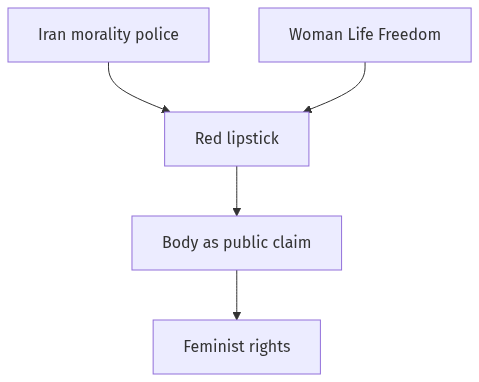
Conclusion
- Red lipstick in this movement is a feminist rights-claim: the face in public against compulsory modesty. It is dissent you can wear when the podium is banned. Theory names it; Iranian women enacted it.
Quick related
Students also ask
-
The world currently has been in the throes of a twin process of 'democratic backsliding' and 'democratic backlash'. How would you explain this paradox?
Next question on this syllabus topic (2025 · Q2(a)). View answer →
-
Is this only an Iranian story?
Iran is the clearest named case. Dress-code policing of women appears in other closed and hybrid regimes; the exam answer should explain the mechanism, not collect slogans.
-
Why ‘red’?
Red maximises visibility in photographs and against a grey uniformed state. The colour is tactical, not mystical.
Same topic · past papers
UPSC has asked this before
These previous-year questions sit on the same topic. Open one to practise the earlier ask.
-
2025 · Q5(d) · PSIR GS 2 · 10 marks
Does the Non-Aligned Movement have any future in the wake of India's growing indifference towards it? -
2024 · Q8(b) · PSIR GS 2 · 15 marks
Discuss the implications of the scrapping of the Free Movement Regime with Myanmar by the Indian Government on the complex ethno-political dynamics of the north-eastern region. -
2023 · Q2(a) · PSIR GS 2 · 20 marks
Discuss the relevance of the normative ethos of the Non-Aligned Movement in magnifying India's soft power in pursuit of her national interest -
2023 · Q3(a) · PSIR GS 2 · 20 marks
"During the Cold War, the Non-Aligned Movement tried to become a Third force in World Politics, but failed because it was too large and unwieldy." Discuss
More from this topic
Q7(a) · UPSC Mains 2026 · PSIR GS 2 · 20 marks · Solution
How does illegal cross border migration pose challenges to India's security? Discuss the steps taken by the government in this direction and their effectiveness
Comparative Politics
Illegal cross-border migration undermines India's national security by altering demographic balances, straining economic resources, and exacerbating internal security vulnerabilities. The government has responded through border fencing, technological integration like SMART fencing, institutional mechanisms, and bilateral agreements. However, porous terrain, regional political complexities, and local connivance limit the complete effectiveness of these measures. A holistic approach combining strict border management with socio-economic development and robust legal frameworks is essential for sustainable containment.
Q5(d) · UPSC Mains 2026 · PSIR GS 2 · 10 marks · Solution
Discuss the main features of the land-boundary agreement between India and Bangladesh.
Comparative Politics
• Operationalized via the 100th Constitutional Amendment Act of 2015 to resolve Radcliffe Line anomalies. • Rooted in the unratified 1974 bilateral agreement and the 2011 additional protocol. • Involved the peaceful exchange of 111 Indian enclaves in Bangladesh and 51 Bangladeshi enclaves in India. • Granted affected residents the sovereign right to choose their nationality and place of residence. • Demarcated roughly 6.1 km of previously un-demarcated land boundaries to end administrative confusion. • Secured human rights and welfare access for over 50,000 formerly stateless enclave residents. • Reduced bilateral trust deficits, paving the way for deeper cooperation in security and connectivity.
Q4(c) · UPSC Mains 2026 · PSIR GS 2 · 15 marks · Solution
What is UNCLOS? Explain its salient features
Comparative Politics
UNCLOS, established in 1982, serves as the constitution of the oceans, codifying customary international law regarding maritime jurisdictions. Its salient features include distinct maritime zones ranging from territorial waters to the high seas, balancing coastal state sovereignty with freedom of navigation. It establishes compulsory dispute settlement mechanisms through institutions like ITLOS. The convention also mandates environmental protection and sustainable management of marine resources. For India, UNCLOS provides a rules-based order in the Indo-Pacific while respecting navigational rights. It remains central to addressing contemporary maritime security and resource challenges.