
Revision summary
Democratic backsliding is incremental erosion of referees by elected executives, not always a coup. Democratic backlash is resistance by courts, streets, media and opposition victories. The paradox is that both run together in a polarised decade, on different clocks. Hungary, the United States, Brazil, Poland and Iran illustrate different mixes of erosion and resistance. Not every backlash is liberal; the task is to distinguish civic repair from counter-populism.
Model answer
Copper italics in this answer — like this — are the key facts. Each one is unpacked in the Facts & figures rail.
Introduction
The 2020s are not a simple story of democracy’s death or of democracy’s revenge. Nancy Bermeo, Steven Levitsky and Daniel Ziblatt, and the V-Dem project describe democratic backsliding: erosion from inside, often by elected executives. At the same time, democratic backlash — courts, streets, journalists, and opposition wins — has returned in several places. The paradox is that both processes now run as twins, not as chapters in sequence.
Body
Backsliding
Backsliding is rarely a colonels’ coup. It is executive aggrandisement, packed courts, captured regulators, tilted electoral law, harassment of the press, and the treatment of opponents as enemies of the nation. Hungary under Viktor Orbán, Turkey after successive shocks to the opposition, Venezuela’s long hollow, and fights over certification and the rule of law in the United States are standard illustrations. Culture war, migration panics, and inequality supply the fuel. Centre-right and radical-right coalitions have been the usual vehicles, which is why the next question on left setbacks belongs in the same decade.
Backlash
Backlash is not automatic sunshine. It is costly mobilisation. Poland’s 2023 opposition coalition ended eight years of Law and Justice rule. Brazil’s 2022 vote removed Jair Bolsonaro, then had to survive a 8 January 2023 assault on the plazas of power. Israel’s 2023 judicial-overhaul crisis filled the streets. Women’s movements, including Iranian and other West Asian protests, are backlash against patriarchal closure, not only against a left–right scorecard. In India, a noisy opposition, a still-independent strand of the higher judiciary, and a competitive if strained federal map are part of backlash capacity even when critics allege backsliding on other metrics.
Why the twin process
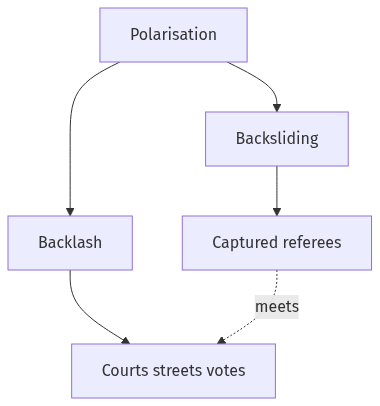
The paradox dissolves once time-scales are separated. Backsliding is often incremental and legalistic. Backlash is episodic and public. Polarisation produces both: the same identity heat that lets a leader dismantle referees also produces counter-identity. International demonstration effects work both ways — Orbánism travels, so do protest repertoires. Digital platforms organise rallies and also drown them in disinformation. Robert Dahl’s polyarchy always rested on contestation plus inclusion; when contestation is attacked, inclusion fights back, unevenly.
- A further twist: backlash can itself be illiberal (majoritarian street against minorities). Not every crowd is a civic culture. The analyst’s job is to sort liberal-democratic repair from counter-populism. The world is in the throes of both, which is why a single headline — “the end of democracy” or “the people have won” — is bad comparative politics.
Flow diagram
Conclusion
Backsliding erodes referees from above. Backlash tries to restore or reinvent them from below and beside. They coexist because polarised societies produce both strongmen and their antibodies. The outcome is unsettled, country by country.
Quick related
Students also ask
-
How successful has the 'ASEAN Plus Three' been in addressing regional problems? Support your answer with specific examples
Next question on this syllabus topic (2025 · Q4(b)). View answer →
-
Is backsliding the same as a coup?
Usually no. Bermeo distinguishes promissory coups, executive aggrandisement and strategic harassment of the opposition. The last two dominate recent cases.
-
Does backlash always win?
No. Turkey, Venezuela and several Sahel cases show failed or reversed backlash. Wins need organisation, elite splits and usable institutions.
Same topic · past papers
UPSC has asked this before
These previous-year questions sit on the same topic. Open one to practise the earlier ask.
-
2022 · Q2(a) · PSIR GS 2 · 20 marks
How has the electoral democracy augmented the participation of people in the democratic process? -
2021 · Q7(b) · PSIR GS 2 · 15 marks
How do the constituent states influence the foreign policy making process in India?
More from this topic
Q7(a) · UPSC Mains 2026 · PSIR GS 2 · 20 marks · Solution
How does illegal cross border migration pose challenges to India's security? Discuss the steps taken by the government in this direction and their effectiveness
Comparative Politics
Illegal cross-border migration undermines India's national security by altering demographic balances, straining economic resources, and exacerbating internal security vulnerabilities. The government has responded through border fencing, technological integration like SMART fencing, institutional mechanisms, and bilateral agreements. However, porous terrain, regional political complexities, and local connivance limit the complete effectiveness of these measures. A holistic approach combining strict border management with socio-economic development and robust legal frameworks is essential for sustainable containment.
Q5(d) · UPSC Mains 2026 · PSIR GS 2 · 10 marks · Solution
Discuss the main features of the land-boundary agreement between India and Bangladesh.
Comparative Politics
• Operationalized via the 100th Constitutional Amendment Act of 2015 to resolve Radcliffe Line anomalies. • Rooted in the unratified 1974 bilateral agreement and the 2011 additional protocol. • Involved the peaceful exchange of 111 Indian enclaves in Bangladesh and 51 Bangladeshi enclaves in India. • Granted affected residents the sovereign right to choose their nationality and place of residence. • Demarcated roughly 6.1 km of previously un-demarcated land boundaries to end administrative confusion. • Secured human rights and welfare access for over 50,000 formerly stateless enclave residents. • Reduced bilateral trust deficits, paving the way for deeper cooperation in security and connectivity.
Q4(c) · UPSC Mains 2026 · PSIR GS 2 · 15 marks · Solution
What is UNCLOS? Explain its salient features
Comparative Politics
UNCLOS, established in 1982, serves as the constitution of the oceans, codifying customary international law regarding maritime jurisdictions. Its salient features include distinct maritime zones ranging from territorial waters to the high seas, balancing coastal state sovereignty with freedom of navigation. It establishes compulsory dispute settlement mechanisms through institutions like ITLOS. The convention also mandates environmental protection and sustainable management of marine resources. For India, UNCLOS provides a rules-based order in the Indo-Pacific while respecting navigational rights. It remains central to addressing contemporary maritime security and resource challenges.