
Revision summary
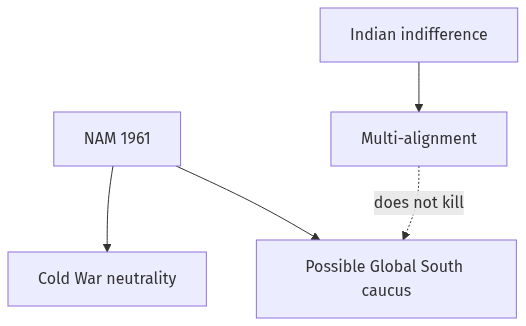
NAM was India’s bipolar-era instrument: Belgrade 1961, refuse camps, keep voice. Delhi now practises multi-alignment and invests in G20, Quad and 2+2s more than in NAM theatre. Indifference is real because India was NAM’s engine; without it the Movement thins. A future remains as a Global South UN-and-development caucus, not as Cold War neutrality. Verdict: damaged as Indian doctrine, not automatically dead as a membership habit.
Model answer
Copper italics in this answer — like this — are the key facts. Each one is unpacked in the Facts & figures rail.
Introduction
The Non-Aligned Movement, born at Belgrade 1961 after Bandung’s moral rehearsal, was India’s gift to a bipolar world: refuse camp membership, keep voice. India’s present practice is multi-alignment — Quad one week, BRICS and Moscow the next — with NAM often treated as a museum. The question is whether the Movement has a future despite that indifference, not whether Delhi will lead a revival parade.
Body
Indifference is real
Summit photography has shifted to G20, SCO, Quad and bilateral 2+2s. NonAlignment 2.0 (2012) already spoke India’s language more than NAM communiqués. Jaishankar’s energetic diplomacy uses issue-based coalitions. Younger officials read NAM as a speech, not a security system. That indifference matters because India was NAM’s intellectual engine. Without a willing engine, a 120-odd member body becomes a caucus of the willing-to-attend.
Why NAM can still live
The Global South still needs a room that is not the OECD, not NATO, and not a Chinese classroom. On Gaza, on climate finance, on WHO equity, and on tariff shocks from a returning Trump, many NAM members want a universality that is not Western by default — the theme of Q7(c). Africa and Southeast Asia did not join the Quad. They still vote at the UN in clusters NAM helped socialise. The Movement’s future is as a normative and voting caucus, not as a military non-doctrine for a world without two camps.
Verdict
- NAM has a future if it becomes a South–South consultative platform with modest aims: coordinate UN positions, defend policy space, and talk development. It has no future as Nehru’s moral bipolarity, because bipolarity is gone and India will not sacrifice the Quad for a Havana paragraph. India’s indifference is therefore damaging but not fatal. Others — Indonesia, South Africa, a returning Egypt — can convene. If they do not, NAM will linger as an annual adjective. The honest 10-mark line: the Movement survives as a Global South habit; it does not survive as India’s master doctrine.
Flow diagram
Conclusion
India’s indifference has retired NAM as Delhi’s organising idea. It has not erased a large membership that still needs a non-alliance roof. NAM’s future is a South caucus, or it is folklore.
Quick related
Students also ask
-
India's reluctance to perceive any 'existential threat' inevitably made the multilateral path to nuclear security a 'default option' until it decided to cross nuclear Rubicon in 1998. Identify and analyze some of the major reasons behind this shift in India's position on the nuclear question
Next question on this syllabus topic (2025 · Q8(a)). View answer →
-
Did India leave NAM?
No. It has de-emphasised it. Formal membership and occasional attendance are not the same as doctrinal centrality.
-
Is multi-alignment just NAM with better branding?
It shares autonomy. It drops the allergy to security minilaterals with the U.S. That drop is the indifference the question names.
Same topic · past papers
UPSC has asked this before
These previous-year questions sit on the same topic. Open one to practise the earlier ask.
More from this topic
Q7(c) · UPSC Mains 2026 · PSIR GS 2 · 15 marks · Solution
India has adopted multi-alignment to fulfill its core values and interests in international relations. Discuss
Changing International Political Order
• Shifted from passive non-alignment to active multi-alignment to navigate a multipolar world. • Preserves strategic autonomy by building overlapping partnerships without joining exclusive blocs. • Drives economic security through diversified energy, trade corridors, and critical technologies. • Promotes a pluralistic, reformed global order rooted in civilizational independence. • Engages simultaneously in diverse platforms like the Quad, BRICS, SCO, and I2U2. • Balances major-power rivalries (US-China, Russia-West) while championing the Global South.
Q4(b) · UPSC Mains 2026 · PSIR GS 2 · 15 marks · Solution
How did the Council of Mutual Economic Assistance (CMEA) reflect geo-political division of the world during the cold war?
Changing International Political Order
The Council of Mutual Economic Assistance (CMEA), established in 1949, served as the Soviet bloc's institutional counterpart to the US-led Marshall Plan, institutionalizing the geo-political division of the global economy during the Cold War. It reflected bipolarity by binding Eastern European satellite states and extra-European socialist economies like Cuba and Vietnam into a centralized, Moscow-directed trade network. While intended to foster socialist internationalism and economic cooperation, it cemented the Eastern Bloc's separation from capitalist markets and reflected asymmetrical Soviet dominance. The organization ultimately highlighted the structural limitations of command economies and disintegrated alongside the Soviet collapse in 1991.
Q8(a) · UPSC Mains 2025 · PSIR GS 2 · 20 marks · Solution
India's reluctance to perceive any 'existential threat' inevitably made the multilateral path to nuclear security a 'default option' until it decided to cross nuclear Rubicon in 1998. Identify and analyze some of the major reasons behind this shift in India's position on the nuclear question
Changing International Political Order
India’s early nuclear path mixed scientific capacity with moral multilateralism and a recessed 1974 PNE. NPT hierarchy, NSG sanctions and CTBT’s closing window turned the default into a cage. China’s arsenal and Pakistan’s weapons-plus-proxy mix supplied the security case for 1998. Vajpayee’s government supplied the political will; status mixed with deterrence. 1998 was admission that survival could no longer be outsourced to a disarming great-power club.