
Revision summary
Non-traditional security covers harms beyond organised military attack: food, environment, health, cyber and crime. Food security is availability, access, utilisation and stability; war, climate and export bans can all break it. Environmental crisis is a threat multiplier through climate, water, disaster and migration. UNDP 1994 human security and Buzan’s sectors supply the theory. These shocks overload the state and also force cooperation through FAO, WHO, Paris and regional reserves.
Model answer
Copper italics in this answer — like this — are the key facts. Each one is unpacked in the Facts & figures rail.
Introduction
Traditional security is the state’s survival against organised violence. Non-traditional security is survival against harms that do not wear a uniform: hunger, pathogens, climate, water, cyber and crime. Barry Buzan and the Copenhagen school widened the sectors. The UNDP Human Development Report 1994 named human security. Food and environment are two of its sharpest tests.
Body
Food as security
A food crisis is not only a harvest failure. It is a break in availability, access, utilisation and stability (FAO). War on Ukraine disrupted Black Sea grain and fertiliser; drought and El Niño have cut output in parts of Africa and South Asia; export bans travel as political weapons. For importing states, bread prices become regime risk — a lesson from 2007–08 and from several Arab uprisings. India’s own buffer stocks, MSP politics and the WTO public-stockholding fight show that food is both a domestic bargain and an IR dossier. Amartya Sen’s entitlement approach still bites: famine can occur without a fall in aggregate food if access collapses.
Environment as security
Climate change is a threat multiplier. Sea-level rise, glacial melt in the Himalaya, heat, floods and crop-zone shifts produce disaster, fiscal stress and movement of people. Water contests on shared rivers, from the Nile to the Indus and the Brahmaputra, sit at the edge of classical geopolitics. The Paris Agreement, loss-and-damage finance, and arguments over a Global South-sensitive climate regime are security talks in another vocabulary. Pandemics, as COVID-19 showed, are environmental–biological shocks that shut borders faster than tanks.
Why the state still matters
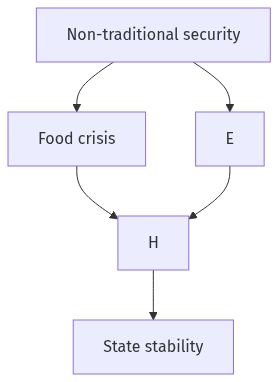
Non-traditional threats do not abolish the state; they overload it. Weak public health and empty granaries can undo a military that looks strong on paper. They also create cooperation: FAO, UNEP, WHO, the Sendai disaster framework, and regional rice reserves in ASEAN. They create conflict when powerful states treat climate or food as someone else’s problem — as in fights over WHO funding and vaccine nationalism. Food and environment now sit on the same agenda as alliances, because they can kill, displace and topple.
Flow diagram
Conclusion
- Food and environmental crises are non-traditional in origin and traditional in effect: they can starve, move and unseat. Human security and state security meet in the granary and the floodplain.
Quick related
Students also ask
-
Comment on the Red Lipstick Movement in the context of feminist rights.
Next question on this syllabus topic (2025 · Q1(e)). View answer →
-
Is climate a national-security issue for India?
Yes as a multiplier: monsoon risk, Himalayan water, coastal cities, disaster budgets and migration. It does not replace China or Pakistan on the classic threat list.
-
Why mention WHO in a food–environment note?
Pandemics and One Health sit on the environment–biology border; U.S. withdrawal debates show how health governance is now high politics.
Same topic · past papers
UPSC has asked this before
These previous-year questions sit on the same topic. Open one to practise the earlier ask.
More from this topic
Q7(a) · UPSC Mains 2026 · PSIR GS 2 · 20 marks · Solution
How does illegal cross border migration pose challenges to India's security? Discuss the steps taken by the government in this direction and their effectiveness
Comparative Politics
Illegal cross-border migration undermines India's national security by altering demographic balances, straining economic resources, and exacerbating internal security vulnerabilities. The government has responded through border fencing, technological integration like SMART fencing, institutional mechanisms, and bilateral agreements. However, porous terrain, regional political complexities, and local connivance limit the complete effectiveness of these measures. A holistic approach combining strict border management with socio-economic development and robust legal frameworks is essential for sustainable containment.
Q5(d) · UPSC Mains 2026 · PSIR GS 2 · 10 marks · Solution
Discuss the main features of the land-boundary agreement between India and Bangladesh.
Comparative Politics
• Operationalized via the 100th Constitutional Amendment Act of 2015 to resolve Radcliffe Line anomalies. • Rooted in the unratified 1974 bilateral agreement and the 2011 additional protocol. • Involved the peaceful exchange of 111 Indian enclaves in Bangladesh and 51 Bangladeshi enclaves in India. • Granted affected residents the sovereign right to choose their nationality and place of residence. • Demarcated roughly 6.1 km of previously un-demarcated land boundaries to end administrative confusion. • Secured human rights and welfare access for over 50,000 formerly stateless enclave residents. • Reduced bilateral trust deficits, paving the way for deeper cooperation in security and connectivity.
Q4(c) · UPSC Mains 2026 · PSIR GS 2 · 15 marks · Solution
What is UNCLOS? Explain its salient features
Comparative Politics
UNCLOS, established in 1982, serves as the constitution of the oceans, codifying customary international law regarding maritime jurisdictions. Its salient features include distinct maritime zones ranging from territorial waters to the high seas, balancing coastal state sovereignty with freedom of navigation. It establishes compulsory dispute settlement mechanisms through institutions like ITLOS. The convention also mandates environmental protection and sustainable management of marine resources. For India, UNCLOS provides a rules-based order in the Indo-Pacific while respecting navigational rights. It remains central to addressing contemporary maritime security and resource challenges.