
Revision summary
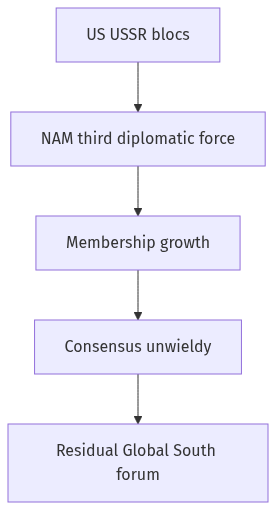
NAM was a third diplomatic force, not a third army, during the Cold War. Decolonisation expanded membership and prestige. Consensus among unlike States produced communiqués more than enforcement. Intra-member wars and Cuba’s Soviet ties exposed the stretch of the label. The movement remains a South forum; unwieldy is a fair description of its method, not a reason to deny its early role.
Model answer
Copper italics in this answer — like this — are the key facts. Each one is unpacked in the Facts & figures rail.
Introduction
NAM presented itself as a third diplomatic force beside NATO and the Warsaw Pact. The comment is largely right: the identity was real in the 1960s, and size plus disagreement later reduced operational unity. Unwieldy does not mean useless.
Body
Third force in the Cold War
- A third force meant a caucus of States that refused formal alliance with Washington or Moscow and that bargained in the UN and in economic talks as a group.
- After Belgrade 1961, NAM coordinated positions on decolonisation, apartheid, and superpower bases.
- It was a force in diplomacy and in numbers at the General Assembly, not a third military pole. It had no joint command and no common nuclear deterrent.
- India, Yugoslavia, and Egypt gave it early prestige. The 1973 oil politics and the New International Economic Order debate showed South bargaining power, even when OPEC was not NAM as such.
Why it grew
- Decolonisation multiplied members. Newly independent States wanted a seat in a club that was not a pact.
- Membership rules were political and loose. States with quite different alignments still claimed the label.
- Havana 1979 and later summits showed a wider ideological range, including Cuba’s close Soviet ties, which older members read as a strain on non-alignment.
Large and unwieldy
- Consensus decision-making among 100-plus members produced long communiqués and few binding outcomes.
- Conflicts among members, including India–Pakistan, Iran–Iraq, and later Gulf wars, could not be settled by NAM.
- Economic diversity from oil exporters to least-developed countries split interests on trade and debt.
- After 1991 the bipolar map that had made a “third” identity simple disappeared. The movement remained, with a weaker contrast object.
Comment that stays fair
- Size was a success of anti-colonial politics and a failure of tight coordination. Both are true.
- Robert Cox would say NAM was a counter-hegemonic language inside a still US-centred world order, not a new order of its own.
- India still uses NAM meetings and the related Global South vocabulary, which shows residual political value.
- The accurate comment is that NAM was a diplomatic third force, never a third superpower, and that expansion without a secretariat of power made it unwieldy.
Flow diagram
Conclusion
NAM was a third force in the sense of a non-bloc diplomatic coalition during the Cold War. It became too large for consensus to equal action. The comment holds if third force is not confused with a third military camp.
Quick related
Students also ask
-
Account for the rise of European Union as a highly influential regional organisation
Next question on this syllabus topic (2023 · Q3(b)). View answer →
-
Did NAM keep India from the 1971 treaty with the USSR?
No. India signed a Treaty of Peace, Friendship and Cooperation while remaining in NAM. Critics called that a tilt; India called it a circumstance of the Bangladesh war.
-
Is a large membership only a weakness?
It is a weakness for rapid action and a strength for legitimacy among developing States.
Same topic · past papers
UPSC has asked this before
These previous-year questions sit on the same topic. Open one to practise the earlier ask.
-
2026 · Q4(b) · PSIR GS 2 · 15 marks
How did the Council of Mutual Economic Assistance (CMEA) reflect geo-political division of the world during the cold war?
More from this topic
Q7(c) · UPSC Mains 2026 · PSIR GS 2 · 15 marks · Solution
India has adopted multi-alignment to fulfill its core values and interests in international relations. Discuss
Changing International Political Order
• Shifted from passive non-alignment to active multi-alignment to navigate a multipolar world. • Preserves strategic autonomy by building overlapping partnerships without joining exclusive blocs. • Drives economic security through diversified energy, trade corridors, and critical technologies. • Promotes a pluralistic, reformed global order rooted in civilizational independence. • Engages simultaneously in diverse platforms like the Quad, BRICS, SCO, and I2U2. • Balances major-power rivalries (US-China, Russia-West) while championing the Global South.
Q4(b) · UPSC Mains 2026 · PSIR GS 2 · 15 marks · Solution
How did the Council of Mutual Economic Assistance (CMEA) reflect geo-political division of the world during the cold war?
Changing International Political Order
The Council of Mutual Economic Assistance (CMEA), established in 1949, served as the Soviet bloc's institutional counterpart to the US-led Marshall Plan, institutionalizing the geo-political division of the global economy during the Cold War. It reflected bipolarity by binding Eastern European satellite states and extra-European socialist economies like Cuba and Vietnam into a centralized, Moscow-directed trade network. While intended to foster socialist internationalism and economic cooperation, it cemented the Eastern Bloc's separation from capitalist markets and reflected asymmetrical Soviet dominance. The organization ultimately highlighted the structural limitations of command economies and disintegrated alongside the Soviet collapse in 1991.
Q8(a) · UPSC Mains 2025 · PSIR GS 2 · 20 marks · Solution
India's reluctance to perceive any 'existential threat' inevitably made the multilateral path to nuclear security a 'default option' until it decided to cross nuclear Rubicon in 1998. Identify and analyze some of the major reasons behind this shift in India's position on the nuclear question
Changing International Political Order
India’s early nuclear path mixed scientific capacity with moral multilateralism and a recessed 1974 PNE. NPT hierarchy, NSG sanctions and CTBT’s closing window turned the default into a cage. China’s arsenal and Pakistan’s weapons-plus-proxy mix supplied the security case for 1998. Vajpayee’s government supplied the political will; status mixed with deterrence. 1998 was admission that survival could no longer be outsourced to a disarming great-power club.