
Revision summary
The EU grew from the 1951 coal and steel pool to a union of law, market, and for many members a currency. Mitrany and Haas explain the method of task integration and spillover. Market size and regulation give the Union influence beyond its members. Enlargement spread that legal order eastward. Military dependence on NATO and internal splits cap that influence.
Model answer
Copper italics in this answer — like this — are the key facts. Each one is unpacked in the Facts & figures rail.
Introduction
The European Union rose from a coal-and-steel pool among six States to a union with a single market, a currency for many members, and a dense legal order. Influence comes from market size, law, and a method of pooling sovereignty that other regions have not copied at the same depth.
Body
Historical rise
- The Schuman Plan and the European Coal and Steel Community (1951) tied French and German heavy industry after two world wars.
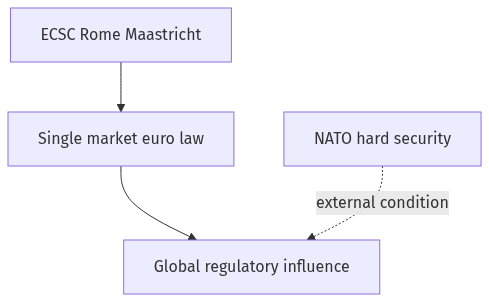
- The Treaty of Rome (1957) created a common market. The Single European Act and the Maastricht Treaty (1992) added political union language, a path to the euro, and a common foreign and security policy in name.
- Enlargement after 1993 and 2004 spread EU law across Central and Eastern Europe. The Lisbon Treaty (2007) adjusted institutions after that growth.
Why it became influential
- Functionalist and neofunctionalist logic, from Mitrany and Haas, fits the early decades: trade and regulation spilled into more policies.
- The single market sets product, data, and competition rules that exporters worldwide must meet. That is regulatory influence, sometimes called the Brussels effect.
- The euro, the European Central Bank, and a large aid and trade network give the Union weight in the IMF, WTO, and climate talks.
- Internally it is a security community. Externally it is a civilian power that still relies on NATO for hard defence, which is a limit as well as a condition of its rise.
Limits that still sit inside the account
- Brexit showed that pooling is reversible in politics if not easily in law.
- Disagreement on migration, fiscal union, and Ukraine-war energy policy shows that influence is not the same as a single State.
- For Waltz, the EU does not cancel anarchy among great powers. For Keohane, it is the densest regime complex in the system.
Flow diagram
Conclusion
The EU rose through task-based integration, enlargement, and a single market whose rules travel. It is highly influential as a regulatory and economic union. It is less so as a military actor, which is part of the same history.
Quick related
Students also ask
-
Discuss the various constraints on American hegemony today. Which of these are likely to become more prominent in the future?
Next question on this syllabus topic (2023 · Q4(c)). View answer →
-
Is the EU a State?
No. It is a union of States with pooled sovereignty in many fields and retained national control in others, especially taxation and armies.
-
Did functionalism alone create the EU?
No. United States security, Cold War politics, and French–German bargains were conditions. Functional method describes how integration thickened.
Same topic · past papers
UPSC has asked this before
These previous-year questions sit on the same topic. Open one to practise the earlier ask.
More from this topic
Q7(c) · UPSC Mains 2026 · PSIR GS 2 · 15 marks · Solution
India has adopted multi-alignment to fulfill its core values and interests in international relations. Discuss
Changing International Political Order
• Shifted from passive non-alignment to active multi-alignment to navigate a multipolar world. • Preserves strategic autonomy by building overlapping partnerships without joining exclusive blocs. • Drives economic security through diversified energy, trade corridors, and critical technologies. • Promotes a pluralistic, reformed global order rooted in civilizational independence. • Engages simultaneously in diverse platforms like the Quad, BRICS, SCO, and I2U2. • Balances major-power rivalries (US-China, Russia-West) while championing the Global South.
Q4(b) · UPSC Mains 2026 · PSIR GS 2 · 15 marks · Solution
How did the Council of Mutual Economic Assistance (CMEA) reflect geo-political division of the world during the cold war?
Changing International Political Order
The Council of Mutual Economic Assistance (CMEA), established in 1949, served as the Soviet bloc's institutional counterpart to the US-led Marshall Plan, institutionalizing the geo-political division of the global economy during the Cold War. It reflected bipolarity by binding Eastern European satellite states and extra-European socialist economies like Cuba and Vietnam into a centralized, Moscow-directed trade network. While intended to foster socialist internationalism and economic cooperation, it cemented the Eastern Bloc's separation from capitalist markets and reflected asymmetrical Soviet dominance. The organization ultimately highlighted the structural limitations of command economies and disintegrated alongside the Soviet collapse in 1991.
Q8(a) · UPSC Mains 2025 · PSIR GS 2 · 20 marks · Solution
India's reluctance to perceive any 'existential threat' inevitably made the multilateral path to nuclear security a 'default option' until it decided to cross nuclear Rubicon in 1998. Identify and analyze some of the major reasons behind this shift in India's position on the nuclear question
Changing International Political Order
India’s early nuclear path mixed scientific capacity with moral multilateralism and a recessed 1974 PNE. NPT hierarchy, NSG sanctions and CTBT’s closing window turned the default into a cage. China’s arsenal and Pakistan’s weapons-plus-proxy mix supplied the security case for 1998. Vajpayee’s government supplied the political will; status mixed with deterrence. 1998 was admission that survival could no longer be outsourced to a disarming great-power club.