
Revision summary
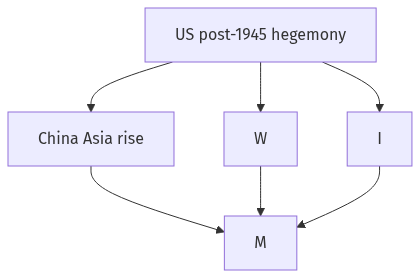
US hegemony mixed force, money, alliances, and a claim to liberal rules. China’s rise, the Afghanistan end in August 2021, and WTO-era rule disputes are present constraints. Cox treats hegemony as consent as well as power; consent is thinner now. Keohane allows cooperation after hegemony, which also means others will not wait on Washington. The future is contested primacy, not automatic Chinese succession.
Model answer
Copper italics in this answer — like this — are the key facts. Each one is unpacked in the Facts & figures rail.
Introduction
American hegemony after 1945 combined military reach, the dollar, alliance networks, and a claim to organise liberal rules. Constraints now come from other centres of capability, from institutions the United States itself built, and from domestic politics. The future is a thicker multipolarity, not an automatic Chinese replacement.
Body
What hegemony meant
- Charles Kindleberger and later hegemonic-stability arguments treated a lead State as the supplier of open trade and reserve currency.
- Robert Cox added that hegemony is also consent around production and ideas, not only ships and bases.
- The United States after 1991 looked unipolar in military terms. That moment was already shorter than the word empire suggested.
Present constraints
- China’s industrial, naval, and technological rise in Asia is the first peer-scale challenge in that region, which is why the Quad exists.
- Russia’s war on Ukraine showed both US alliance leadership in NATO and the limit of global isolation of a nuclear P5 member.
- The WTO appellate crisis, industrial subsidies, and export controls show that Washington will not always live under the rules it designed. Keohane’s After Hegemony already argued that cooperation can persist without a single hegemon, and also that the hegemon may defect.
- Wars in Iraq and Afghanistan, ending with the Taliban takeover of Kabul in August 2021, displayed the limit of military primacy in political reconstruction.
- Domestic polarisation, debt, and industrial capacity gaps constrain long campaigns and even the making of trade agreements.
Future
- Demographic and military advantages remain large. The dollar and alliance system have not collapsed.
- Future constraint is diffusion: EU regulation, Indian and Global South preference for multi-alignment, and issue-based clubs such as I2U2 and the Quad rather than a single US-led map.
- Offensive-realist reading: the United States will try to stop a Chinese regional hegemon. Defensive-realist reading: over-extension is the risk.
- The likely future is contested primacy, not a clean handover and not a restored 1990s unipolarity.
Flow diagram
Conclusion
American hegemony is constrained by China’s rise, by the political failure of long wars, by rule-breaking in the very institutions Washington built, and by US domestic limits. The future is competitive multipolarity in which the United States remains first in many capabilities but not the organiser of a settled consent.
Quick related
Students also ask
-
Arms trade, economic ties and congruent geo-political interests are no longer the three pillars of India - Russia relationship in the emerging strategic context. Comment
Next question on this syllabus topic (2023 · Q6(a)). View answer →
-
Is American decline already complete?
No. Military, financial, and alliance assets remain unmatched as a bundle. Hegemony as uncontested organising power is what is constrained.
-
Does a constraint on the United States automatically help India?
It opens space for multi-alignment. It also raises the cost of a China-centric Asia if US attention or capacity falls.
Same topic · past papers
UPSC has asked this before
These previous-year questions sit on the same topic. Open one to practise the earlier ask.
-
2024 · Q3(c) · PSIR GS 2 · 15 marks
Do you agree with the view that the USA uses NATO as a traditional tool of strategy to perpetuate its hegemony in the world? -
2024 · Q4(a) · PSIR GS 2 · 20 marks
"The Gramscian theory of hegemony provides many valuable insights into the nature of global power." Comment.
More from this topic
Q7(c) · UPSC Mains 2026 · PSIR GS 2 · 15 marks · Solution
India has adopted multi-alignment to fulfill its core values and interests in international relations. Discuss
Changing International Political Order
• Shifted from passive non-alignment to active multi-alignment to navigate a multipolar world. • Preserves strategic autonomy by building overlapping partnerships without joining exclusive blocs. • Drives economic security through diversified energy, trade corridors, and critical technologies. • Promotes a pluralistic, reformed global order rooted in civilizational independence. • Engages simultaneously in diverse platforms like the Quad, BRICS, SCO, and I2U2. • Balances major-power rivalries (US-China, Russia-West) while championing the Global South.
Q4(b) · UPSC Mains 2026 · PSIR GS 2 · 15 marks · Solution
How did the Council of Mutual Economic Assistance (CMEA) reflect geo-political division of the world during the cold war?
Changing International Political Order
The Council of Mutual Economic Assistance (CMEA), established in 1949, served as the Soviet bloc's institutional counterpart to the US-led Marshall Plan, institutionalizing the geo-political division of the global economy during the Cold War. It reflected bipolarity by binding Eastern European satellite states and extra-European socialist economies like Cuba and Vietnam into a centralized, Moscow-directed trade network. While intended to foster socialist internationalism and economic cooperation, it cemented the Eastern Bloc's separation from capitalist markets and reflected asymmetrical Soviet dominance. The organization ultimately highlighted the structural limitations of command economies and disintegrated alongside the Soviet collapse in 1991.
Q8(a) · UPSC Mains 2025 · PSIR GS 2 · 20 marks · Solution
India's reluctance to perceive any 'existential threat' inevitably made the multilateral path to nuclear security a 'default option' until it decided to cross nuclear Rubicon in 1998. Identify and analyze some of the major reasons behind this shift in India's position on the nuclear question
Changing International Political Order
India’s early nuclear path mixed scientific capacity with moral multilateralism and a recessed 1974 PNE. NPT hierarchy, NSG sanctions and CTBT’s closing window turned the default into a cage. China’s arsenal and Pakistan’s weapons-plus-proxy mix supplied the security case for 1998. Vajpayee’s government supplied the political will; status mixed with deterrence. 1998 was admission that survival could no longer be outsourced to a disarming great-power club.