
Revision summary
India’s early nuclear path mixed scientific capacity with moral multilateralism and a recessed 1974 PNE. NPT hierarchy, NSG sanctions and CTBT’s closing window turned the default into a cage. China’s arsenal and Pakistan’s weapons-plus-proxy mix supplied the security case for 1998. Vajpayee’s government supplied the political will; status mixed with deterrence. 1998 was admission that survival could no longer be outsourced to a disarming great-power club.
Model answer
Copper italics in this answer — like this — are the key facts. Each one is unpacked in the Facts & figures rail.
Introduction
- India’s nuclear story is unusual among great-power candidates: a long reluctance to treat the bomb as existential, a 1974 PNE that was not a doctrine, and a default faith that multilateral disarmament would eventually equalise the field. May 1998 ended that default. The shift was not a mood. It was a reading that the multilateral path had become a cage.
Body
The default
Nehru backed both a nuclear science estate and a moral campaign against big-power weapons. India stayed out of the NPT (1968) as a nuclear apartheid treaty, not because it was racing to test. The 1974 Pokhran explosion was called peaceful. Successive governments kept a recessed capability: neither weaponisation at pace nor signature of the NPT. NAM and UN speeches treated general and complete disarmament as the real security. That stance was possible because, in Delhi’s self-picture, no existential threat required a deployed arsenal — China 1962 was a humiliation, not a nuclear lesson fully taken, and Pakistan was not yet a nuclear peer.
Why the multilateral path failed India
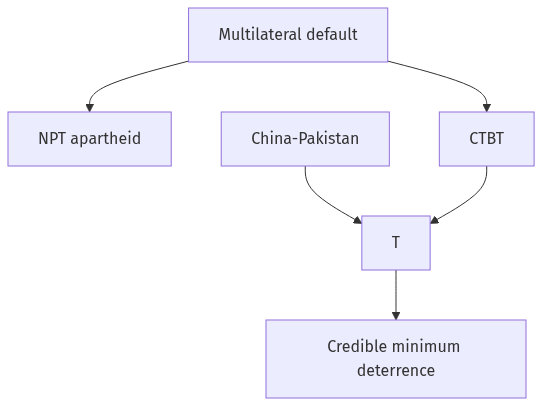
The NPT locked a hierarchy. The CTBT (1996) threatened to close the test window without touching existing arsenals. The NSG after 1974 punished India’s fuel cycle. Great powers preached non-proliferation and modernised their own warheads. After the Cold War, the promised disarmament dividend did not arrive. A default that depended on others’ virtue became, in K. Subrahmanyam’s realist school, a strategic liability.
Why 1998
China was a nuclear weapon state with a rising conventional punch. Pakistan had a weapons programme, A. Q. Khan’s network, and a doctrine of covering jihad with a nuclear shield. The CTBT timeline said: test now or live forever as a threshold state under legal fire. The BJP government of Vajpayee had fewer inhibitions than Congress about breaking the sermon. Status — entry to a de facto nuclear club — mixed with security. The tests were followed by a doctrine of credible minimum deterrence and, later, the U.S. civil nuclear bargain that partially laundered 1998 into the order.
The ‘existential’ word in the question is the key. Until the 1990s India could tell itself that survival did not require a public bomb. China–Pakistan nuclear and missile coupling, and a closing test ban, made that self-talk look like unilateral abstinence. Crossing the Rubicon was the admission that multilateral default had failed the security test, not the moral one alone.
Flow diagram
Conclusion
India delayed the bomb because it did not, for decades, read its threats as existential and because it bet on a disarming world. NPT, CTBT and the China–Pakistan pair killed that bet. 1998 was the security state catching up with a closed multilateral door.
Quick related
Students also ask
-
The changing global order and ongoing regional conflicts, with the global powers taking sides, have jeopardized the progress made towards disarmament in the past. Comment.
Next question on this syllabus topic (2024 · Q1(e)). View answer →
-
Was 1974 already the Rubicon?
It was a technological crossing without a deployed doctrine. 1998 was the political-security crossing.
-
Did the U.S. nuclear deal undo 1998?
It partially integrated India into the order without NPT accession. It did not restore the old multilateral-default faith.
Same topic · past papers
UPSC has asked this before
These previous-year questions sit on the same topic. Open one to practise the earlier ask.
More from this topic
Q7(c) · UPSC Mains 2026 · PSIR GS 2 · 15 marks · Solution
India has adopted multi-alignment to fulfill its core values and interests in international relations. Discuss
Changing International Political Order
• Shifted from passive non-alignment to active multi-alignment to navigate a multipolar world. • Preserves strategic autonomy by building overlapping partnerships without joining exclusive blocs. • Drives economic security through diversified energy, trade corridors, and critical technologies. • Promotes a pluralistic, reformed global order rooted in civilizational independence. • Engages simultaneously in diverse platforms like the Quad, BRICS, SCO, and I2U2. • Balances major-power rivalries (US-China, Russia-West) while championing the Global South.
Q4(b) · UPSC Mains 2026 · PSIR GS 2 · 15 marks · Solution
How did the Council of Mutual Economic Assistance (CMEA) reflect geo-political division of the world during the cold war?
Changing International Political Order
The Council of Mutual Economic Assistance (CMEA), established in 1949, served as the Soviet bloc's institutional counterpart to the US-led Marshall Plan, institutionalizing the geo-political division of the global economy during the Cold War. It reflected bipolarity by binding Eastern European satellite states and extra-European socialist economies like Cuba and Vietnam into a centralized, Moscow-directed trade network. While intended to foster socialist internationalism and economic cooperation, it cemented the Eastern Bloc's separation from capitalist markets and reflected asymmetrical Soviet dominance. The organization ultimately highlighted the structural limitations of command economies and disintegrated alongside the Soviet collapse in 1991.
Q5(d) · UPSC Mains 2025 · PSIR GS 2 · 10 marks · Solution
Does the Non-Aligned Movement have any future in the wake of India's growing indifference towards it?
Changing International Political Order
NAM was India’s bipolar-era instrument: Belgrade 1961, refuse camps, keep voice. Delhi now practises multi-alignment and invests in G20, Quad and 2+2s more than in NAM theatre. Indifference is real because India was NAM’s engine; without it the Movement thins. A future remains as a Global South UN-and-development caucus, not as Cold War neutrality. Verdict: damaged as Indian doctrine, not automatically dead as a membership habit.