
Revision summary
The EU is the deepest regional integration: single market, supranational law, euro for many, Schengen and enlargement conditionality. Success is clearest against ASEAN, SAARC, Mercosur and NAFTA/USMCA in legal depth and peace among former enemies. Challenges: Brexit, Hungarian and Polish rule-of-law conflicts, migration splits, Russia’s war and energy shock, and incomplete fiscal union. NATO still holds the hard-security core. Verdict: most successful experiment so far, under a live stress test of political consent.
Model answer
Copper italics in this answer — like this — are the key facts. Each one is unpacked in the Facts & figures rail.
Introduction
- Regional integration is a crowded field: ASEAN, African Union, Mercosur, USMCA, SAARC. The claim that the European Union has so far been the most successful experiment is justified if success means depth of law, market and peace among former enemies. The same answer must account for recent challenges, or it becomes a brochure.
Body
Successes
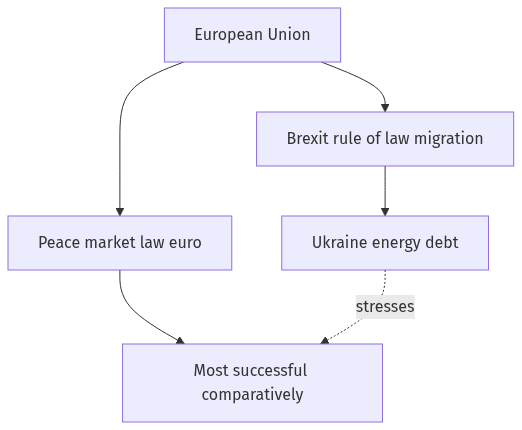
The EU turned a coal-and-steel bargain among states that had destroyed each other twice in a century into a single market, a dense body of directly effective law, a Court of Justice, and, for many members, a single currency. Schengen made internal movement ordinary. Repeated enlargement spread democratic conditionality to Southern and then Eastern Europe. No other regional body has pooled so much regulatory sovereignty or produced so much intra-regional trade as a share of members’ lives. In the language of question 2(b), it is the home of the post-modern state. Compared with ASEAN’s informal consensus or SAARC’s freeze, the EU is a legal community, not only a meeting calendar.
Peace among France and Germany is the foundational success. The euro, for all its faults, is a political fact that NAFTA never attempted. Global standard-setting — data protection, chemicals, digital markets — gives the EU power beyond its military weight.
Recent challenges
Brexit was the first major secession. It showed that pooling is reversible and that identity politics can defeat market logic. Rule-of-law fights with Hungary and Poland exposed a gap: the Union has tools against backsliding, and it uses them slowly. Migration after 2015 split front-line and interior states and revived internal borders. Russia’s war on Ukraine ended the cheap-energy model and forced a security debate that NATO still dominates, which is the limit of EU strategic autonomy. Debt and inflation after the euro crisis and COVID strained North–South solidarity; joint borrowing was a step, not a finished federal treasury. Enlargement toward Ukraine and the Western Balkans will test absorption again.
These challenges are serious. They have not dissolved the single market or the Court. Success is therefore comparative and incomplete.
Verdict
- Yes: the EU remains the most successful regional integration experiment in depth and in transforming interstate war into domestic-style law. No: it is not a finished federation, and the 2010s–2020s have been a stress test of consent. Other regions should copy institutions and law, not a fantasy of frictionless identity.
Flow diagram
Conclusion
The EU’s successes are peace among historic enemies, a single market, supranational law and a currency union for many members. Recent challenges — Brexit, rule of law, migration, war and fiscal strain — show the limits of consent. As a regional experiment it is still first in class. It is not beyond examination.
Quick related
Students also ask
-
Discuss the rationale behind replacing the "Asia-Pacific" strategy with the new term "Indo-Pacific" strategy.
Next question on this syllabus topic (2024 · Q5(d)). View answer →
-
Is ASEAN a fair comparison?
Yes as regionalism, no as legal depth. ASEAN succeeded as a diplomatic community with less pooling. The EU’s claim is about integration, not about every regional goal.
-
Did the EU fail in Ukraine?
It failed as a substitute for NATO hard power. It succeeded as a sanctions, finance and candidate-status actor. That split is the challenge.
Same topic · past papers
UPSC has asked this before
These previous-year questions sit on the same topic. Open one to practise the earlier ask.
More from this topic
Q7(a) · UPSC Mains 2026 · PSIR GS 2 · 20 marks · Solution
How does illegal cross border migration pose challenges to India's security? Discuss the steps taken by the government in this direction and their effectiveness
Comparative Politics
Illegal cross-border migration undermines India's national security by altering demographic balances, straining economic resources, and exacerbating internal security vulnerabilities. The government has responded through border fencing, technological integration like SMART fencing, institutional mechanisms, and bilateral agreements. However, porous terrain, regional political complexities, and local connivance limit the complete effectiveness of these measures. A holistic approach combining strict border management with socio-economic development and robust legal frameworks is essential for sustainable containment.
Q5(d) · UPSC Mains 2026 · PSIR GS 2 · 10 marks · Solution
Discuss the main features of the land-boundary agreement between India and Bangladesh.
Comparative Politics
• Operationalized via the 100th Constitutional Amendment Act of 2015 to resolve Radcliffe Line anomalies. • Rooted in the unratified 1974 bilateral agreement and the 2011 additional protocol. • Involved the peaceful exchange of 111 Indian enclaves in Bangladesh and 51 Bangladeshi enclaves in India. • Granted affected residents the sovereign right to choose their nationality and place of residence. • Demarcated roughly 6.1 km of previously un-demarcated land boundaries to end administrative confusion. • Secured human rights and welfare access for over 50,000 formerly stateless enclave residents. • Reduced bilateral trust deficits, paving the way for deeper cooperation in security and connectivity.
Q4(c) · UPSC Mains 2026 · PSIR GS 2 · 15 marks · Solution
What is UNCLOS? Explain its salient features
Comparative Politics
UNCLOS, established in 1982, serves as the constitution of the oceans, codifying customary international law regarding maritime jurisdictions. Its salient features include distinct maritime zones ranging from territorial waters to the high seas, balancing coastal state sovereignty with freedom of navigation. It establishes compulsory dispute settlement mechanisms through institutions like ITLOS. The convention also mandates environmental protection and sustainable management of marine resources. For India, UNCLOS provides a rules-based order in the Indo-Pacific while respecting navigational rights. It remains central to addressing contemporary maritime security and resource challenges.