
Revision summary
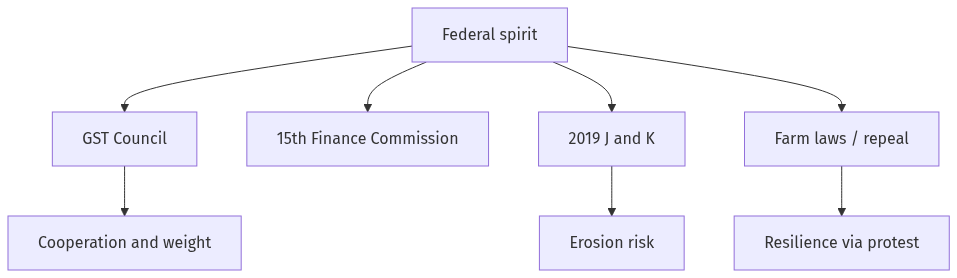
The spirit of Indian federalism is bargaining among units, not only the three Lists. GST created a shared tax forum that the Supreme Court treated as federal dialogue, while compensation and Union weight still skew the table. The 2019 J&K reorganisation is the strongest evidence of unilateral thinning of a constituent unit, even after judicial upholding. The farm laws showed Union overreach into the agrarian political economy; their repeal showed that protest and states can restore bargaining. The Fifteenth Finance Commission remains a constitutional federal mechanism, contested over 2011 population and cesses that bypass the divisible pool.
Model answer
Copper italics in this answer — like this — are the key facts. Each one is unpacked in the Facts & figures rail.
Introduction
India is a Union that Ambedkar said could be both unitary and federal as need required. The ‘true spirit’ of federalism is not only a list of Lists in the Seventh Schedule. It is the habit of bargaining with states as partners. Recent years supply evidence for both erosion and resilience. A critical examination must use the illustrations asked for, not a hymn to cooperative federalism or a dirge.
Body
GST: shared tax, strained voice
The Goods and Services Tax created a common market and a GST Council, which the Supreme Court in Union of India v. Mohit Minerals (2022) described as a forum of federal dialogue whose recommendations have a real, though not dictatorial, force. That is an institutional deepening of shared rule. At the same time, compensation politics, rate-setting in which the Union’s weight is heavy, and delays in meeting states’ cash-flow fears show a spirit that can become Union-led uniformity. K. C. Wheare’s classical coordinate federalism was never India’s model; Granville Austin’s cooperative federalism is closer. GST tests whether cooperation is consent or compliance.
Jammu and Kashmir, 2019
The end of Article 370 and the conversion of a state into Union Territories without the kind of state-legislature consent that many federal theorists would expect is the hardest illustration against the claim. Even if the Supreme Court upheld the constitutional pathway, the political spirit of federalism — that a constituent unit’s identity is not unilaterally thinned — was strained. Ladakh’s demand for a legislature and J&K’s demand for statehood are the aftershocks of that strain.
Farm laws and repeal
The 2020 farm laws used Union entries with thin committee scrutiny. States and farmers treated this as an invasion of agriculture in spirit. Their repeal in 2021 showed that protest and party maps can restore bargaining — resilience from society, not from the original process.
Fifteenth Finance Commission
Using 2011 population, the 15th FC reopened southern fears of being punished for lower fertility. Article 280 remains a federal pillar; cesses that bypass the divisible pool weaken it. The claim of an uneroded spirit is too smooth. GST and the FC still work, roughly. J&K 2019 and the farm laws show unilateralism, partly corrected. Living federalism is this oscillation.
Flow diagram
Conclusion
Recent politics has both used and bruised the federal spirit. GST and the Fifteenth Finance Commission keep shared rule alive under Union weight. The 2019 J&K change and the farm laws reveal how far the Centre can go; the farm-law repeal shows that states and movements can still force a return to bargaining. The statement is only half true, and the illustrations are why.
Quick related
Students also ask
-
Discuss the major provisions of the 74th Constitutional Amendment Act. Do you think that the Act remains an 'unfulfilled dream'? Argue your case
Next question on this syllabus topic (2023 · Q6(a)). View answer →
-
Did the Supreme Court say GST destroyed federalism?
No. In Mohit Minerals it treated the Council as a federal forum and refused to make the Union the sole voice of GST law.
-
Is repeal of the farm laws proof that federalism is healthy?
It is proof that extra-parliamentary and electoral federalism can correct a central statute. It is not proof that the original process honoured states.
Same topic · past papers
UPSC has asked this before
These previous-year questions sit on the same topic. Open one to practise the earlier ask.
-
2024 · Q2(a) · PSIR GS 1 · 20 marks
Elucidate the meanings inherent in the term "political" with appropriate illustrations.
More from this topic
Q7(b) · UPSC Mains 2026 · PSIR GS 1 · 15 marks · Solution
Highlight any five constitutional provisions that restrain the powers of the executive, and evaluate their effectiveness in current times
Federalism
This model answer examines five constitutional mechanisms designed to check executive overreach in India: parliamentary accountability, judicial review under Article 13 and 32, the President's suspensive veto, the federal distribution of powers under the Seventh Schedule, and constitutional bodies like the Election Commission. It analyses their formal design alongside contemporary challenges to their operational efficacy, such as declining parliamentary scrutiny, ordinance routes, and pressure on institutional autonomy. The synthesis underscores that while the textual architecture for executive restraint is robust, its real-world effectiveness depends on political morality and judicial vigilance.
Q6(c) · UPSC Mains 2026 · PSIR GS 1 · 15 marks · Solution
Evaluate the Centre-State relation with reference to Article 293 and analyze its implications for the Indian federal structure
Federalism
Article 293 empowers states to borrow within territory limits subject to Centre's consent if central loans are outstanding. This fiscal lever has triggered intense friction between the Union and opposition-ruled states over net borrowing ceilings and off-budget borrowings. While designed for macroeconomic stability, its centralized enforcement risks undermining the fiscal autonomy of states. The judiciary and Sarkaria-Punchhi commissions have repeatedly emphasized consultative fiscal federalism to resolve such tensions.
Q6(b) · UPSC Mains 2025 · PSIR GS 1 · 15 marks · Solution
Examine the constitutional provisions and nature of advisory jurisdiction of Supreme Court of India. Evaluate your answer with relevant examples
Federalism
Article 143 lets the President refer questions of public importance to the Supreme Court for an opinion. Clause (1) is discretionary for the Court; clause (2) on certain treaty disputes requires a report. The opinion is not an ordinary decree, though it is politically and legally weighty. Kerala Education Bill and Berubari show the jurisdiction at its best as advance constitutional counsel. The Ayodhya reference shows the Court may refuse a question that is better left to a pending suit; 2G shows how an invited opinion can bind the inviter politically.