
Revision summary
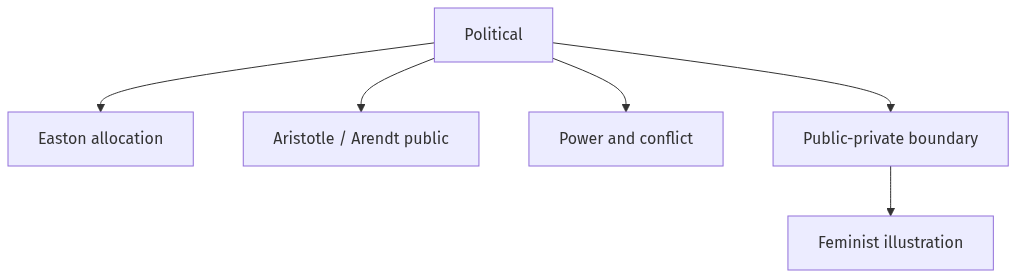
The political is not one object but a set of meanings used in political theory. Easton’s meaning is the authoritative allocation of values, illustrated by budgets, courts, and elections. Aristotle and Arendt treat the political as public speech and action among citizens, illustrated by assemblies and satyagraha. Marx, Schmitt, Dahl, and Gramsci treat it as organised power, conflict, decision, and hegemony. Feminist theory and movements such as anti-arrack show that the public–private boundary itself is a political question.
Model answer
Copper italics in this answer — like this — are the key facts. Each one is unpacked in the Facts & figures rail.
Introduction
- The word political does not name one object. It names a family of meanings: the public allocation of values, the life of the polis, the contest for power, and the drawing of a line between public and private. To elucidate those meanings with illustrations is to show why students of political theory cannot treat the term as self-evident.
Body
Authoritative allocation
David Easton defined politics as the authoritative allocation of values for a society. A budget that funds a scheme and denies another, a court that upholds a right, and an election that authorises a cabinet are political in this sense. The illustration is ordinary government. What makes the act political is not passion but authority that binds.
The polis and public action
For Aristotle, the political is the life of the polis, where speech about justice is possible among citizens. Hannah Arendt recovered action and plurality: politics is appearing before others in a public space, not the household’s labour and not the craftsman’s making. Parliament, a Gram Sabha after the 73rd Amendment, and a satyagraha meeting are illustrations. A closed family decision is, on this map, not yet political.
Power, conflict, and the state
Realists and Marx treat the political as organised power and conflict. Carl Schmitt made the friend–enemy distinction the criterion of the political. War, party cleavage, and class struggle illustrate this darker sense. Dahl’s decisions and Gramsci’s hegemony both belong here: politics is who prevails and whose common sense rules.
Boundary work
Feminist theory, and Carole Pateman in particular, showed that calling the household pre-political hid male power. The slogan that the personal is political does not mean that every feeling is a statute. It means that marriage law, unpaid care, and domestic violence are already organised by public power. India’s anti-arrack movement in Andhra Pradesh illustrated that a ‘private’ liquor economy was a public injury to women.
Liberal theory still needs a public–private distinction so that conscience is not fully administered. The political, then, is also the activity of drawing that line: what the state may command, and what it may not.
A working set of meanings
- One may therefore say: the political is (i) authoritative allocation, (ii) civic public action, (iii) organised power and conflict, and (iv) the contest over the public–private boundary. Locke’s civil government, Rawls’s basic structure, and Habermas’s public sphere each emphasise a different member of this set. Illustrations should be matched to the meaning in use, or debate talks past itself.
Flow diagram
Conclusion
The term political means authoritative allocation, public civic action, organised power, and the drawing of the public–private line. Easton, Aristotle, Arendt, Marx, Schmitt, Dahl, Gramsci, and feminist theory name these senses. Clear writing states which meaning is in play and illustrates it, rather than treating political as a single undefined atmosphere.
Quick related
Students also ask
-
Dharmashastra presents a duty-centric worldview for individuals and communities. Comment.
Next question on this syllabus topic (2024 · Q3(c)). View answer →
-
Is every social issue political?
On the feminist and Eastonian maps, an issue becomes political when it is bound by public authority or when the public–private line is itself contested. Not every private preference is a political act.
-
Why does Schmitt’s friend–enemy criterion matter?
It shows a meaning of the political as existential conflict. Liberal theory rejects making that the whole of politics, but it names a real limit case of power.
Same topic · past papers
UPSC has asked this before
These previous-year questions sit on the same topic. Open one to practise the earlier ask.
-
2025 · Q6(c) · PSIR GS 1 · 15 marks
The recent developments in Indian Politics has not eroded the true spirit of federalism in India. Critically examine this statement with the help of appropriate illustrations -
2026 · Q1(a) · PSIR GS 1 · 10 marks
Resurgence of political theory. -
2026 · Q8(c) · PSIR GS 1 · 15 marks
"The lack of political will in preventing environmental degradation is one of the major challenges that India is experiencing." Comment -
2025 · Q1(a) · PSIR GS 1 · 10 marks
Explain the Philosophical approach to the study of Political theory -
2025 · Q3(a) · PSIR GS 1 · 20 marks
Provide a comparative analysis of behavioural and institutional approach to the study of Political theory
More from this topic
Q8(c) · UPSC Mains 2026 · PSIR GS 1 · 15 marks · Solution
"The lack of political will in preventing environmental degradation is one of the major challenges that India is experiencing." Comment
Political Theory
This 15-mark PSIR answer evaluates India's environmental degradation through the lens of political will, balancing developmental imperatives with ecological imperatives. It examines how electoral cycles, populist short-termism, and growth-first paradigms often sideline ecological security. Key thinkers like Ramachandra Guha and political economy frameworks are integrated to explain the structural inertia. The response provides Indian illustrations ranging from developmental clearances to air pollution crises. It concludes with a policy-forward outlook anchored in constitutional provisions like Article 48A and 51A(g).
Q8(a) · UPSC Mains 2026 · PSIR GS 1 · 20 marks · Solution
Discuss the causes and consequences of inter-State water disputes in India
Political Theory
This answer examines the structural causes and multi-dimensional consequences of inter-State water disputes in India. It highlights federal friction, climate variability, and legal-institutional gaps as primary causes. The consequences span socio-economic losses, inter-regional animosity, and challenges to federal integrity. The response incorporates institutional frameworks like the Inter-State Water Disputes Act and concludes with cooperative water federalism as the way forward.
Q7(c) · UPSC Mains 2026 · PSIR GS 1 · 15 marks · Solution
Map the different types of ethnic conflicts that have emerged in 21st century India
Political Theory
This 15-marker maps the typology of ethnic conflicts in 21st-century India, distinguishing between indigenous-immigrant clashes, tribal identity assertions, and sub-nationalist movements. It examines the structural roots of these conflicts in uneven development, resource competition, and cultural anxiety. The answer integrates theoretical insights on identity politics with concrete Indian case studies across the Northeast and mainland. It concludes with a policy-oriented view emphasizing federal accommodation, democratic dialogue, and inclusive development.