
Revision summary
The 74th Amendment inserted Part IXA and the Twelfth Schedule of eighteen municipal functions. It requires regular elections, reservations including for women, a State Finance Commission, and district and metropolitan planning committees. Devolution of functions, funds, and functionaries remains a State choice, so parastatals and commissioners often still run the city. Constitutional status of municipalities is achieved; self-government in daily urban services is not. The Act is therefore a partially fulfilled design: constitutional status exists, and a completed third tier of functions and funds does not.
Model answer
Copper italics in this answer — like this — are the key facts. Each one is unpacked in the Facts & figures rail.
Introduction
The Constitution (Seventy-fourth Amendment) Act, 1992, inserted Part IXA and made municipalities a third tier of government. The major provisions are institutional: elections, functions, finance commissions, and district planning. Whether the Act is an unfulfilled dream depends on whether States actually transferred functions, funds, and functionaries listed in the Twelfth Schedule.
Body
Major provisions
- Part IXA (Articles 243P to 243ZG) defines municipalities: Nagar Panchayat, Municipal Council, and Municipal Corporation, according to the size and nature of the urban area.
- Regular elections under a State Election Commission, a five-year term, and a bar on prolonged supersession are meant to end administrator rule as the normal form.
- Article 243T reserves seats for Scheduled Castes and Scheduled Tribes in proportion to population, and not less than one-third of seats (including offices of chairpersons, as the State provides) for women.
- Article 243W read with the Twelfth Schedule lists eighteen functions that the State legislature may endow, including urban planning, land use, water, public health, fire services, and slum improvement.
- Articles 243X and 243Y provide for municipal taxes, duties, tolls and fees, and for a State Finance Commission to review the financial position of municipalities.
- Article 243ZD and 243ZE create District Planning Committees and Metropolitan Planning Committees to integrate rural and urban plans.
- Article 243ZG bars courts from interfering in electoral matters except by election petition, on the model of panchayat elections.
The unfulfilled-dream argument
- The Amendment is a framework. Devolution of the Twelfth Schedule is left to State legislatures, so parastatal development authorities, water boards, and State-appointed commissioners still hold the functions the Schedule names.
- Property-tax ceilings, delayed State Finance Commission awards, and poor own-revenue keep municipalities grant-dependent.
- Mayor–commissioner splits, delayed elections, and nominated local bodies in practice contradict the five-year elected term.
- District Planning Committees often exist on paper, which empties the spatial-planning promise of Article 243ZD.
- Granville Austin’s social-revolution strand of the Constitution is incomplete in cities if elected councils cannot run water, planning, and housing.
The contrary case, and a judgment
- The dream is not empty: reserved women councillors, State Election Commissions, and the legal duty to constitute municipalities are real.
- The 74th Amendment created a justiciable expectation of local democracy that did not exist as higher law before 1993.
- Dahl’s polyarchy at the municipal scale still requires contestation plus capacity; India built the first more than the second.
- The accurate judgment is that the Act is a partially fulfilled design: constitutional status is achieved, functional and financial self-government is not.
- Fulfilment now depends on State conformity laws that transfer the Schedule, fix a powerful elected executive, and publish devolution data, not on another Union slogan.
Flow diagram
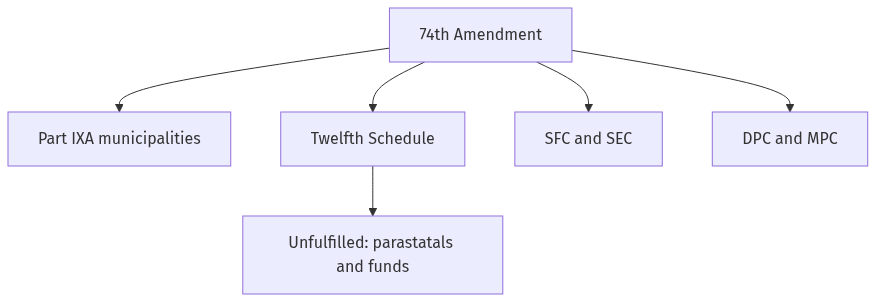
Conclusion
The 74th Amendment’s major provisions are Part IXA, the Twelfth Schedule, reserved councils, State Finance and Election Commissions, and district and metropolitan planning. It remains an unfulfilled dream in functions and funds, and a fulfilled one in constitutional status. The remaining work is State devolution, not the absence of a text.
Quick related
Students also ask
-
The rise of caste politics is to be attributed to both regional aspirations and electoral manifestations. Comment
Next question on this syllabus topic (2023 · Q8(a)). View answer →
-
Can the Union force a State to transfer water and planning to the corporation?
Not by a simple executive order. Article 243W leaves endowment to the State legislature. The Union can set schemes and conditions, not rewrite the municipal list.
-
Is the 74th Amendment useless without funds?
Without funds it cannot deliver services. It is still not useless: it makes delayed elections and missing SFCs a constitutional failure, not only a political complaint.
Same topic · past papers
UPSC has asked this before
These previous-year questions sit on the same topic. Open one to practise the earlier ask.
-
2025 · Q7(b) · PSIR GS 1 · 20 marks
Caste remains a vital axis for political mobilisation in India. How would the caste census address the aspirations of people? Discuss
More from this topic
Q7(b) · UPSC Mains 2026 · PSIR GS 1 · 15 marks · Solution
Highlight any five constitutional provisions that restrain the powers of the executive, and evaluate their effectiveness in current times
Federalism
This model answer examines five constitutional mechanisms designed to check executive overreach in India: parliamentary accountability, judicial review under Article 13 and 32, the President's suspensive veto, the federal distribution of powers under the Seventh Schedule, and constitutional bodies like the Election Commission. It analyses their formal design alongside contemporary challenges to their operational efficacy, such as declining parliamentary scrutiny, ordinance routes, and pressure on institutional autonomy. The synthesis underscores that while the textual architecture for executive restraint is robust, its real-world effectiveness depends on political morality and judicial vigilance.
Q6(c) · UPSC Mains 2026 · PSIR GS 1 · 15 marks · Solution
Evaluate the Centre-State relation with reference to Article 293 and analyze its implications for the Indian federal structure
Federalism
Article 293 empowers states to borrow within territory limits subject to Centre's consent if central loans are outstanding. This fiscal lever has triggered intense friction between the Union and opposition-ruled states over net borrowing ceilings and off-budget borrowings. While designed for macroeconomic stability, its centralized enforcement risks undermining the fiscal autonomy of states. The judiciary and Sarkaria-Punchhi commissions have repeatedly emphasized consultative fiscal federalism to resolve such tensions.
Q6(b) · UPSC Mains 2025 · PSIR GS 1 · 15 marks · Solution
Examine the constitutional provisions and nature of advisory jurisdiction of Supreme Court of India. Evaluate your answer with relevant examples
Federalism
Article 143 lets the President refer questions of public importance to the Supreme Court for an opinion. Clause (1) is discretionary for the Court; clause (2) on certain treaty disputes requires a report. The opinion is not an ordinary decree, though it is politically and legally weighty. Kerala Education Bill and Berubari show the jurisdiction at its best as advance constitutional counsel. The Ayodhya reference shows the Court may refuse a question that is better left to a pending suit; 2G shows how an invited opinion can bind the inviter politically.