
Revision summary
Fascism is a genus of revolutionary right-wing mass movements hostile to liberal parliament and to Marxism. Italian Fascism under Mussolini and Gentile exalted the ethical state, corporatism, and Roman imperial myth. Race was not its original core, though racial laws arrived in 1938 under German pressure. German National Socialism made biological antisemitism, Gleichschaltung, and genocidal war the centre of the regime. Griffin’s palingenetic ultranationalism covers both; Paxton and Arendt help explain why the German brand became totalitarian in a harsher sense.
Model answer
Copper italics in this answer — like this — are the key facts. Each one is unpacked in the Facts & figures rail.
Introduction
- Fascism is a revolutionary right-wing family: mass mobilisation, a cult of the leader, hostility to liberal parliament and to Marxist class war, and the worship of the nation as an organism. Stanley Payne, Roger Griffin, and Robert Paxton treat it as a genus. The Italian and German brands are the two type-species, and they are not twins.
Body
Italian Fascism
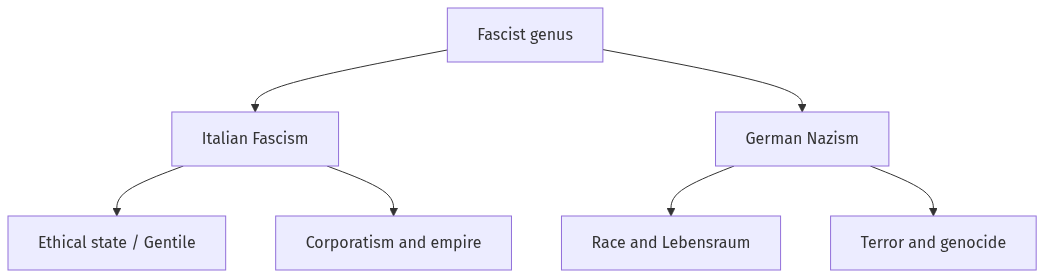
Benito Mussolini’s movement rose in a recently unified Italy, among veterans, nationalists, and a weak liberal state. Giovanni Gentile supplied actualism: the state as the true ethical reality, the individual complete only inside it. The 1932 Doctrine of Fascism, issued under Mussolini’s name, rejected both socialism and laissez-faire. Corporatism would organise capital and labour in state-supervised syndicates. The myth was Romanita, the new Rome, and later empire in Ethiopia.
Race was secondary at first. Italy persecuted enemies, invaded, and issued racial laws in 1938 under German pressure, but it did not begin as a biological world-view. The monarchy and the Church survived until the Salò collapse. Violence was squadrist and imperial, not industrial genocide as the original core.
German National Socialism
Adolf Hitler’s National Socialism was built on völkisch antisemitism and a racial hierarchy with Jews as the existential enemy. Gleichschaltung coordinated party and state. War in the east was annihilation, with the Holocaust as policy. Hannah Arendt analysed this as ideology plus terror.
Italian doctrine exalted the ethical state; Nazi practice exalted race and Lebensraum. Both crushed labour and the left and used Griffin’s palingenetic myth of rebirth. Biological racism and genocide are the decisive German difference.
Flow diagram
Conclusion
Italian Fascism was statolatry, corporatism, and imperial nationalism with a later racial overlay. German Nazism was racial totalitarianism and genocidal war. They share the fascist genus — leader, mass, anti-liberalism, anti-Marxism — and they must still be distinguished, or the word fascism loses its edge.
Quick related
Students also ask
-
Karl Popper presents a defence of the open society against its enemies. Elaborate
Next question on this syllabus topic (2025 · Q2(b)). View answer →
-
Was Italian Fascism totalitarian?
It aspired to total claim over politics and often used the word. The monarchy, Church, and incomplete coordination make many historians call it authoritarian-totalitarian rather than the full Nazi type.
-
Why not treat both as simply ‘dictatorship’?
Dictatorship is a form. Fascism is a mobilising ideology of national rebirth. The Italian–German contrast shows different cores inside that ideology.
Same topic · past papers
UPSC has asked this before
These previous-year questions sit on the same topic. Open one to practise the earlier ask.
-
2023 · Q3(a) · PSIR GS 1 · 20 marks
Fascism displays an ambivalent stance towards parliamentary democracy. Explain
More from this topic
Q8(c) · UPSC Mains 2026 · PSIR GS 1 · 15 marks · Solution
"The lack of political will in preventing environmental degradation is one of the major challenges that India is experiencing." Comment
Political Theory
This 15-mark PSIR answer evaluates India's environmental degradation through the lens of political will, balancing developmental imperatives with ecological imperatives. It examines how electoral cycles, populist short-termism, and growth-first paradigms often sideline ecological security. Key thinkers like Ramachandra Guha and political economy frameworks are integrated to explain the structural inertia. The response provides Indian illustrations ranging from developmental clearances to air pollution crises. It concludes with a policy-forward outlook anchored in constitutional provisions like Article 48A and 51A(g).
Q8(a) · UPSC Mains 2026 · PSIR GS 1 · 20 marks · Solution
Discuss the causes and consequences of inter-State water disputes in India
Political Theory
This answer examines the structural causes and multi-dimensional consequences of inter-State water disputes in India. It highlights federal friction, climate variability, and legal-institutional gaps as primary causes. The consequences span socio-economic losses, inter-regional animosity, and challenges to federal integrity. The response incorporates institutional frameworks like the Inter-State Water Disputes Act and concludes with cooperative water federalism as the way forward.
Q7(c) · UPSC Mains 2026 · PSIR GS 1 · 15 marks · Solution
Map the different types of ethnic conflicts that have emerged in 21st century India
Political Theory
This 15-marker maps the typology of ethnic conflicts in 21st-century India, distinguishing between indigenous-immigrant clashes, tribal identity assertions, and sub-nationalist movements. It examines the structural roots of these conflicts in uneven development, resource competition, and cultural anxiety. The answer integrates theoretical insights on identity politics with concrete Indian case studies across the Northeast and mainland. It concludes with a policy-oriented view emphasizing federal accommodation, democratic dialogue, and inclusive development.