
Revision summary
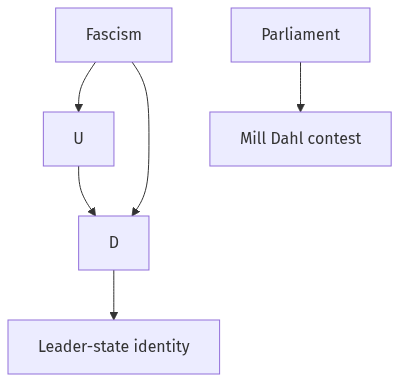
Fascism rejects liberal parliament as talk, class division, and weak decision. It still uses elections, ministries, and plebiscites as a road to monopoly. Schmitt and Gentile supply the anti-parliamentary doctrine; Mill and Dahl supply the democratic criterion that is abolished. Enabling acts and emergency power convert a majority into a regime without removable opposition. Post-war rights and basic-structure limits are designed against that ambivalence.
Model answer
Copper italics in this answer — like this — are the key facts. Each one is unpacked in the Facts & figures rail.
Introduction
Fascism did not treat parliamentary democracy as a partner in a mixed constitution. It used parliament, elections, and mass mobilisation to capture the state, and then emptied those forms of opposition, rights, and limited government. The stance is ambivalent because the movement both exploited democratic devices and defined itself against liberal parliament.
Body
What fascism opposed in parliament
- Liberal parliament, in Mill and in Dahl’s polyarchy, is a place of contest, publicity, and removable rulers.
- Fascist theory, in Giovanni Gentile and in Mussolini’s doctrine, treated the individual as real only inside the state, which cancels Mill’s harm-limited liberty.
- Carl Schmitt attacked parliament as endless talk that cannot decide in an emergency, and he praised acclamation over discussion.
- Multi-party bargaining was named as weakness, class conflict, and national humiliation after war and economic crisis.
- The fascist alternative was a single movement, a leader, and a corporatist organisation of labour and capital under the state.
How fascism used democratic forms
- Italian Fascists and German National Socialists contested elections, sat in chambers, and formed ministries by constitutional appointment before they destroyed the same constitution.
- Plebiscites and managed acclamation produced a show of popular unity without an opposition that could win.
- Mass suffrage was not rejected as a number. It was recoded as the leader’s identity with the people, which is the opposite of Locke’s trust and of Rawls’s public reason.
- Emergency decrees, enabling acts, and violence against rivals converted a parliamentary majority into a monopoly.
- The ambivalence is therefore tactical and ideological at once: parliament is useful as a ladder and illegitimate as a continuing limit.
Why the ambivalence matters for democratic theory
- A democracy that does not limit its own power, the theme of Hobbes versus constitutionalism, can vote in its own replacement.
- Foucault’s work on how bodies and populations are governed helps explain fascist spectacle, youth organisations, and racial statistics as power, not only as ideology.
- Easton’s support can be mobilised by propaganda so that outputs look authoritative while opposition inputs are closed.
- Post-war constitutions, including India’s Part III, militant democracy in some European texts, and Kesavananda’s basic structure, are replies to that ambivalence: some devices of popular government are not available to abolish the regime of rights.
- The explanation is complete only if it names both the anti-parliamentary doctrine and the parliamentary road to dictatorship.
Limits of the explanation
- Not every strong executive is fascist. The test is the destruction of organised opposition, independent courts, and equal citizenship, often with a myth of national rebirth and enemies within.
- Parliamentary democracy can fail for other reasons, including colonial exclusion and caste, which Ambedkar named; those failures are not identical with fascism.
- Ambivalence is not sympathy. It is the combination of use and destruction.
Flow diagram
Conclusion
Fascism is ambivalent toward parliamentary democracy because it uses elections and chambers to take power and then abolishes contest, rights, and limited government. Mill, Dahl, and constitutional basic structure name what is destroyed. Schmitt and Gentile name the doctrine that justifies the destruction.
Quick related
Students also ask
-
Environmentalism of the poor.
Next question on this syllabus topic (2023 · Q5(b)). View answer →
-
Did fascists always reject universal suffrage?
They often kept mass mobilisation and plebiscites. They rejected a suffrage that could replace the leader through organised opposition.
-
Is a hung parliament a fascist situation?
No. Coalition bargaining is a liberal-parliamentary method. Fascism treats that bargaining as a disease to be ended.
Same topic · past papers
UPSC has asked this before
These previous-year questions sit on the same topic. Open one to practise the earlier ask.
More from this topic
Q8(b) · UPSC Mains 2026 · PSIR GS 1 · 15 marks · Solution
Critically comment on the shifts in the functioning of the Indian Parliament in the last two decades
Indian Nationalism
This 15-mark answer analyses the transformation of the Indian Parliament over the past two decades, moving from a deliberative forum to an arena of executive assertion. It highlights declining debate hours, bypassing of Department-Related Standing Committees (DRSCs), and the rise of ordinance-making and bypassing of bicameral consensus through Money Bills. The critique incorporates Morris-Jones and Pratap Bhanu Mehta's insights on the hollowing out of institutions. The conclusion argues for systemic institutional reforms to restore Parliament's core constitutional role as a deliberative check on executive power.
Q7(a) · UPSC Mains 2025 · PSIR GS 1 · 20 marks · Solution
Enunciate the impediments to women's participation in local governance in the process of political decentralisation
Indian Nationalism
The 73rd and 74th Amendments reserved local seats for women, which is a structural opening, not yet equal participation. Sarpanch-pati proxy rule, unpaid care, and a male bureaucracy remain the everyday patriarchal impediments. Caste and class decide which women can act; Dalit women office-holders face additional violence and veto. Thin devolution of money and staff makes many local offices ceremonial, so participation has no policy content. Parties and seat rotation often transfer the reserved ticket to a household rather than building a woman’s public career.
Q7(b) · UPSC Mains 2025 · PSIR GS 1 · 20 marks · Solution
Caste remains a vital axis for political mobilisation in India. How would the caste census address the aspirations of people? Discuss
Indian Nationalism
Caste remains a mobilisation axis because it still structures dignity, land, and access to the state, as Kothari, Mandal, and bahujan politics show. Parties already count jatis; the demand is that the official Census should too, beyond SC and ST. Aspirations include fairer reservation design, targeting of welfare, and recognition after the unpublished 2011 SECC caste data. Risks include reification of identity and a pure percentage war that forgets class, gender, and Ambedkar’s horizon of annihilation. A democratic census would publish usable aggregates while protecting persons and keeping constitutional individual rights at the centre.