
Revision summary
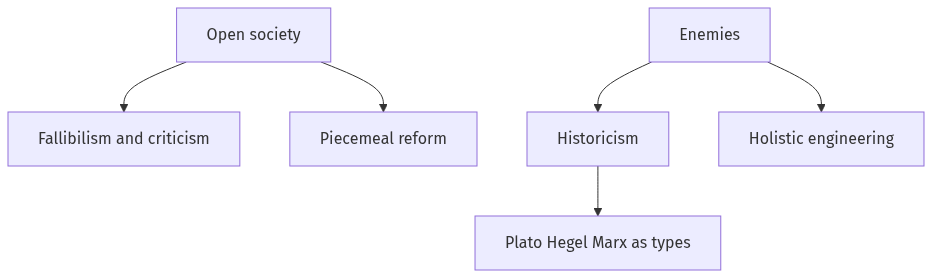
Popper’s open society is one in which laws and rulers can be criticised and changed without a myth of historical destiny. It is the political partner of falsification: policies are experiments, not revelations. Historicism and holistic social engineering are the intellectual enemies, illustrated through his readings of Plato, Hegel, and Marx. Piecemeal social engineering, democratic dismissal of governments, and the prevention of suffering form the defence. The argument is epistemological as much as moral: no guardian, party, or philosopher-king owns the whole of social knowledge.
Model answer
Copper italics in this answer — like this — are the key facts. Each one is unpacked in the Facts & figures rail.
Introduction
Karl Popper wrote The Open Society and Its Enemies in wartime, as a defence of a society that can change its laws without blood-myths of destiny. An open society is one in which institutions are criticisable, rulers can be dismissed, and no class of guardians owns the meaning of history. Its enemies are those who claim scientific or philosophical knowledge of the whole of social fate.
Body
Open and closed
Popper’s open society is the political twin of his philosophy of science. In science, theories are conjectures that survive attempted falsification. In politics, policies are experiments that must be open to criticism and reversal. A closed society, by contrast, resembles a tribe bound by taboo, or a state bound by an unfalsifiable philosophy of history. The individual is absorbed into the whole. Dissent is treachery against being itself.
- He therefore attacks historicism: the belief that history has laws from which the future can be prophesied, and that politics should accelerate that necessity. Holistic social engineering follows. If one knows the true form of the city, one may remake persons and institutions in a single sweep.
The enemies named
Plato, on Popper’s reading, designs a closed city of guardians and noble lies. Hegel is charged with blessing success as the march of Spirit. Marx is praised for a hypothesis about capitalism, then condemned for a historicist prophecy that licensed violence and silenced criticism. They feed a politics that cannot admit error.
The defence
- The defence is piecemeal social engineering: reform one institution, watch, correct. Popper supported a protective state against misery; he refused total knowledge. Negative utilitarianism fits better than a blueprint of happiness. Freedom of criticism and the right to dismiss a government without civil war are fallibilism in institutions. Mill is nearby, but Popper’s edge is epistemological: planners and vanguards err too. Critics say he caricatured Plato and Hegel. The defence still stands: an open society can say it was wrong.
Flow diagram
Conclusion
Popper defends the open society as a criticisable order of free individuals against historicist enemies who would close the future in the name of Plato’s city, Hegel’s Spirit, or Marx’s necessity. Piecemeal engineering, democracy, and fallibilism are the political method of that defence. The open society is not a tribe with better manners; it is a civilisation that institutionalises the right to be mistaken.
Quick related
Students also ask
-
Provide a comparative analysis of behavioural and institutional approach to the study of Political theory
Next question on this syllabus topic (2025 · Q3(a)). View answer →
-
Did Popper reject all planning?
No. He rejected holistic, unfalsifiable planning. He accepted targeted state action against misery, provided it could be criticised and undone.
-
Why is Marx listed among enemies if Popper respected his critique of capitalism?
Because, for Popper, Marx’s historicist prophecy and the politics it licensed closed criticism, which is the cardinal sin against an open society.
Same topic · past papers
UPSC has asked this before
These previous-year questions sit on the same topic. Open one to practise the earlier ask.
-
2024 · Q3(c) · PSIR GS 1 · 15 marks
Dharmashastra presents a duty-centric worldview for individuals and communities. Comment.
More from this topic
Q8(c) · UPSC Mains 2026 · PSIR GS 1 · 15 marks · Solution
"The lack of political will in preventing environmental degradation is one of the major challenges that India is experiencing." Comment
Political Theory
This 15-mark PSIR answer evaluates India's environmental degradation through the lens of political will, balancing developmental imperatives with ecological imperatives. It examines how electoral cycles, populist short-termism, and growth-first paradigms often sideline ecological security. Key thinkers like Ramachandra Guha and political economy frameworks are integrated to explain the structural inertia. The response provides Indian illustrations ranging from developmental clearances to air pollution crises. It concludes with a policy-forward outlook anchored in constitutional provisions like Article 48A and 51A(g).
Q8(a) · UPSC Mains 2026 · PSIR GS 1 · 20 marks · Solution
Discuss the causes and consequences of inter-State water disputes in India
Political Theory
This answer examines the structural causes and multi-dimensional consequences of inter-State water disputes in India. It highlights federal friction, climate variability, and legal-institutional gaps as primary causes. The consequences span socio-economic losses, inter-regional animosity, and challenges to federal integrity. The response incorporates institutional frameworks like the Inter-State Water Disputes Act and concludes with cooperative water federalism as the way forward.
Q7(c) · UPSC Mains 2026 · PSIR GS 1 · 15 marks · Solution
Map the different types of ethnic conflicts that have emerged in 21st century India
Political Theory
This 15-marker maps the typology of ethnic conflicts in 21st-century India, distinguishing between indigenous-immigrant clashes, tribal identity assertions, and sub-nationalist movements. It examines the structural roots of these conflicts in uneven development, resource competition, and cultural anxiety. The answer integrates theoretical insights on identity politics with concrete Indian case studies across the Northeast and mainland. It concludes with a policy-oriented view emphasizing federal accommodation, democratic dialogue, and inclusive development.